


- High ticket sales is the sale of premium products or services, typically £10,000 ($10,000) or more in B2B and £1,000 ($1,000) or more in B2C
- Deals are won on trust, value and ROI, and usually involve a buying group rather than one decision-maker
- The five core strategies: build trust before you pitch, qualify ruthlessly, personalise the experience, sell on value, and map the deal with the buyer
- Oyster AE Brittni Ralston raised her win rate from 13% to 30% in one quarter by running deals in trumpet Pods
- Digital Sales Rooms give every stakeholder one personalised, trackable space for the deal, and carry context through to Customer Success
High ticket sales is the practice of selling premium products or services that typically cost £10,000 ($10,000) or more per deal in B2B, or £1,000 ($1,000) or more in B2C. The price isn't what makes a sale high ticket. The complexity is: more stakeholders, longer cycles, and a buyer who needs to trust you before they sign.
This guide covers how high ticket sales differ from transactional sales, the five strategies that close them, a step-by-step process, real examples from B2B teams, and the challenges to plan for.
What are high ticket sales?
High ticket sales are deals where the buyer is making a significant, considered investment. They're won on depth, not volume.
Common examples include:
- Enterprise software and SaaS contracts
- Consulting, agency and professional services retainers
- Industrial equipment and B2B technology platforms
- Executive coaching and leadership programmes
- Real estate and high-value financial products
- Luxury goods such as cars, watches and jewellery
The buyer is usually researching for weeks or months, comparing alternatives, and bringing in colleagues before they commit.
How are high ticket sales different from regular sales?
Price is the obvious difference. The real differences are in how the deal is run.
Selling a high ticket product the way you'd sell a low ticket one is the most common reason these deals fail. Buyers can tell within minutes.
How do you close high ticket sales? Five core strategies

1. Build trust before you pitch
High ticket buyers don't buy from sellers they don't trust, and that trust is built before the sales call, not in it. Share useful content, show customer stories from companies like theirs, and let your track record do the talking. By the demo, the buyer should already see you as a credible advisor, not a vendor.
2. Qualify ruthlessly
Chasing every lead is the fastest way to waste a high ticket sales motion. Focus on buyers with a real problem you solve, the authority to act, and the budget to invest. Use discovery calls to test fit, not to rehearse your pitch.
3. Personalise the buying experience
High ticket buyers expect to feel known. Generic decks and templated emails don't cut it. Tailor the content, language and proof to each buyer's situation and role. A Digital Sales Room that carries the buyer's branding and speaks to their use case turns a standard pitch into something built for them.
4. Sell on value, not features
The buyer doesn't care about your feature list. They care about the outcome. Use value-based selling to anchor every conversation in their goals, their current pain, and the result they want:
- Quantify the problem in their terms: revenue lost, time wasted, risk carried
- Anchor pricing against the cost of doing nothing, not against competitors
- Show outcome-led case studies, not feature comparisons
5. Map the deal with the buyer
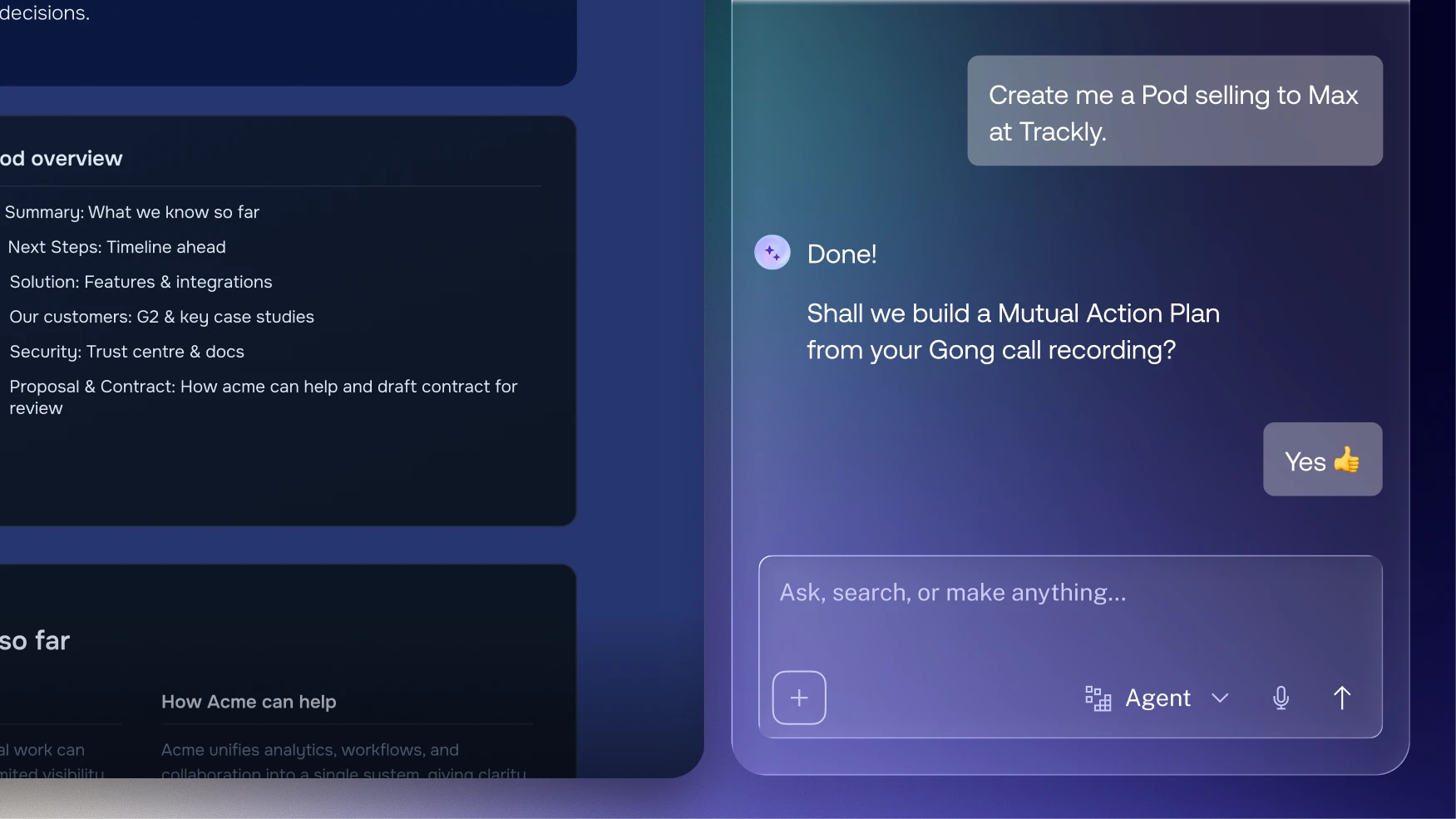
Every high ticket deal benefits from a Mutual Action Plan: a shared timeline of the steps left before signature, with owners and dates on both sides. It removes ambiguity, keeps momentum between meetings, and surfaces stakeholders who'd otherwise stay hidden. Build it with the buyer, not for them.
Want to run your next high ticket deal this way? Book a demo and see it in trumpet
The high ticket sales process, step by step
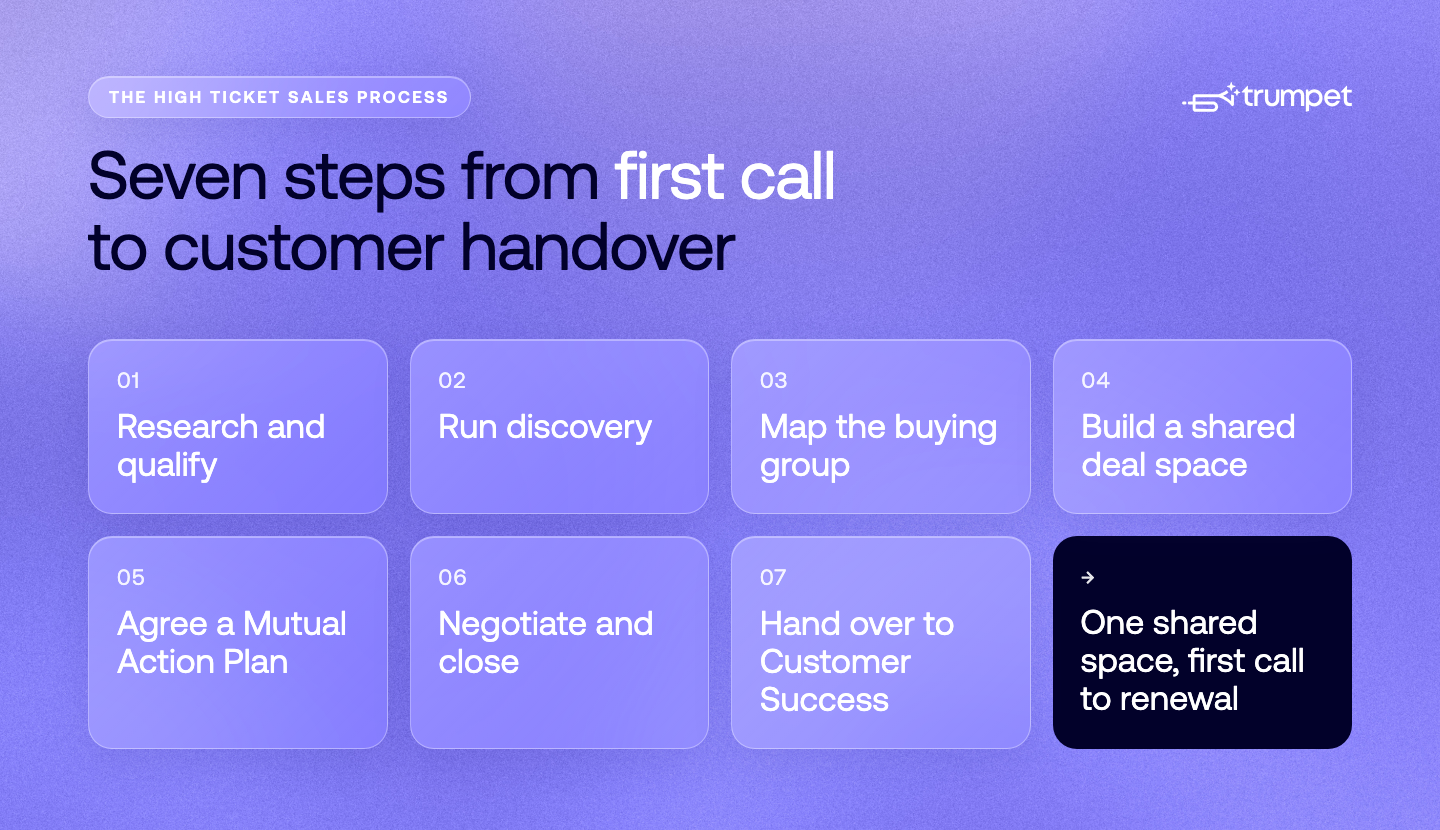
- Research and qualify. Confirm the account has the problem, budget and authority before you invest serious time.
- Run discovery. Understand the pain, the cost of inaction, and what success looks like for each stakeholder.
- Map the buying group. Identify the champion, the economic buyer, the signer and any likely blockers. Use an Org Chart so gaps are visible early.
- Build a shared deal space. Put the proposal, pricing, case studies and demo recordings in one place your champion can forward internally.
- Agree a Mutual Action Plan. Set out every step to signature, with owners and dates on both sides.
- Negotiate and close. Use Insights and Signals to see which stakeholders are engaged and what they're reading, so you follow up on the right thing at the right time.
- Hand over to Customer Success. Bring CS in before signature so the customer's goals and context carry straight into onboarding.
High ticket sales examples
Oyster: win rate up from 13% to 30% in one quarter

Brittni Ralston, an Account Executive at global employment platform Oyster, had a 13% win rate in Q3. After her team started running deals in trumpet Pods, it rose to 30% in Q4. Her follow-up email response rate also climbed from 33% to 43%.
The difference was visibility. Brittni could see which documents each stakeholder opened and who her champion shared the Pod with. When she noticed a buyer repeatedly viewing the contract, she followed up with a clear next step. Read the full Oyster story.
Gong: catching missing stakeholders before they become blockers
For Lesley Ronaldson, VP of EMEA at Gong, the biggest risk in complex deals was sellers assuming who mattered. Stakeholder mapping in trumpet changed that.
"Now, with stakeholder mapping, I can say: guys, you've missed that person, they could be a blocker, a champion, or even the signer."
Her team also uses the Mutual Action Plan timeline to spot patterns across deals, such as bringing Customer Success in earlier. Read the full Gong story.
Aptitude8: keeping enterprise deals on track
Consultancy Aptitude8 runs multi-stakeholder enterprise deals where context easily gets lost in email. With every deck, document and next step in one buyer workspace, new stakeholders get up to speed without a briefing call, and Mutual Action Plans keep the deal moving.
"Handoffs to delivery are cleaner because scope and decisions live in one place."
Read the full Aptitude8 story.
What are the biggest challenges in high ticket sales?
Longer sales cycles
Bigger decisions take longer, and high ticket deals often run for months. Shorten the cycle by mapping the buying process explicitly, surfacing stakeholders early, and keeping the buyer engaged between meetings, not just on calls.
Higher buyer expectations
A buyer spending five or six figures expects a buying experience to match. Personalised content, fast responses and clear ROI thinking aren't extras. They're the baseline.
Multi-stakeholder complexity
Complex B2B purchases usually involve a buying group of several people, each with different priorities. Single-threaded deals, where you only speak to one champion, are the most common way these deals stall. Multi-thread early, give every stakeholder one shared space to land in, and make it easy for your champion to sell internally.
How does a Digital Sales Room help with high ticket sales?
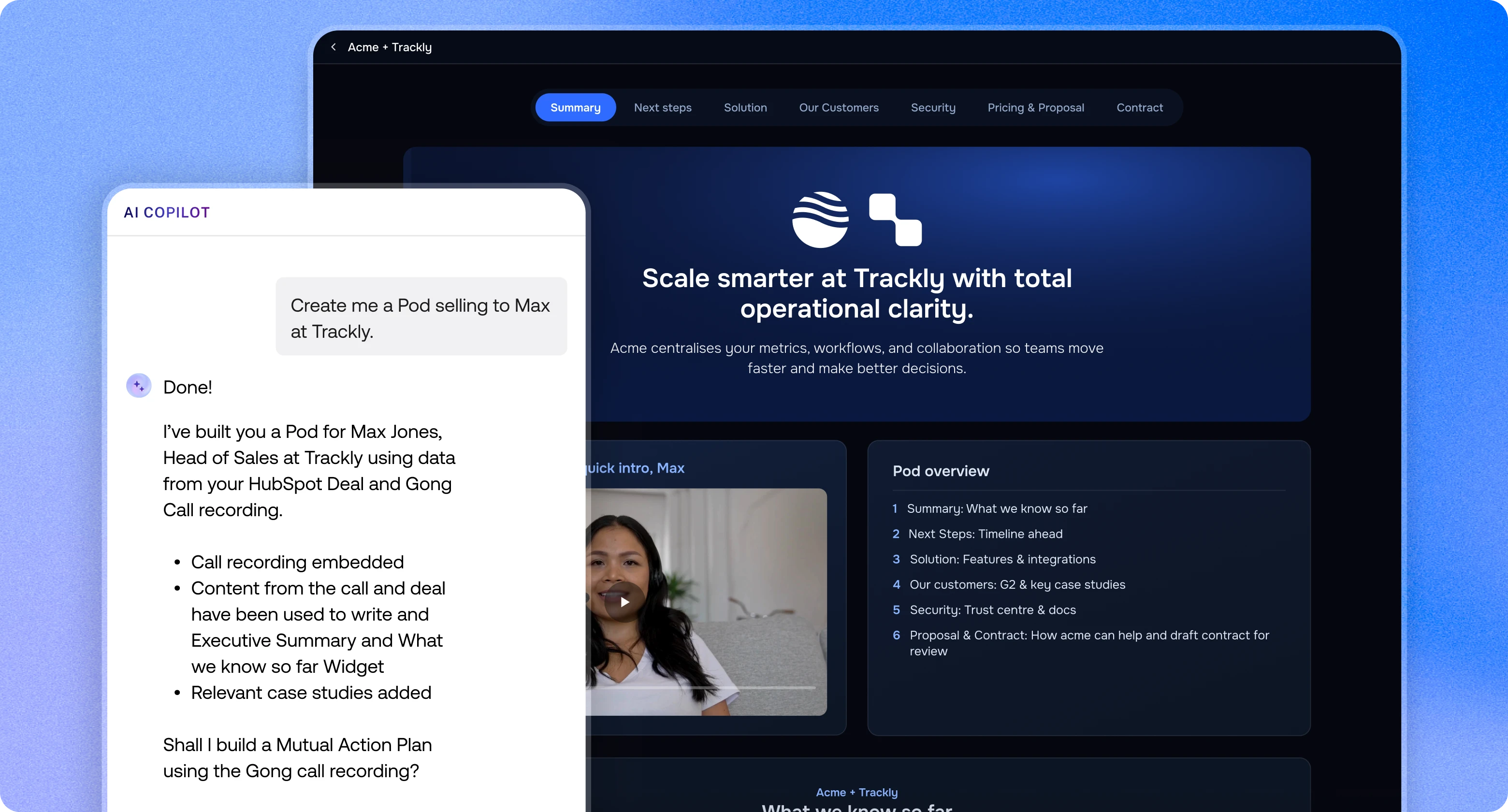
A Digital Sales Room (in trumpet, a Pod) is a shared online space where sellers, buyers and internal teams work on the deal together. It replaces scattered email threads and attachments with one source of truth.
For high ticket deals, that means:
- Personalisation at scale: branded, role-specific spaces for every buyer, built from Templates rather than from scratch
- Multi-threading: every stakeholder sees the same up-to-date content, with no lost context
- Engagement signals: see who's viewing what, so you spot hidden stakeholders and cooling deals before they go silent
- Mutual Action Plans: the deal timeline sits alongside the content that supports it
- A smooth handover: Customer Success inherits the full deal context, so onboarding starts where the sale left off
Trumpet is the intelligent GTM layer for revenue teams: one shared space where sales, customer success, buyers and customers work together across the whole deal lifecycle, from first call to renewal.
Final thoughts
High ticket sales reward sellers who treat the deal as a relationship, not a transaction. Build trust first, qualify hard, personalise the experience, sell on value, and map the deal openly with the buyer. Long cycles, high expectations and large buying groups are predictable, so they can be planned for.
FAQs
What price point counts as a high ticket sale?
There's no fixed threshold. A common rule of thumb is £1,000 ($1,000) or more in B2C and £10,000 ($10,000) or more in B2B. What really defines it is the complexity and commitment of the buying decision.
How long does a high ticket sales cycle last?
It depends on deal size and the number of people involved. Expect weeks to months, and longer for enterprise software or large services contracts that go through procurement.
Is high ticket sales the same as being a high ticket closer?
Not quite. "High ticket closer" usually describes a commission-based role closing coaching or info-product sales over the phone. B2B high ticket sales involves longer cycles, buying groups and a consultative process run across many touchpoints.
What is the difference between high ticket sales and luxury sales?
Luxury sales focus on brand and the buyer's identity. High ticket sales focus on the value, ROI and outcome the product delivers. Some products fit both, but the sales motion is different.
How do you get better at selling high ticket products?
Focus on three things: deeper discovery, stricter qualification, and consultative communication that positions you as an advisor rather than a vendor.
What is the biggest mistake in high ticket sales?
Treating it like a transactional sale. High ticket buyers can tell when they're being pitched rather than partnered with, and they walk away.
.png)

See what your buyers are doing between meetings
Build a Pod, share it with the buying committee and watch the signals roll in. Free to start.
.png)
.png)
.png)

.png)
.png)


![How to Get Started with Buyer Enablement [With Examples]](https://cdn.prod.website-files.com/65cf4fecbed2754c2236665d/65cf4fecbed2754c22366bdb_65a5af83e742f76e34ce06f3_Customer%2520Onboarding%2520_%2520Everything%2520you%2520need%2520(2).png)



.png)

.png)