




.jpg)





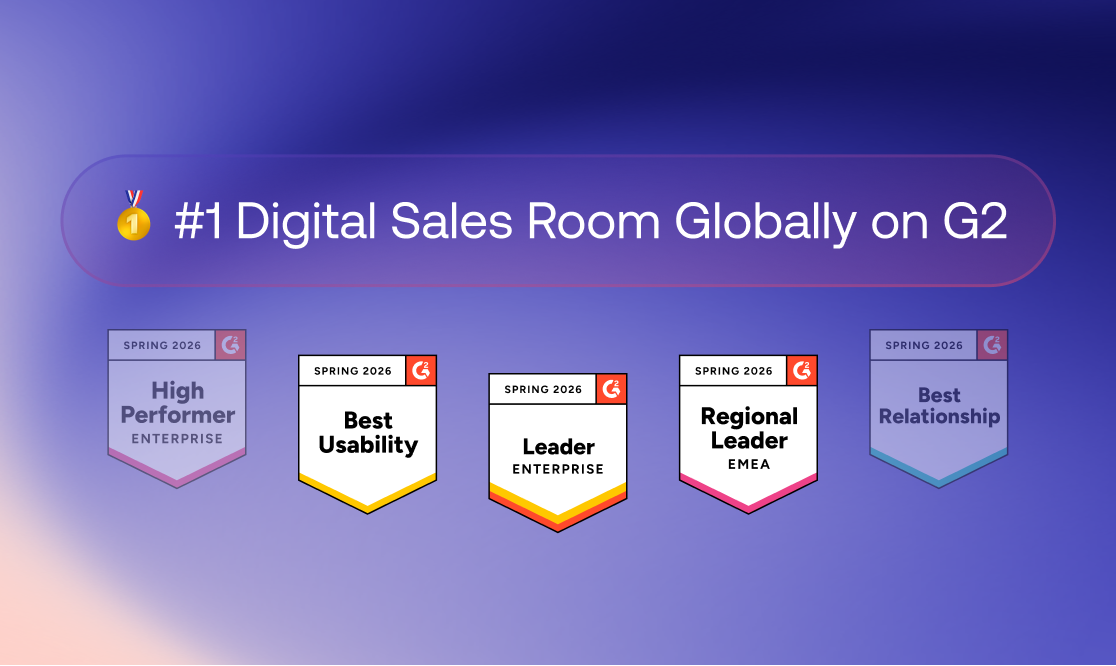
- Trumpet is the #1-ranked Digital Sales Room globally in G2’s Winter 2026 Reports, with #1 rankings across Mid-Market, Enterprise and SMB
- Mid-market DSR buyers care most about standardisation, sales-to-CS hand-off, and stakeholder visibility
- Dock is the best alternative if lifecycle breadth (sales, onboarding, AM, renewal) is the priority
- Aligned suits sales-only teams whose buying motion is champion-led
- GetAccept fits where eSign is the centre of gravity, DealHub suits CPQ-heavy quoting
- The right time to adopt a DSR is when forecasting accuracy starts slipping or rep-by-rep variance becomes visible to RevOps
Mid-market is the segment where standardising your sales process pays back fastest. Reps are running 30 to 120 day cycles with 5 to 8 stakeholders per deal. Forecasting accuracy starts slipping. The hand-off from sales to customer success becomes the place revenue quietly leaks out.
A Digital Sales Room (DSR) fixes those problems together. Pick the right one and you standardise without flattening personalisation, you keep the buying group aligned, and CS inherits the deal instead of restarting it.
Trumpet is currently ranked the #1 Digital Sales Room globally, with #1 rankings across Mid-Market, Enterprise and SMB in G2’s Winter 2026 Reports. Here’s how it compares to the other platforms mid-market teams are evaluating in 2026.
What "mid-market" means in this context
Mid-market means different things in different companies. For the purposes of choosing a DSR, this is the working definition: revenue teams of roughly 25 to 250 sellers, deal sizes between $25k and $250k ACV, sales cycles of 30 to 120 days, and 3 to 8 stakeholders per deal.
You're not running 18-month enterprise procurement reviews. You're past the point where a deck and a Loom can carry the deal.
Mid-market teams typically buy a DSR for one of three reasons.
- Standardisation
Reps each have a different version of "the sales process," and forecasting is suffering. - Hand-off pain
Sales is closing the deal but onboarding starts from scratch, killing time-to-value. - Stakeholder visibility
Reps lose track of who's reading what across a 5 to 8 person buying group.
The right DSR fixes all three. The wrong one only fixes one.
What to look for in a mid-market DSR
Six things matter more in mid-market than in either SMB or enterprise.
- Templates and team-level governance, so a 50-rep team can ship rooms that look the same without losing personalisation.
- MAPs that don't feel heavy. Enterprise-grade MAP tooling can be over-engineered for a 60-day cycle.
- CS hand-off in the same room, so onboarding inherits the room and the context.
- Stakeholder-level engagement, not just "the deal got opened" but who in the buying group engaged with what.
- CRM integration RevOps actually trusts. Bidirectional Salesforce or HubSpot sync, not just a webhook.
- Pricing that scales linearly with seats. Mid-market teams add reps in waves, pricing should not punish that.
The 5 best Digital Sales Rooms for mid-market in 2026
1. Trumpet: Best overall for mid-market
Trumpet is ranked #1 across Mid-Market, Enterprise and SMB in G2’s Winter 2026 Reports, making it a strong fit for scaling revenue teams that need a platform they won’t outgrow.
For mid-market teams, three things make it win.
Enterprise-grade security (SOC 2 Type II, ISO 27001, SSO, SCIM) without the procurement friction. MAPs and engagement analytics that fit a 60-day cycle without being over-engineered. And the same room carrying the deal into onboarding so CS doesn't restart the relationship.
Where it wins for mid-market:
- Standardises selling across the team via templates and team-level permissions, without flattening personalisation.
- Stakeholder-level engagement analytics that map cleanly to mid-market buying groups (5 to 8 people).
- Built-in MAPs and document signing, with no second contract.
- Sales and customer success use the same room, so onboarding inherits context.
- Salesforce and HubSpot sync that RevOps actually trusts.
Best fit: mid-market revenue teams of 25 to 250 sellers running 30 to 120 day deal cycles where sales-to-CS hand-off is a known pain point.
2. Dock: Great for lifecycle breadth
Dock works as a customer collaboration workspace across the full lifecycle: pitch, close, onboard, expand, renew. The templates library is one of the deepest in the category and integrations are broad (55+).
Where it wins for mid-market:
- Same workspace from first call through renewal.
- Strong onboarding and account management workflows.
- Action-plan model that's well-suited to mid-market complexity.
Trade-off: lifecycle scope means less depth in pure sales-stage features compared with sales-first DSRs.
3. Aligned: Great for sales-only, champion-led teams
If your team is sales-only and the gating issue is keeping a 5 to 8 person buying committee aligned, Aligned is well-targeted. The MAP UX is best-in-class and the analytics on champion engagement are strong.
Trade-off: you'll need a separate tool for onboarding and renewals.
4. GetAccept: Great when eSign is the anchor
GetAccept built up from eSign and added DSR around it. The document and signing experience is mature. Strong fit if your team's biggest friction is contract-signing speed inside the buyer experience.
Trade-off: the room experience around the document is less differentiated than DSR-native vendors.
5. DealHub: Great for CPQ-heavy mid-market
DealHub fits mid-market teams where quoting is complex and a DSR needs to bolt onto CPQ rather than the other way around. Heavy compliance stack (SOC 2 Type II, ISO 27001, GDPR), useful even at mid-market when you sell into regulated industries.
Trade-off: heavier than the use case requires if you're not buying CPQ alongside it.
How to choose a DSR for a mid-market team
Three questions cut the shortlist fast.
- Does sales hand off to CS in the same product?
If yes, narrow to trumpet or Dock. Mid-market teams lose more revenue at the hand-off than they realise, and keeping the room intact reclaims it. - Is your sales process consistent across reps?
If no, prioritise platforms with strong templating and team-level governance. A DSR is the fastest way to standardise without writing a 40-page playbook nobody reads. - Is the buying committee 3–8 people or 1–2?
For 1–2 person buying groups, almost any DSR works. For 3+, prioritise stakeholder-level engagement analytics. Not all DSRs surface this and it's the difference between forecasting and guessing.
Final thoughts
Most mid-market teams hit the threshold for adopting a DSR around 10 to 15 sellers, when forecasting accuracy starts slipping and rep-by-rep variance in sales process becomes visible to RevOps. Wait too long and you're untangling habits across a bigger team. Move now and the next 50 reps inherit a standardised motion from day one.
For most mid-market revenue teams, trumpet is the strongest default. The G2 rankings, the enterprise-grade security stack, and the sales-to-CS continuity all point the same way.
FAQs
What is a Digital Sales Room?
A Digital Sales Room is a shared workspace where a seller and a buyer's whole buying group review content, run Mutual Action Plans, sign contracts, and track engagement through a deal.
What's the best Digital Sales Room for mid-market companies?
Trumpet is the #1-ranked Digital Sales Room globally in G2’s Winter 2026 Reports, followed by Dock for lifecycle breadth, Aligned for sales-only champion-led use cases, GetAccept for eSign-led workflows, and DealHub for CPQ-heavy quoting.
When should a scaling sales team adopt a Digital Sales Room?
Most mid-market teams hit the threshold around 10 to 15 sellers and average deal sizes above $25k ACV, when forecasting accuracy starts slipping and rep-by-rep variance in sales process becomes visible to RevOps.
Is trumpet good for mid-market sales teams?
Yes. Trumpet is ranked #1 Digital Sales Room globally in G2’s Winter 2026 Reports and offers SOC 2 Type II, ISO 27001, SSO and SCIM at the same level as enterprise plans, without enterprise-tier complexity.
What's the difference between a Digital Sales Room and a customer portal?
A DSR is sales-led, deal-stage, and includes engagement analytics, MAPs, and signing. A customer portal is post-sale, account-stage, and includes support, billing, and product usage. The best DSRs carry into the post-sale stage so the room becomes both.
Will a Digital Sales Room replace our CRM?
No. A DSR sits alongside the CRM and pushes engagement and stakeholder data back into Salesforce or HubSpot. The CRM stays the system of record.










![How to Get Started with Buyer Enablement [With Examples]](https://cdn.prod.website-files.com/65cf4fecbed2754c2236665d/65cf4fecbed2754c22366bdb_65a5af83e742f76e34ce06f3_Customer%2520Onboarding%2520_%2520Everything%2520you%2520need%2520(2).png)
.png)


.png)



.png)


.png)


.png)

.png)
.png)





