







- Enterprise buyer enablement implementation is a workflow change, not just a tool rollout
- A 90-day rollout is enough to move from pilot to standard process across the team
- Mutual Action Plans double win rates. The sweet spot is 6–20 completed steps
- 10+ stakeholders in a shared workspace gives a 75% close rate; bringing in Procurement alone improves win rate by 83%
- The biggest impact comes from extending the model into customer success at handoff
- Consistency across deals matters more than feature adoption
Enterprise buyer enablement sounds like a strategy project. In reality, it's usually a response to a very specific problem.
Enterprise buyer enablement sounds like a strategic initiative, but for most revenue teams it starts with a deal that unexpectedly slows down. Everything appears to be moving in the right direction until procurement, legal, security, finance, and senior stakeholders enter the process, each with different priorities, questions, and approval requirements. Suddenly a deal that felt close became a deal that felt stuck.
Most enterprise deals no longer succeed or fail based on product fit alone. They succeed or fail based on how effectively a buying group can get organised, share information internally, and reach consensus.
The teams getting ahead aren't relying on more follow-up emails or more meetings. They're creating a buying experience that gives stakeholders a shared place to collaborate, clear next steps, and visibility into the path forward.
This guide explains how enterprise and mid-market revenue teams implement buyer enablement in practice, including a proven 90-day rollout framework backed by data from more than one million Digital Sales Rooms.
Quick answer
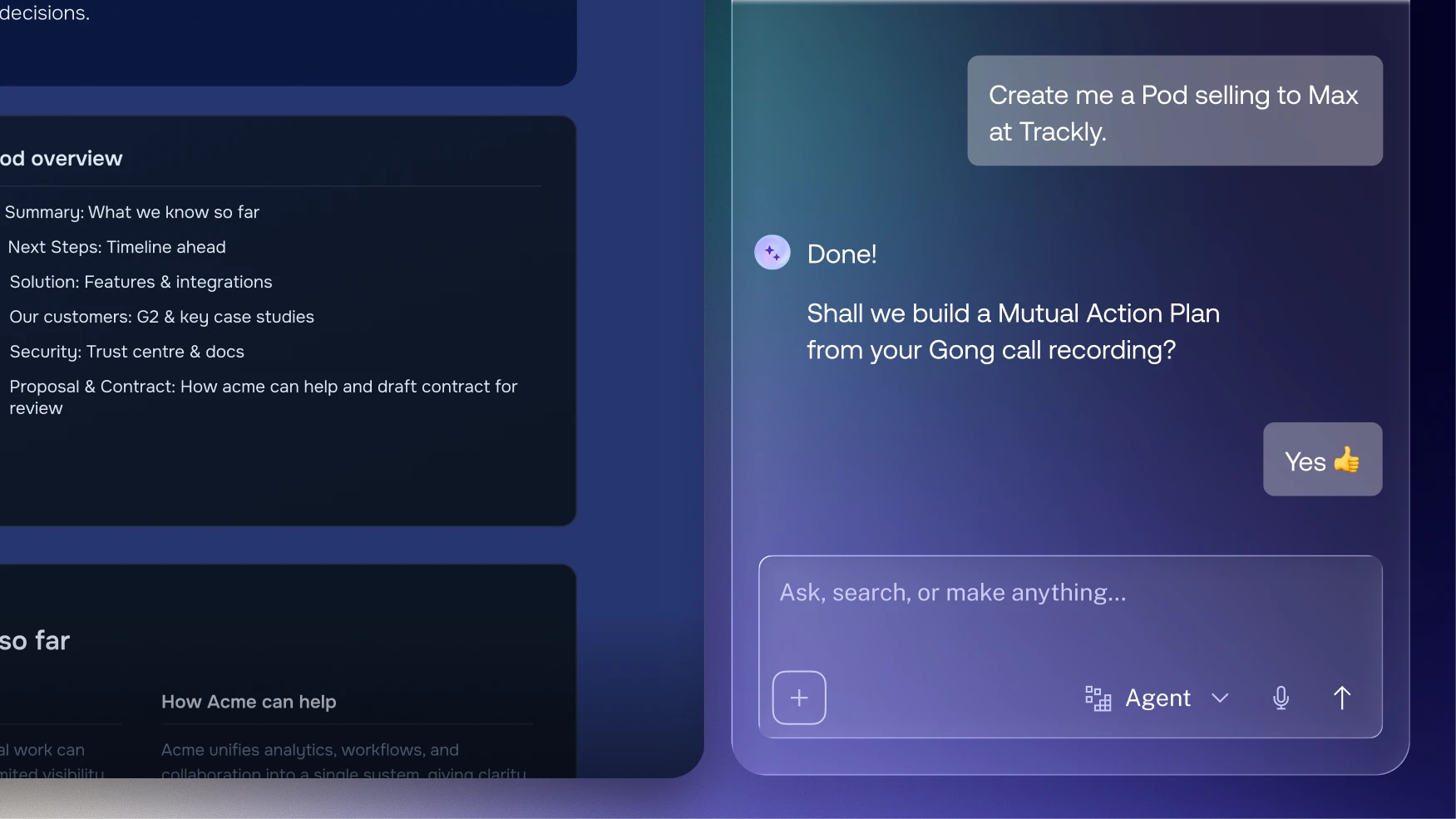
Enterprise and mid-market buyer enablement is implemented by introducing a shared digital workspace or also known as a Digital Sales Room, for every qualified deal, standardising how teams run Mutual Action Plans, tracking stakeholder engagement at an individual level, and carrying the same structure from sales into customer success.
Most teams can roll this out in 90 days. The ones that do it well don't change everything at once. They introduce structure, prove it on real deals, and scale it.
Why enterprise deals need a different approach
In a typical enterprise deal, you're not selling to one person. You're selling to a buying committee that often includes 10 or more stakeholders. Most of their internal syncing happens without you in the room.
That's the core problem buyer enablement solves. It gives your champion the clarity, content, and structure to sell internally on your behalf. And the data backs it up.
According to trumpet's research across more than one million Digital Sales Rooms:
- Deals with 4 unique stakeholders engaged in a shared workspace have double the close rate versus deals with only 1 or 2
- 6 stakeholders gives a 51% chance of close
- 10+ stakeholders gives a 75% chance of close
- Bringing Procurement into the deal workspace increases win rate by 83%
- The highest-performing enterprise combination, IT + C-Suite + Sales + Marketing, improves win rate by 158%
The implication is clear: enterprise buyer enablement isn't about simplifying your pitch. It's about making it easier for more of the right people to get organised faster.
What "implementation" actually means
Implementing buyer enablement is not buying a tool and asking reps to use it.
It means changing how deals are run:
- Deals move from email threads to a shared, trackable workspace
- Progress moves from "next meeting" to a visible, mutual plan
- Engagement moves from guesswork to stakeholder-level visibility
- Handoffs move from a meeting that loses context to a workspace that carries it forward
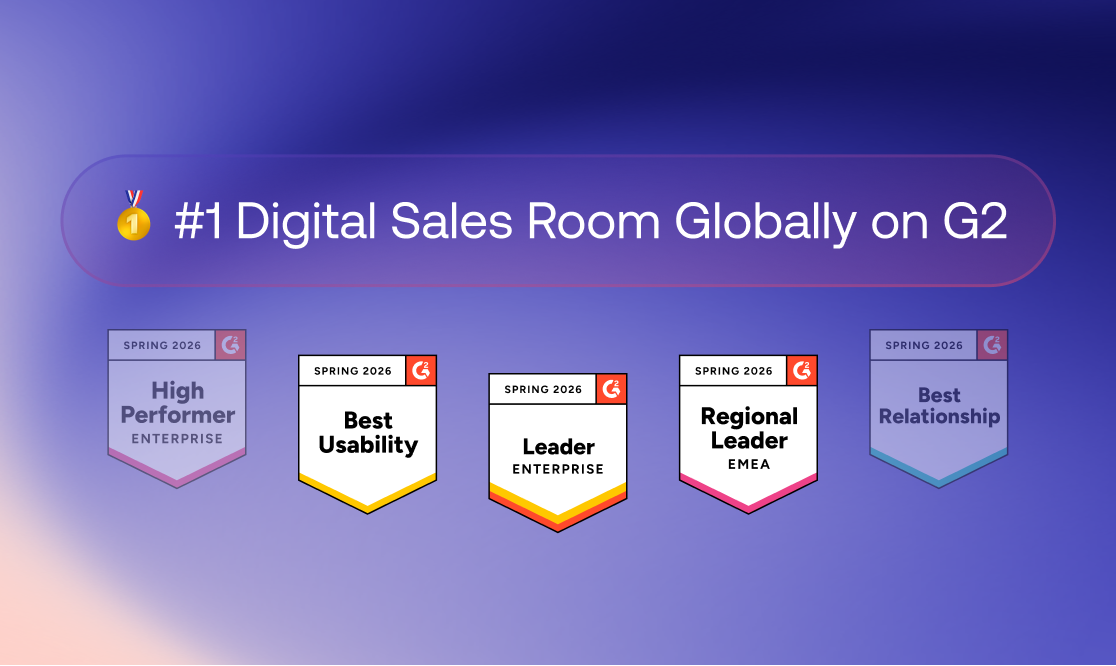
Platforms like trumpet, rated #1 Digital Sales Room for Mid-Market and Enterprise on G2, make this possible. But the impact comes from how the workflow is rolled out, not from the technology alone.
The 90-day rollout plan
Days 0–30: Foundation
The goal of the first 30 days is to get real deals running inside a new structure. Start small and focused. A pilot is how you prove the model before you scale it.
What to do:
- Choose your platform and define what success looks like (win rate, sales cycle length, stakeholder engagement)
- Build three core templates: discovery, proposal, and procurement/legal
- Select 5–10 active enterprise deals and move them into shared digital workspaces
- Train reps on stakeholder mapping from the first call, not just at proposal stage
- Add Mutual Action Plans to every active deal, even if they're simple to begin with
Why it matters: the MAP data
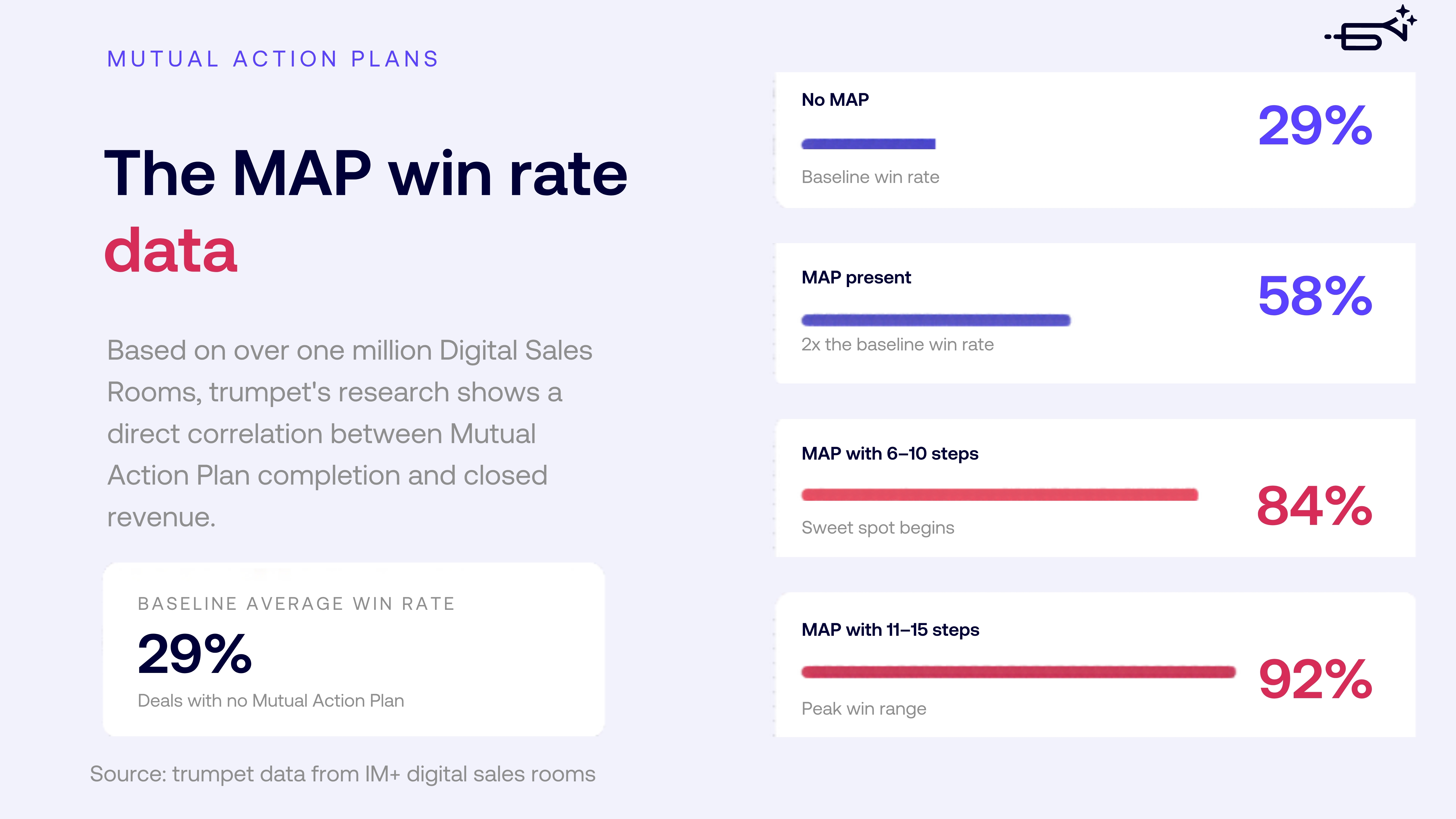
Pods (digital deal workspaces) that include a Mutual Action Plan double the win rate. Against a baseline win rate of 29%, that's a material lift from a single structural change.
More specifically, from trumpet's dataset:
- MAPs with 6–10 completed steps achieve an 84% win rate
- MAPs with 11–15 completed steps reach a 92% win rate
- The sweet spot is 6–20 steps. Beyond 30, win rates drop back to no-MAP levels
At this stage, consistency matters more than scale. One well-structured template used across 10 deals will teach you more than 50 half-used ones.
Days 30–60: Standardisation
Once the first deals are live, the focus shifts to making this the default, not just the experiment.
What to do:
- Every new qualified deal gets a shared workspace from the point of first meeting
- MAPs become mandatory at proposal stage, with clear step ownership on both sides
- Stakeholder-level engagement data becomes part of pipeline reviews: who is viewing, who hasn't been in the room yet.
- Managers review deals based on MAP completeness and stakeholder breadth, not just rep commentary
The stakeholder sharing signal:
A deal workspace that gets shared internally by the buyer has a 56% win rate, double that of workspaces that are never shared internally (28%). A workspace with just 1–2 internal buyer shares reduces sales cycle length by 15% and increases win rate by 1.8x.
This is the signal that matters in enterprise: is your champion bringing others in? Are those people engaging? If the answer is no, the deal isn't progressing. It's stalling.
This is where buyer enablement moves from "pilot" to "process."
Days 60–90: Sales to CS continuity
Most teams stop at sales. That's where the biggest opportunity is left on the table.
The enterprise buying experience doesn't end at signature. Onboarding, implementation, and renewal are all part of the same relationship. If the handoff is a jarring reset, you erode the trust you spent months building.
What to do:
- Customer success joins the deal workspace at contract stage, not after signature
- Onboarding plans replace pre-sale MAPs in the same workspace, same structure, same stakeholders
- Stakeholder maps carry into the customer lifecycle so CS isn't starting blind
- Time-to-first-value becomes a tracked metric, not a post-sale afterthought
As Alice de Courcy, Group CMO, puts it: "What happens after the deal is just as important as what happens before it... Enablement shouldn't stop at closing. It needs to support onboarding, adoption, and everything that comes after. Otherwise, you're just setting your CS team up to fail."
The workspace doesn't reset. It evolves. That continuity is the competitive difference in enterprise accounts.
Day 90+: Compounding impact
After 90 days, the system starts to generate the kind of insight that changes how you forecast, coach, and win.
What this looks like:
- Engagement data flows into CRM: which stakeholders viewed what, when, and how often
- RevOps identifies which behaviours correlate with wins (and which content is actually moving deals)
- Templates improve based on real usage, not guesswork
- Forecast accuracy improves because pipeline review is based on buyer behaviour, not rep optimism
On content timing: a counterintuitive finding
Adding new content to a workspace in the final third of the sales cycle increases win rate by 51% and speeds the cycle by 33%. The optimum is five new pieces in that window, which cuts cycle time by 43%.
But loading too much content at the start works against you. Adding over 11 pieces of content in the first third of the sales cycle slows deals by 2.5x and decreases win rate by 3%. Enterprise buyers need information at the right moment, not everything at once.
At this point, buyer enablement is no longer a tool. It's part of the operating system.
What changes inside the team
Implementation works when behaviour changes, not just tools.
For reps:
- They stop sending deal context via email threads
- They run deals inside a shared workspace their buyer can return to, share, and act on
- They use MAPs to give their champion a visible path forward, one they can relay to legal, procurement, and finance without needing another meeting
For managers:
- They stop relying on subjective rep updates
- They review stakeholder maps, engagement data, and MAP completeness
- They coach based on gaps in multi-threading and deal structure, not opinions about pipeline
For RevOps:
- They move from CRM hygiene to buyer visibility
- They track engagement signals, not just stage movement
- They optimise based on real deal behaviour from real data: which personas to involve, which content to surface, and when
Enterprise-specific considerations
For mid-market and enterprise teams, there are a few additional factors that generic buyer enablement guides don't cover.
Security and compliance: Enterprise buyers, particularly in regulated industries, need to know their data is handled correctly. trumpet is SOC 2 Type II and ISO 27001 certified, and GDPR compliant. Having that conversation early (and having the documentation ready in the workspace) removes a common procurement blocker.
Procurement and legal timelines: Bringing procurement into the workspace increases win rate by 83%, but it also adds time to the cycle (+48% on average). The teams that handle this best treat procurement not as a hurdle but as a stakeholder to enable, with a dedicated section of the workspace covering legal FAQs, security questionnaires, and contract summaries.
Multi-threading at scale: The single biggest enterprise deal risk is single-threaded relationships. When your champion leaves, the deal often leaves with them. Systematically involving IT, legal, security, and finance from the proposal stage isn't just good selling. It's risk management.
CRM and tech stack integration: trumpet integrates with Salesforce, HubSpot, Gong, DocuSign, PandaDoc, Slack, and 35+ other tools. For enterprise RevOps teams, this means deal workspace data flows back into existing systems rather than creating another silo.
Common mistakes to avoid
Most failed rollouts look the same:
- Treating it as a content library rather than a live deal workspace
- Rolling out MAPs without clear ownership on both the buyer and seller side
- Not enforcing stakeholder mapping, letting reps skip it when deals feel "simple"
- Stopping at sales and leaving CS to rebuild context from scratch
- Rolling out to the whole team at once instead of proving the model on a focused pilot
Buyer enablement works when it's structured and expected, not optional and ad hoc.
What success looks like at 90 days
After a successful rollout, enterprise and mid-market teams typically see:
- Clear visibility into who is involved in each deal, and who isn't
- Fewer "surprise stakeholders" appearing late in the cycle
- Faster progression through procurement and legal review
- Shorter time-to-value post-sale, with CS inheriting full context at handoff
- More consistent deal execution across reps. The best rep's approach becomes the default template
The difference isn't dramatic in a single deal. It compounds across the pipeline.
Teams with dedicated buyer enablement functions see 20% higher win rates than those without. And with 57% of enterprise buyers now expecting demonstrable ROI within 90 days, the teams that implement this earliest are setting the standard their competitors will have to catch up to.
Why trumpet is the platform of choice for enterprise and mid-market teams
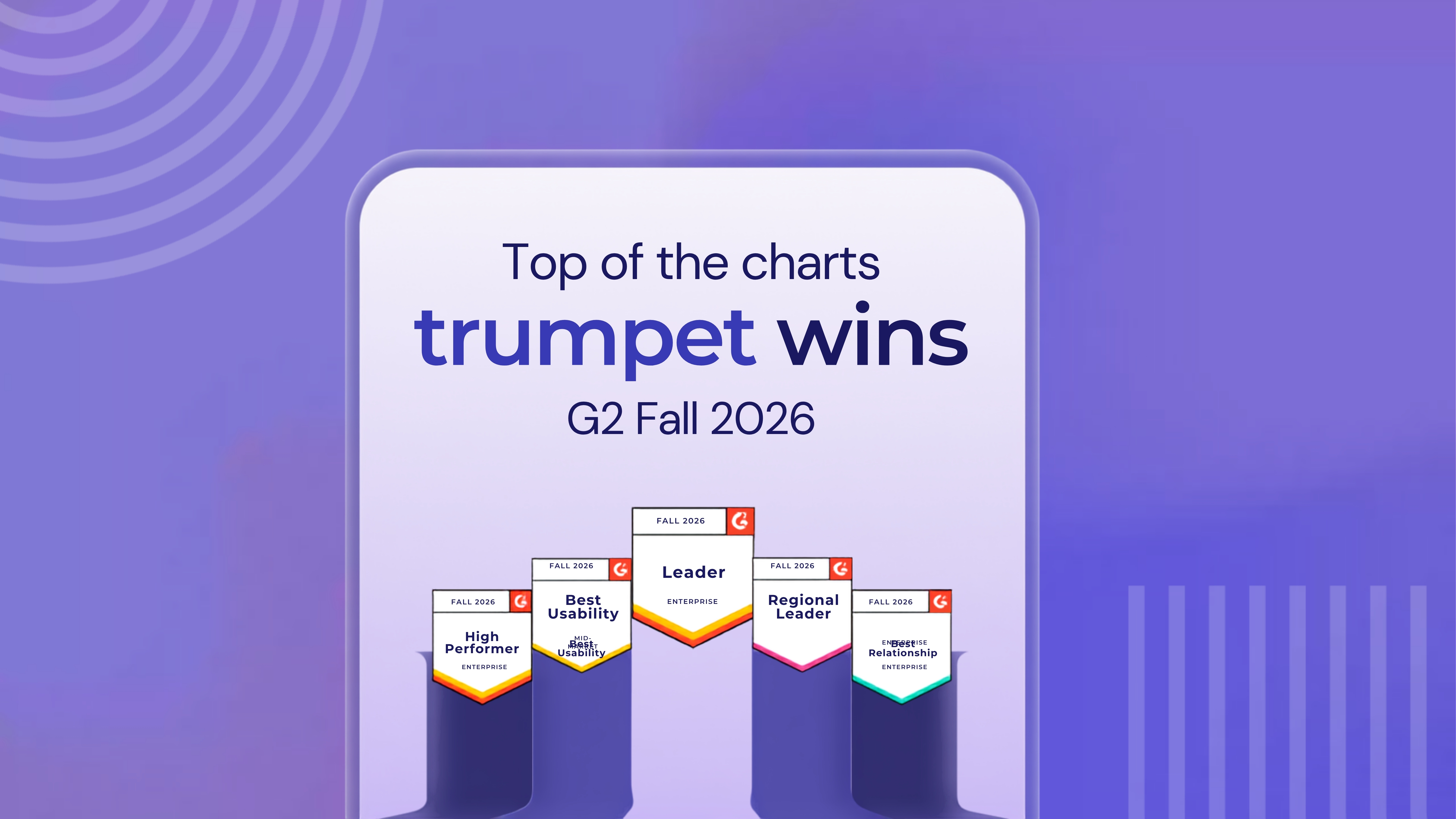
Trumpet is the #1 rated Digital Sales Room for Mid-Market and Enterprise globally (G2 Fall 2025), with a 4.8/5 rating across 930+ verified reviews.
It's used by GTM teams at Gong, HubSpot, Personio, Stripe, Cognism, and Miro to run buyer enablement at scale, from the first outbound touch through to renewal.
What makes it the right choice for enterprise specifically:
- Mutual Action Plans built into every workspace, with step-by-step progress tracking, buyer assignment, and automated reminders
- AI stakeholder mapping that surfaces engagement by individual, flags missing contacts, and tracks multi-threading across the buying committee
- Content analytics showing which assets drive engagement and which personas are most active, feeding back into CRM and pipeline reviews
- Sales to CS continuity in a single workspace. No handoff meeting needed, context carries forward
- Enterprise-grade security: SOC 2 Type II, ISO 27001, GDPR compliant
- Deep integrations with Salesforce, HubSpot, Gong, DocuSign, PandaDoc, Slack, and 35+ more
FAQs
How long does it take to implement buyer enablement?
Most teams roll it out in 90 days. Start with 5–10 deals, prove the model, then scale it across all qualified opportunities.
Do Mutual Action Plans improve win rates?
Yes. Deals with a MAP double win rates. The strongest results come from 6–20 completed steps.
How many stakeholders should be involved in an enterprise deal?
More than most teams include. 10+ stakeholders in a shared workspace can drive up to a 75% close rate, with Procurement involvement increasing win rate further.
Does buyer enablement work for mid-market teams?
Yes. The structure scales. Mid-market deals have fewer stakeholders but the same challenge of internal decision-making between meetings.
How does trumpet handle the sales-to-CS handoff?
The workspace carries through. Customer success joins before close, and the same MAP and context continue into onboarding.
Is trumpet suitable for enterprise security requirements?
Yes. trumpet is SOC 2 Type II, ISO 27001, and GDPR compliant, with security content embedded directly in the workspace.
What’s the hardest part of implementing buyer enablement?
Behaviour change. Success depends on consistent usage by reps and structured coaching from managers.








![How to Get Started with Buyer Enablement [With Examples]](https://cdn.prod.website-files.com/65cf4fecbed2754c2236665d/65cf4fecbed2754c22366bdb_65a5af83e742f76e34ce06f3_Customer%2520Onboarding%2520_%2520Everything%2520you%2520need%2520(2).png)
.png)


.png)


.png)


.png)

.png)

.png)
.png)





