









- Enterprise B2B deals typically involve 12 to 20 stakeholders
- Four habits drive success: stakeholder mapping, MAPs with named owners, stakeholder-level engagement tracking, and a shared workspace
- MAPs improve deal velocity and win rates (Aligned, Mindtickle data)
- Stakeholder-level engagement is more important than deal-level engagement
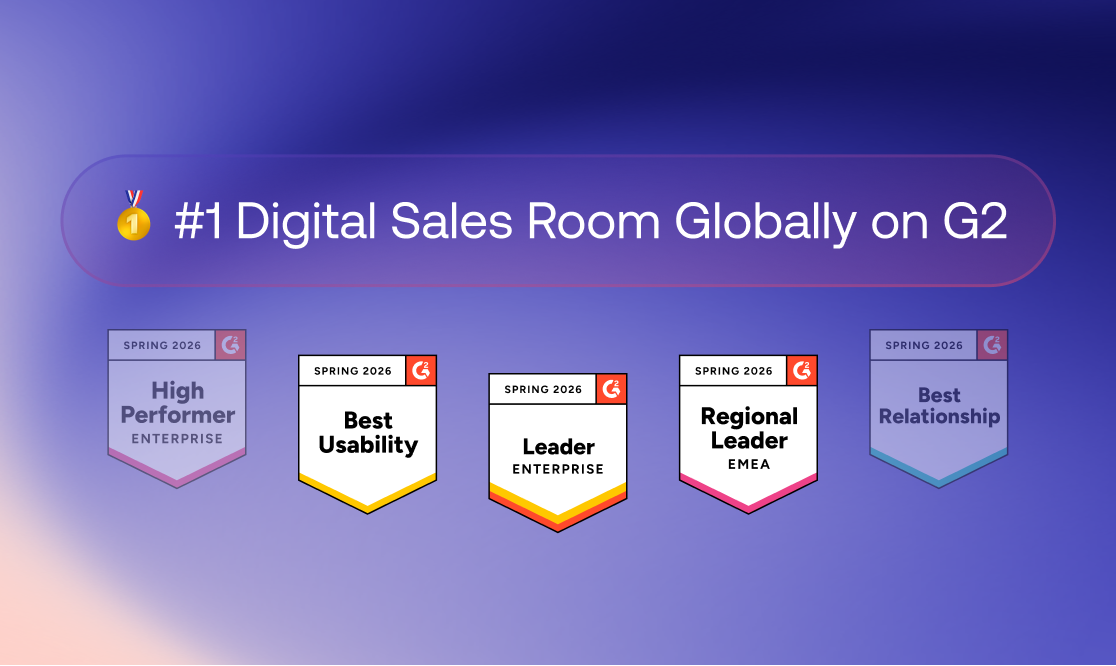
- trumpet is ranked the #1 Digital Sales Room globally in G2’s Winter 2026 Reports, including #1 across Enterprise, Mid-Market and SMB segments
The average enterprise B2B deal now involves 12 to 20 stakeholders. Economic buyer, exec sponsor, project lead, end users, IT, security, procurement, legal, finance, sometimes a board observer. Each one can advance the deal or stop it.
The reps who close enterprise deals consistently aren't more charismatic. They're better at making a buying group of 12 feel like a buying group of three.
Here’s how they do it.
Why enterprise deals fall apart at 10+ stakeholders
Gartner's research has shown that the average B2B buying group contains 6 to 10 stakeholders. In enterprise deals, the number is routinely 12 to 20.
The failure mode is consistent. The seller has a strong relationship with one or two champions and a partial picture of everyone else. The deal moves through a steering committee where two stakeholders the seller hasn't spoken to raise objections. By the time those objections come back through the champion, two weeks have passed and the deal has slipped a quarter.
The four habits of enterprise sellers who win complex deals
1. Explicit buying-group mapping
Every enterprise deal needs a named map of the buying group. Not a guess, not "the procurement team", but names, roles, decision-making weight, and what each person needs to see to say yes.
The map is a living document. It gets updated after every meeting and every new stakeholder reveal.
The practical version is a single page that lists every stakeholder, their role (economic buyer, technical evaluator, end user, blocker), what they care about, and what stage of the journey they're at. It's the first thing any rep should be able to show their manager when asked "where's the deal?"
2. Mutual Action Plan with named owners across both orgs
A Mutual Action Plan isn’t a checklist. It’s how deals actually move forward. And the key word is mutual. The best MAPs are built with your customer, not for them, with accountability shared across both teams.
The strongest enterprise MAPs assign every task to a specific person across both organisations. Not "Procurement to review by Friday," but "Maria to send security questionnaire to David by Friday." Tasks have dependencies. Reminders fire automatically.
The data is consistent. Aligned reports that 90% of revenue leaders say MAPs help expedite deals and 70% report higher win rates with MAPs in use. Mindtickle reports a 3x win-rate uplift on deals where reps used MAPs with their champions.
3. Stakeholder-level engagement tracking
Deal-level engagement is misleading. A deal that's "highly engaged" might be three people opening the same doc 40 times while seven other stakeholders haven't opened anything. That's not an engaged deal. That's a deal with a champion problem.
Enterprise sellers track engagement at the stakeholder level.
Who from the buying group has actually viewed the security one-pager? Who has clicked into the pricing? Who hasn't engaged at all and needs a re-engagement nudge?
This is the data that lets a rep walk into a forecast meeting saying "I'm at risk on this deal because the IT lead hasn't engaged with anything we've sent in three weeks" instead of "things are going well."
4. One workspace, surviving the hand-off
The deal doesn't end at signature. Enterprise customer success teams that inherit a fresh blank slate spend the first 30 days re-discovering everything the rep already knew: the stakeholders, the goals, the timeline, the pre-sale promises.
The teams that compress time-to-value treat the sales workspace as the customer workspace. The same room, the same stakeholder map, the same MAP, extended into onboarding milestones. CS doesn't restart. It picks up.
What this looks like in practice
A typical enterprise deal workflow run inside a Digital Sales Room.
- Discovery + champion identification. Pod is created, branded for the prospect, and shared with the champion. Initial buying-group map is drafted from CRM and the champion's input.
- Stakeholder onboarding. Each new stakeholder is invited into the Pod with a tailored landing view: exec summary for the sponsor, technical deep-dive for IT, security pack for InfoSec, business case for procurement.
- MAP build. Champion and rep co-build the MAP with named owners across both orgs. Procurement, legal, security, IT, exec review, and signature steps are all sequenced.
- Engagement tracking. Rep watches stakeholder-level engagement weekly. When IT or security hasn't engaged in 7+ days, that's flagged before it becomes a deal slip.
- Procurement and legal. Security questionnaire, MSA redlines, and DPA all live in the same Pod with version control and comment threads.
- Signature. Native eSign inside the Pod, no separate tool.
- Hand-off to CS. The same Pod becomes the onboarding Pod. Stakeholder map and MAP carry over. Onboarding milestones replace pre-sale milestones. Time-to-value compresses because nothing is re-discovered.
This is what enterprise revenue teams using trumpet do. The principles are platform-agnostic, they hold across DSRs.
Common enterprise deal blockers (and how to fix them)
Where Digital Sales Rooms fit
A Digital Sales Room is a buyer-facing workspace where sales and customer success teams manage deals, share content, run Mutual Action Plans, and track stakeholder engagement in one place.
A DSR is the practical container for the four habits. The buying-group map lives in the room. The MAP lives in the room. The engagement data is captured in the room. The hand-off to CS happens by adding CS to the room, not by replacing the room.
For revenue teams running enterprise deals, the DSR isn't optional infrastructure. It's the difference between forecasting a deal and hoping for one.
Trumpet is ranked the #1 Digital Sales Room globally in G2’s Winter 2026 Reports, including #1 across Enterprise, Mid-Market and SMB segments. It earned 30+ #1 rankings across global, regional and segment reports.
Final thoughts
Multi-stakeholder enterprise sales is not getting simpler. The buying groups are getting bigger, the cycles longer, and the procurement scrutiny tighter.
The reps who close enterprise deals consistently in 2026 aren't running on charisma. They're running on structure. Map the buying group. Run a real MAP with named owners. Track engagement at the stakeholder level. Carry the room into customer success.
Do those four things and a deal with 15 stakeholders starts behaving like a deal with three.
FAQs
How many stakeholders are in a typical enterprise B2B deal?
Enterprise deals typically involve 12 to 20 stakeholders, while Gartner reports an average of 6 to 10 across B2B.
What’s the best way to manage 10+ stakeholders?
Map the buying group, run a MAP with named owners, track stakeholder engagement, and centralise everything in one workspace.
How do Digital Sales Rooms help?
They centralise stakeholders, content, engagement data, and workflows in one place.
Which DSR is best for enterprise multi-stakeholder deals? trumpet ranks #1 Digital Sales Room globally for the third consecutive quarter in G2's Winter 2026 reports, including #1 for Enterprise, Mid-Market, and SMB. It supports stakeholder-level engagement tracking, role-aware MAPs, and a single Pod that carries through to customer success.










![How to Get Started with Buyer Enablement [With Examples]](https://cdn.prod.website-files.com/65cf4fecbed2754c2236665d/65cf4fecbed2754c22366bdb_65a5af83e742f76e34ce06f3_Customer%2520Onboarding%2520_%2520Everything%2520you%2520need%2520(2).png)
.png)


.png)


.png)


.png)


.png)

.png)
.png)





