







Most sales reps treat multi-threading as a nice-to-have. Something you do when you have time, or when the champion goes quiet. The data says you should be treating it as the job.
We analysed thousands of deals closed through trumpet Pods, and the finding is hard to ignore: the more unique stakeholders engaged in your deal, the more likely you are to win it. Not marginally more likely. Significantly more likely.
Here’s what the numbers actually look like.
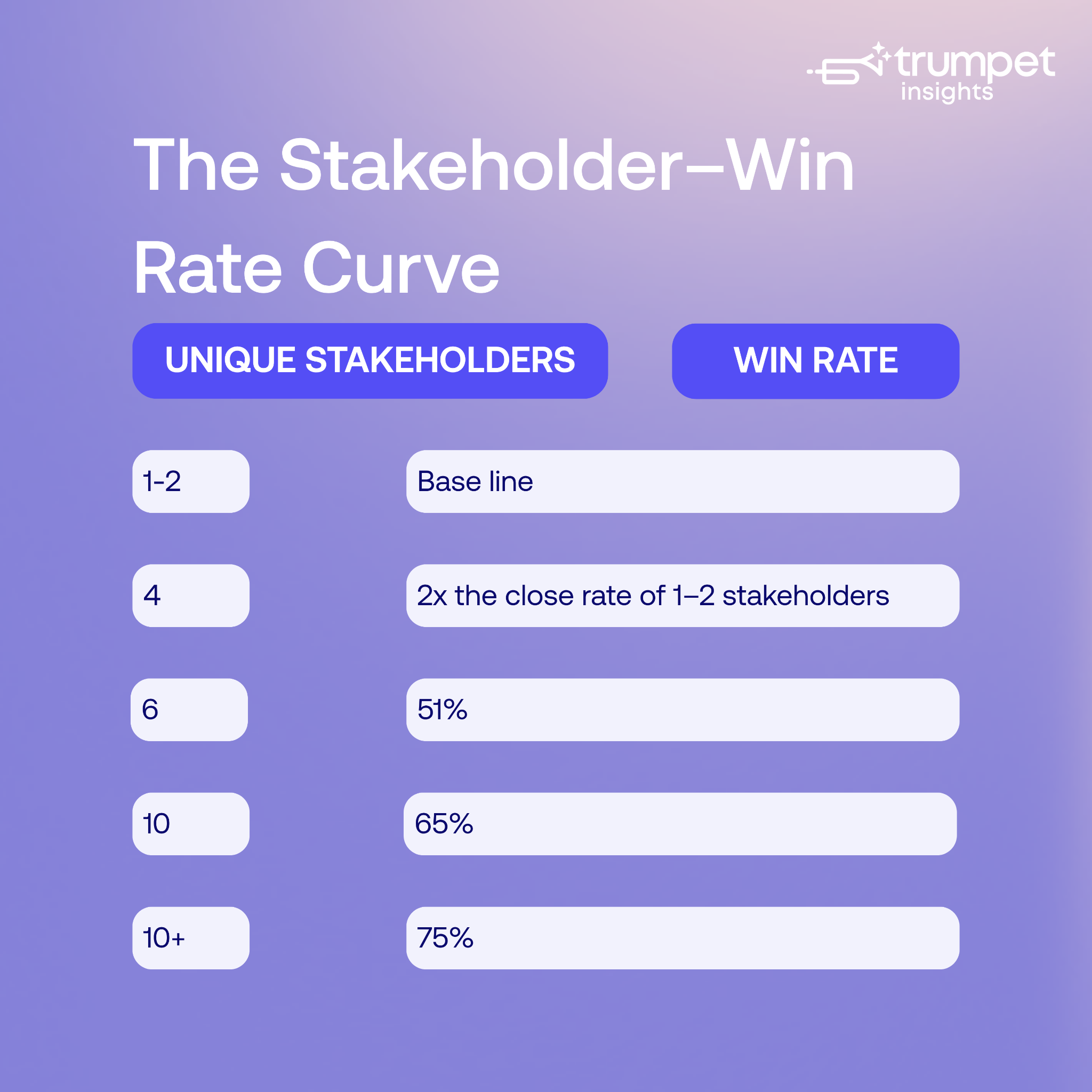
Getting from one or two contacts to four doubles your chance of closing. That’s not a small improvement. That’s a complete shift in your odds.
At ten or more stakeholders, you’re closing three in every four deals. At one or two, you’re losing most of them.
Why This Happens
When only one or two people are aware of your solution, you’re entirely dependent on your champion to sell internally on your behalf.
They have their own priorities. Their own political capital to manage. Their own blind spots about what matters to different parts of the business.
The more stakeholders you bring into the conversation directly, on your terms, with your materials and your framing, the less you rely on a game of telephone.
→ You control the narrative.
→ You address objections earlier.
→ You build consensus instead of hoping it happens.
More stakeholders also means more internal advocates, even passive ones. People who have seen the Pod, read the proposal, or watched the demo. When the buying decision happens in a room you’re not in, you want as many people in that room as possible to recognise your name and your solution.
What This Means in Practice
For AEs: Multi-threading isn’t just a prospecting tactic. It’s a closing tactic.
If you’re heading into late-stage deals with fewer than four stakeholders engaged, your odds are already working against you.
Ask your champion directly:
"Who else needs to feel confident about this before we move forward?"
Then make it easy for them. Share a Pod they can forward internally. Give them something that carries your narrative for you.
For Sales Leaders: If your team is consistently working deals with one or two stakeholders, you don’t have a pipeline problem. You have a win rate problem.
Make stakeholder coverage visible.
- Track it in deal reviews
- Add it as a field in your CRM
- Coach towards it consistently
What gets measured here will directly impact revenue.
One Important Caveat: Don’t Overwhelm
More stakeholders, yes. More complexity, no not necessarily. The data shows that Mutual Action Plans with over 30 steps see win rates drop to the same level as having no Mutual Action Plan (MAP) at all. Therefore bringing more people into the deal only works if the experience is clear.
If your Pod is messy, bloated, or hard to follow, adding more viewers just amplifies the problem.
The practical takeaway:
Bring in more stakeholders, but keep the experience sharp.
→ A clear, structured Pod works.
→ A cluttered one with 35 steps does not.
Final thoughts
Winning 75% of your deals is possible, and the data shows it happens when ten or more unique stakeholders are genuinely engaged. This isn’t down to luck, but to how the deal is worked. By starting with four stakeholders, you can double your chances of closing, and from there, continue to build broader engagement across the buying group to strengthen your position.
FAQs
Why does having more stakeholders increase win rates?
Because you are no longer relying on one person to sell internally. More stakeholders means broader buy-in, fewer hidden objections, and stronger internal support when decisions are made.
How many stakeholders should be involved in a deal?
At least four. Deals with four stakeholders double their close rate compared to those with one or two. The highest-performing deals involve ten or more stakeholders.
What is multi-threading in sales?
Multi-threading is engaging multiple stakeholders within an account, rather than relying on a single champion. This includes decision-makers, influencers, and anyone involved in the buying process.
Can too many stakeholders slow down a deal?
More stakeholders can add complexity, but only if the experience is unclear. The data shows that clear, structured Pods maintain strong win rates even with large buying groups.
What is the risk of having only one or two stakeholders?
Deals with one or two stakeholders have the lowest win rates. You are dependent on a single internal contact, which increases the risk of miscommunication, stalled deals, or internal misalignment.









![How to Get Started with Buyer Enablement [With Examples]](https://cdn.prod.website-files.com/65cf4fecbed2754c2236665d/65cf4fecbed2754c22366bdb_65a5af83e742f76e34ce06f3_Customer%2520Onboarding%2520_%2520Everything%2520you%2520need%2520(2).png)
.png)


.png)


.png)


.png)


.png)

.png)
.png)





