


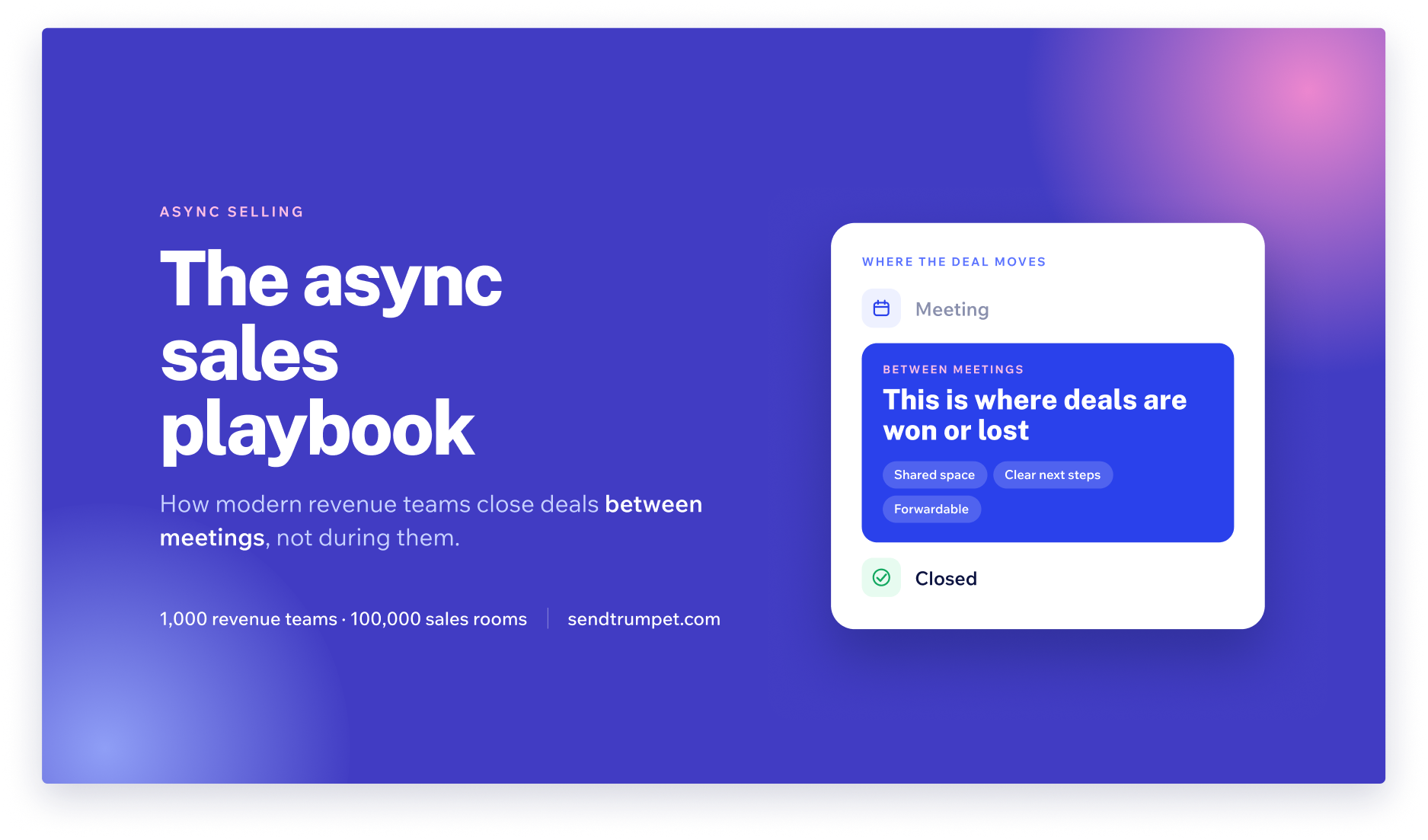





- Async selling is an operating model, not a tactic. It replaces calendar dependency with buyer-led progress captured in one shared space.
- Modern B2B deals die between meetings, not during them. If a deal cannot move forward without another meeting, it is structurally weak.
- Great async follow-ups capture decisions, not conversation. Every follow-up should answer a question the buyer hasn't asked yet.
- Re-engagement is about evidence, not timing. Re-engage on specific signals, hold when buyers are actively consuming content, intervene only on real inactivity.
- Buyers forward short videos, plain-language pricing, and clear next-step summaries. They do not forward slide decks or call notes.
- Digital Sales Rooms (Pods) are the infrastructure of async selling. They centralise decisions, context, and next steps so momentum continues without meetings.
Async selling is the practice of running a B2B deal so that progress happens between meetings, not only during them. It replaces calendar dependency with buyer-led momentum, and it matches how modern buyers already behave.
Most B2B buyers today spend the majority of their journey researching, sharing, and deciding without a salesperson present. Calendars no longer define progress. Buyer action does. This guide is a practical playbook for revenue teams that want to run the async operating model deliberately.
It is drawn from trumpet's work with 1,000 revenue teams and 100,000 sales rooms, alongside contributions from senior sellers running async cycles inside Gong, Rubrik, Cognism, and other high-performing organisations.
What is async selling?
Async selling enables buyers to move deals forward without requiring real-time interaction with a seller. It replaces waiting for meetings with steady, visible progress captured in one shared space.
What async selling looks like in practice:
- Structured follow-ups after every interaction
- Short video and written content buyers can revisit
- All decision materials in one shared place
- Clear next steps buyers can drive internally
What async selling is not:
- Fewer meetings for the sake of it
- Slower or less engaged selling
- "Send and hope" follow-ups without context
The core shift is this: async selling replaces calendar dependency with buyer-led progress.
Why don't buyers close deals in meetings anymore?
The behaviour has already changed. Meetings now confirm progress; they don't create it.
"Buyers are spending less and less time with AEs."
Charlotte Johnson, Mid-Market Account Executive, Rubrik (ex-Salesloft)
What has changed:
- Buyers research independently before the first sales call.
- Decisions are shaped offline between meetings.
- Internal alignment happens without sellers present.
- Meetings now confirm progress, they don't create it.
What this means for revenue teams:
- Calls are for setting direction, not setting progress.
- Progress must be visible after every meeting.
- If no async movement happens between calls, the deal is at risk regardless of the CRM stage.
Where do B2B deals actually die?
Deals rarely die on calls. They die between them.
The most dangerous moment in a modern B2B sale is when the buyer says: "I just need to socialise this internally."
What that really means:
- Your buyer is now selling on your behalf.
- The narrative is leaving the meeting.
- Momentum depends on what they can share internally.
Why it is risky:
- Decisions happen without guidance.
- Context gets diluted as it moves internally.
- Objections surface without you present to answer them.
The rule: every deal must be able to move forward without another meeting. If your buyer cannot progress the deal without you present, the deal is structurally weak by design.
Why does meeting-first selling actually kill momentum?
Meeting-first sales feels like control. In practice, it creates drag at the exact moments buyers need clarity.
The pattern:
- Meetings feel like control. In reality, deals stall waiting for availability.
- Calendars masquerade as progress. In reality, context resets every call.
- Champions are left alone to sell internally without the tools to do it well.
- Momentum fades silently, without anyone noticing.
This isn't a productivity problem. It is a structural failure. The more your deal depends on meetings, the more progress happens without you.
What does a great async follow-up look like?
Most deals are won or lost in what happens after the call, not during it. The typical follow-up and the async-first follow-up look very different.
Typical follow-up (what not to do): "Let me know if you have any questions."
- Open-ended and vague.
- Pushes responsibility back to the buyer.
- Creates silence and delay.
- Hard to forward internally.
Async-first follow-up (what good looks like): "Here's a 60-second recap of the decisions we discussed. I've outlined what finance typically asks next and what teams usually do from here."
- Decision-focused.
- Forwardable internally.
- Reduces internal friction.
- Guides the next step.
What great async follow-ups do:
- Capture decisions, not conversation.
- Add clarity the buyer hasn't asked for yet.
- Make the next step obvious.
The anchor line: every follow-up should answer a question the buyer hasn't asked yet.
What does the seller's role become in an async cycle?
The most important part of the sale happens when you are not in the room. Your buyer is explaining value internally, defending trade-offs, and navigating objections without you.
Your job is no longer to convince. It is to equip.
"Buyers get deals done, not sellers."
Brian LaManna, Enterprise Account Executive, Gong
What great async sellers focus on:
- Making decisions easy to explain.
- Giving buyers language they can reuse internally.
- Anticipating objections before they surface.
- Reducing friction across stakeholders.
What they stop relying on:
- Being present for every conversation.
- Repeating the same context live.
- Defaulting to "another call" as the next step.
If your buyer can't confidently sell internally without you, you are still selling the old way.
What do buyers actually share internally?
Buyers don't forward decks. They forward content that is easy to reuse.
When a buyer shares something internally, they are trying to avoid having to:
- Explain it themselves.
- Get challenged without backup.
- Answer follow-up questions they aren't equipped for.
What gets forwarded:
- Short videos that explain what was decided and why.
- Pricing explained in plain language.
- A clear "here's what happens next".
- Anything that already answers finance or leadership questions.
What usually doesn't get forwarded:
- Slide decks that need narration.
- Case studies without relevance.
- Notes taken during a call.
- Anything that requires "context on another call".
If your buyer has to explain, defend, or translate the content, it won't move the deal forward.
What does a full async sales rhythm look like?
High-performing teams run a repeatable async cycle across four stages.
1. Live call. Sets direction and aligns on what matters. Identifies who else needs to be involved. Establishes the decisions that need to happen next.
2. Async recap in the shared Digital Sales Room. Decisions, not notes. Clear context for stakeholders who weren't present. Next steps documented in one place the buyer can forward.
3. Buyer review and internal sharing. Buyers revisit the recap in their own time. Links, videos, pricing, and plans are forwarded internally. New stakeholders enter the same space with full context.
4. Signal-based re-engagement. Seller re-enters based on buyer behaviour, not on a calendar reminder. Engagement, sharing, and specific questions guide timing. Follow-ups respond to decisions already forming.
What this rhythm enables:
- Buyers move forward without waiting on meetings.
- Stakeholders enter with full context.
- Sellers re-engage based on real signals.
The signal: if nothing moves inside a shared deal room after a call, the deal is not progressing regardless of what the CRM stage says.
When should you re-engage vs stay quiet?
Re-engagement is not just about timing. It is about evidence.
Re-engage when you see these signals:
- The recap or workspace is being revisited multiple times.
- New stakeholders have viewed or engaged with materials.
- Pricing, plans, or implementation details are being opened.
- A specific question appears after a period of review.
Hold (doing nothing is often the right move) when you see:
- Ongoing views without replies.
- Internal sharing activity without new questions.
- Stakeholders consuming different sections at different times.
This is buying work in progress. Interrupting here often slows things down.
Intervene only when this happens:
- No activity in the shared workspace.
- No engagement with the recap or decision materials.
- No internal sharing after a clear next step.
Silence plus inactivity is real risk. That is when to step in.
What great re-engagement actually looks like
The wrong instinct, "just checking in", "any thoughts?", "wanted to bump this", signals uncertainty and resets momentum.
Example 1: Internal review in progress:
"Looks like the pricing is being shared internally now. Teams usually pause here to sanity-check scope with finance, so I've added a short note covering the two questions that tend to come up at this point. Might save you having to explain it again."
Example 2: No movement after next steps:
"I haven't seen any movement in the workspace since we agreed on next steps. When that happens, it is usually because one detail needs clearing up. I've added a quick clarification on implementation timing in case that helps unblock things."
Why do most async selling attempts fail?
Most teams don't fail at async selling. They fail by doing async around the deal instead of inside it.
Common patterns and what to do instead:
- Sending follow-ups after every call → buyers have to explain decisions internally. Instead: capture decisions, not conversations.
- Recording meetings → recordings don't get forwarded. Instead: share short demos buyers can forward.
- Sharing decks over email → buyers have to translate context internally. Instead: centralise materials in one shared space.
- Chasing silence → momentum gets reset. Instead: respond to signals, not time.
- Booking "another call" → progress depends on availability. Instead: design for buyer-led progress.
The full async cycle checklist
After first call / discovery:
- A written recap that captures why the buyer cares (not a call summary).
- Clear problem framing the buyer can repeat internally.
- Named stakeholders who need to be involved next.
- A visible "what happens next" that doesn't require another call.
After demo / solution alignment:
- A short video or written summary explaining what was agreed and why.
- Clear scope boundaries (what's in / what's out).
- Answers to the 2-3 objections that usually surface internally.
- Materials that can be forwarded to finance, IT, or leadership.
Evaluation / internal alignment:
- Pricing explained in plain language.
- Implementation or rollout clarity (Mutual Action Plan).
- Evidence buyers can reuse (examples, benchmarks, proof points).
- One place where new stakeholders can self-serve context.
Late-stage / decision pending:
- Clear summary of what's been decided vs what's still open.
- Final decision criteria made explicit.
- Confirmation of who signs and what they need.
- Follow-ups triggered by buyer behaviour, not by time or silence.
Why async selling wins in 2026
Async selling matches how buyers already behave.
"Prospects actually told us they now enjoyed being sold to."
Jonathon Ilett, VP Global Sales, Cognism
Buyers aren't trying to avoid sellers. They are trying to buy on their own terms. Async works because it fits how decisions actually happen now:
- They review materials after meetings, not during them.
- They share links or recordings, not summaries.
- They come back with new stakeholders already looped in.
- They make decisions between touchpoints, not on calls.
Async selling eliminates the three biggest sources of drag in modern B2B: waiting for availability to move forward, re-explaining the same context to every new stakeholder, and stalled deals caused by calendar gaps.
Final thoughts
Async selling works when you stop treating meetings as progress and start treating buyer action as the source of truth.
Every live call should create something durable: decisions, context, and next steps that move without you present. If progress only exists while you are talking, the deal is still seller-led, regardless of how modern your tools are.
The goal isn't fewer calls. It is fewer moments where the buyer gets stuck without context.
If it doesn't move between calls, it isn't moving.
FAQs
What is async selling?
Async selling enables buyers to move deals forward without requiring real-time interaction with a seller. It replaces calendar dependency with steady, visible progress captured in one shared space. It is not fewer meetings for the sake of it, it is progress that continues between them.
Why do most B2B deals die between meetings, not during them?
Modern B2B buyers spend the majority of their journey researching, sharing, and deciding without a salesperson present. If a deal cannot move forward without another meeting, the deal is structurally weak. Deals die when calendar gaps break momentum, not when calls go poorly.
When should you re-engage a B2B buyer who has gone quiet?
Re-engage when you see specific signals: repeat revisits to the sales room, new stakeholders viewing materials, pricing or implementation content being opened, or a specific question after a period of review. Hold when the buyer is actively consuming content without asking questions. Intervene only when there is no activity and no internal sharing.
What is the difference between a typical follow-up and an async-first follow-up?
A typical follow-up asks the buyer to do the work ("Let me know if you have any questions"). An async-first follow-up captures decisions, adds clarity the buyer hasn't asked for yet, and makes the next step obvious in a way the buyer can forward internally without needing to explain the context.
What kind of content do buyers actually forward internally?
Short videos that explain decisions, pricing in plain language, clear next-step summaries, and content that already answers finance or leadership questions. Buyers do not forward slide decks that need narration, call notes, or anything that requires "context on another call".
How does async selling work with Digital Sales Rooms?
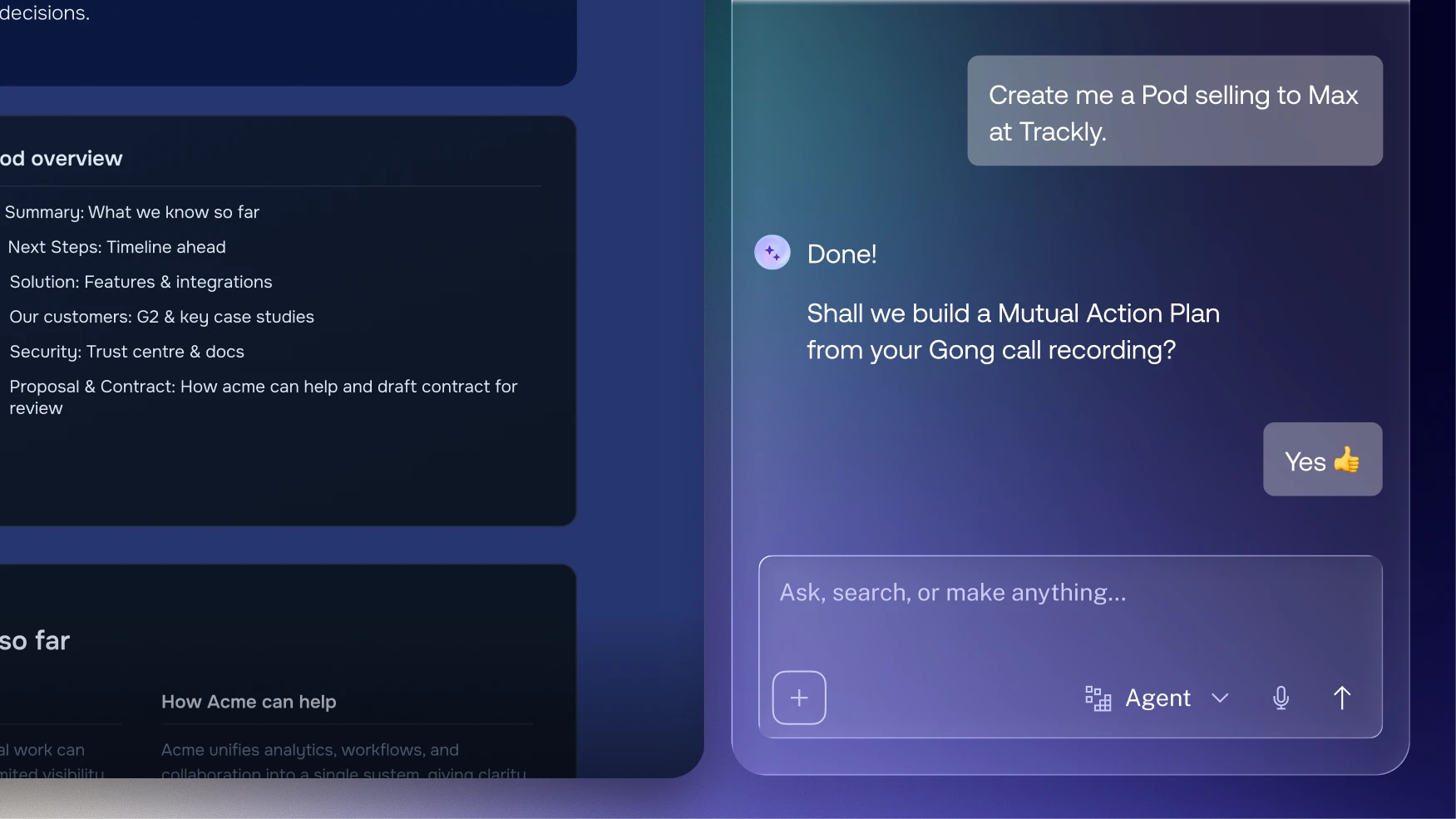
A Digital Sales Room (also called a Pod) is the physical infrastructure of async selling. It replaces scattered email threads with a single shared space where decisions, context, and next steps live. Buyers can review, share internally, and self-serve context without booking another call. Sellers can see engagement in real time and respond to buyer behaviour rather than to silence.





![How to Get Started with Buyer Enablement [With Examples]](https://cdn.prod.website-files.com/65cf4fecbed2754c2236665d/65cf4fecbed2754c22366bdb_65a5af83e742f76e34ce06f3_Customer%2520Onboarding%2520_%2520Everything%2520you%2520need%2520(2).png)
.png)


.png)


.png)


.png)

.png)

.png)
.png)





