


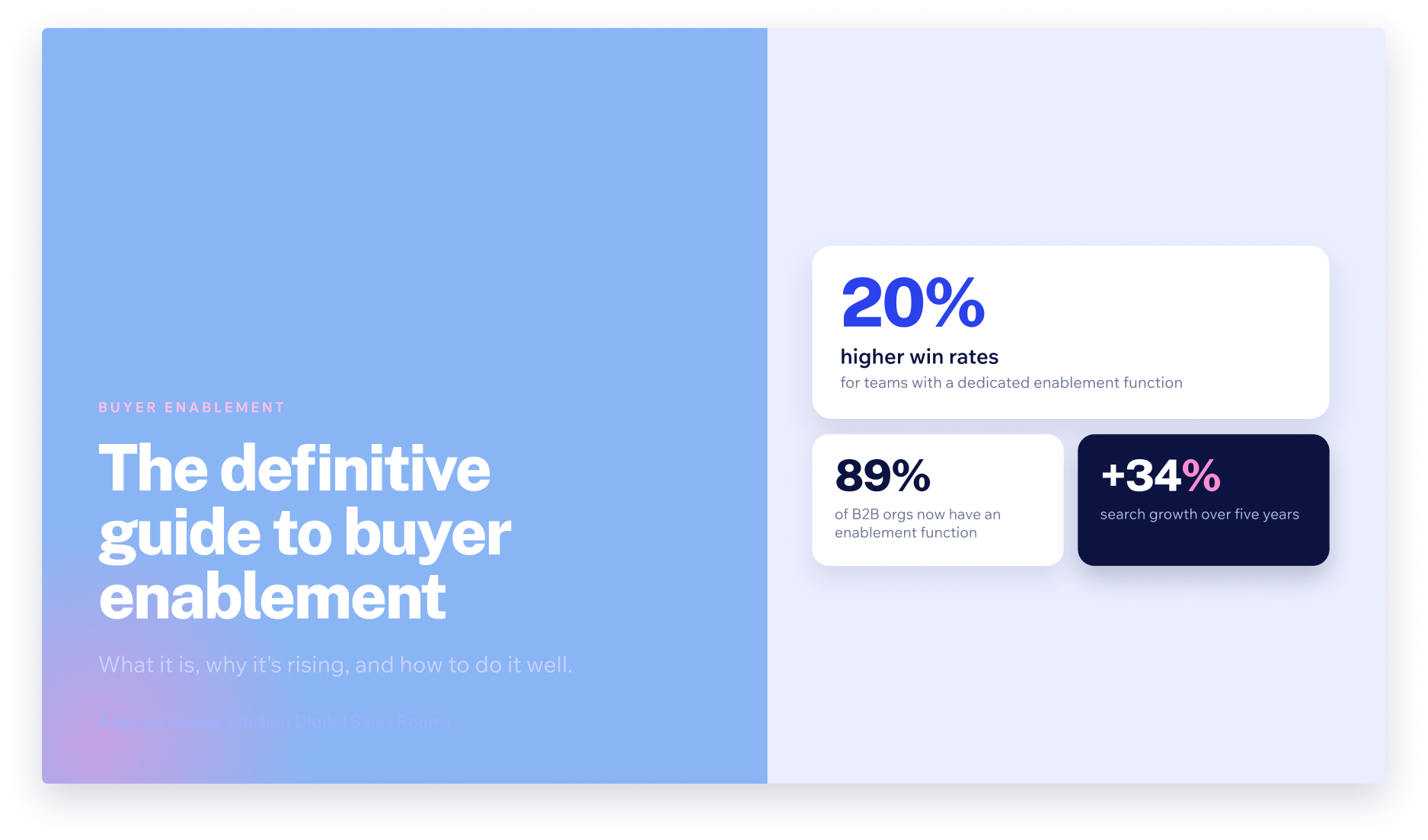





- Buyer enablement is the discipline of equipping buyers (not sellers) with the tools and content they need to navigate a complex B2B purchase
- Search volume is up 34%; 89% of B2B orgs have an enablement function; teams with dedicated enablement see 20% higher win rates
- Six forces have reshaped B2B buying: digital-first decisions, personalisation as the baseline, speed expectations, fading urgency, more stakeholders, and generational tone shifts
- The average B2B buying group is now 10-11 stakeholders (up from 6-7 five years ago); 60% of deals are lost to no decision, not competitors
- Trumpet's data on 1M+ Digital Sales Rooms shows Pods with a Mutual Action Plan win 2x more often; deal timelines drive 33% faster cycles
- Pods are 32% more effective and 47% more memorable than slide decks; stakeholders using Pods make decisions 18% faster
Buyer enablement is the discipline of helping potential customers understand, evaluate, and decide on a purchase by giving them the right tools, in the right format, at the right time. It reframes the seller's role from convincing to equipping, and it exists because B2B buying has become too complex for the traditional sales motion.
Over the past five years, buyer enablement has moved from a niche tactic to a core strategic priority. Search volume is up 34%. Dedicated buyer enablement roles now exist at Consensus, Benify, Unit4, Oyster, and others. 89% of B2B organisations now have an enablement function. And the data is clear: teams with dedicated enablement functions see 20% higher win rates than those without.
This guide is the reference for what buyer enablement is, why it matters in 2026, what the underlying data shows, and how to do it well. It draws on trumpet's analysis of over 1 million Digital Sales Rooms, external research from Gartner and G2, and contributions from senior revenue leaders at Zoopla, Unit4, Cognism, and others.
What is buyer enablement?
Buyer enablement is about helping your potential customers understand and solve their challenges, every step of the way. It is not about flooding them with decks and data. It is about giving them the right tools, in the right format, at the right time so they can make smart decisions with confidence.
Done well, buyer enablement turns your internal champions into your best salespeople, even when you are not in the room. With the right support, champions can explain your product, handle objections, and build the case across their teams.
Buyer enablement gives them what they need to do that well: clarity, content, and confidence.
"Enablement needs to touch every part of the journey, not just onboarding or pre-sales. It should show up in implementation, in retention, and even in renewal conversations. That's how you drive real revenue impact."
Malvina EL-Sayegh, Revenue Enablement, Zoopla & Oyster HR
Why has buyer enablement become a strategic priority in 2026?
Three data points make the shift undeniable.
Search volume for "buyer enablement" is up 34% over five years in the UK and US. "Sales enablement" is up 51% in the same period. This isn't a content trend; it is a market recognition that buying journeys are too complex for both sides to navigate without support.
89% of B2B organisations now have a dedicated enablement function. 53% increased their enablement headcount in the past 12 months. Enablement team headcount is up 5%+ in over half of B2B organisations.
Investment in buyer enablement tech is accelerating. The fastest-growing segments in B2B SaaS are the tools that help buyers explore, align stakeholders, and make confident decisions:
- Async video software: 20.1% CAGR
- Customer review software: 17% CAGR
- E-closing software: 16.8% CAGR
- Product tour and micro-demo software: 16.1% CAGR
- Proposal management software: 14.8% CAGR
- Digital sales room software: 10.6% CAGR
The Digital Sales Room category alone has seen a 52% increase in new entrants over the past two years on G2. Enablement is no longer a nice-to-have. It is becoming operational.
What has changed about B2B buying that broke the old sales model?
Six forces have reshaped B2B buying and made the traditional sales motion obsolete.
1. Digital-first decisions
In 2025, up to 90% of B2B buying journeys will have started before a rep even enters the conversation. Digital presence now drives pipeline.
85% of buyers have their vendor shortlist before starting the research phase. If you are not discoverable in the channels buyers use to self-educate (communities, review platforms, video content, independent creators, industry forums), you are not in the deal.
2. Personalisation or irrelevance
73% of buyers expect tailored experiences. Generic, one-size-fits-all outreach no longer earns trust or attention.
4 in 5 B2B buyers now make decisions based on personalised digital content, not just conversations. Buyers are selective and hard to impress; they do not want to feel like "just one account of many".
3. Efficiency and speed as the baseline
B2B buyers are used to B2C speed:
- 83% expect immediate responses.
- 86% will abandon a vendor that can't demonstrate ROI quickly.
- 57% expect ROI within 90 days, up from 47% just six months ago.
And with 70% of organisations facing flat or shrinking sales budgets, buyers want tools that make them look good without needing more headcount, budget, or complexity.
4. Fading urgency and shifting priorities
Most sales aren't lost to competitors. They are lost to no decision.
"You can have the best product, best pitch, best pricing, and the buyer still does nothing. Your job is to give them a reason to act. Remove the friction. Make the next step feel easy."
Daniel Disney, CEO
84% of buyers say their priorities shift at least once during the buying process, often delaying or derailing progress. Buyers change their problem statement 3.1 times on average during complex purchases. And 60% of deals today end up lost to customers who express intent to purchase but ultimately fail to act.
5. More stakeholders, more friction
Today's buying process isn't one decision. It is ten. At least.
- The average B2B buying group has grown to 10-11 stakeholders, up from 6-7 just five years ago.
- Multinational deals can involve 15+ decision-makers.
- 52% of buying groups now include VP-level decision-makers or above.
- 38% involve the CEO directly.
- In 79% of cases, the CFO holds final approval power.
- Final decisions now require consensus from at least 5 key stakeholders.
- 58% of buyers say their choices are overruled by senior execs.
- Buying timelines have stretched to 11.5 months on average.
- 86% of deals stall as teams try to align on requirements.
6. A generational shift in tone and format
71% of B2B buyers are now Millennials or Gen Z. They buy differently:
- 67% of buyers under 35 prefer self-serve over speaking to sales.
- 65% of Millennial B2B buyers prefer video as their primary way to learn about products.
- 86% of Millennial buyers favour a casual, human tone over formal messaging.
"Buyers are more informed. They're joining communities. They're reading Substacks. They're watching YouTube videos. They're listening to podcasts. They've already made a decision about your product before they talk to sales."
Sandy Mangat, Head of Marketing
What does buyer enablement look like at each stage of the sales cycle?
Buyer enablement is not just a principle. It is a stage-by-stage playbook.
Outreach
Purpose: Help the buyer identify and name a problem they may not fully realise yet. Create early value to earn trust, not just attention. Equip them with simple, forwardable content they can use to start internal conversations.
What good looks like:
- Personalised LinkedIn voice note or custom Loom explaining a common blind spot in their industry.
- Mini-audit or benchmark data ("You're spending 5x more time doing X than your peers at [company]").
- A short one-pager deal room with a video, solution overview, and pain points specific to their ICP.
"Start conversations, not pitches. Instead of pitching buyers during your first conversation, look to start a conversation about their role, their perspective, their industry, or another relevant topic."
Mark Goldberger, Head of Enterprise Sales
Discovery / demo call
Purpose: Help the buyer clarify their problem and align stakeholders around it. Surface internal blockers early. Begin arming your champion with materials they'll need to build internal consensus.
What good looks like:
- Problem breakdown overview with 1-2 stats to build credibility.
- "Cost of inaction" calculator or back-of-the-napkin ROI math.
- Champion enablement slide that helps them pitch internally.
- Live case study snapshots relevant to their industry.
- Objection-handling FAQ cards.
"Always be inquisitive, ask the 'WHY'. Why will this deal happen? Why won't it happen? Why is someone acting out of character? That paranoia will help you navigate problems before they occur."
Natalie Johnson, Chief Revenue Officer
Post-call follow-up
Purpose: Reinforce shared understanding of the buyer's goals. Equip the buyer to explain and advocate for your solution internally. Reduce internal friction proactively.
What good looks like:
- Personalised call recap video (60-90 seconds).
- Deal room or one-pager highlighting pain to solution.
- Interactive Mutual Action Plan hosted in a shared space.
- 30/60/90-day value or implementation plan.
- Role or industry-specific customer stories.
Business case
Purpose: Enable the buyer to clearly articulate the business value. Help the champion win over budget holders, leadership, or legal with tailored proof.
What good looks like:
- Custom ROI model in the buyer's language.
- Procurement-ready one-pager covering security, compliance, and legal.
- Executive summary with a CFO-focused TLDR.
- Multi-stakeholder content hub, organised so each internal reviewer sees only what's relevant to them.
- Social proof pack with logos and customer outcomes.
"You have to make it easy for your champion to sell you internally. The business case can't sound like marketing fluff. It should sound like them. If they don't believe it, or worse, if it sounds like you're selling too hard, it won't go anywhere."
Scott Leese, Fractional CRO and GTM Advisor
Proposal and quote
Purpose: Make it easy for the buyer to review, share, and approve the proposal internally.
What good looks like:
- Simple, editable proposal or quote summary.
- Commercial summary slide with pricing rationale.
- Mutual Action Plan with signing and kickoff milestones.
- Success metrics or SLA commitments.
Contract and negotiation
Purpose: Help the buyer navigate internal legal, procurement, and finance hurdles.
What good looks like:
- Final editable contract draft via e-signature platform.
- Legal and procurement FAQ or playbook.
- Post-signature kickoff milestones.
- Summary of negotiated terms or changes.
"Sometimes we forget that buyers are navigating their own internal politics. You might be speaking to someone who wants your solution, but they still need to convince legal, finance, IT. Good sellers make that easier. They don't just pitch and hope. They equip the buyer to tell the story internally, in a way that lands."
Lesley Ronaldson, EMEA GM & VP
Onboarding
Purpose: Ensure a smooth handoff and align stakeholders on delivery, timelines, and success.
What good looks like:
- Welcome pack with key milestones and team intros.
- Onboarding checklist with roles and deadlines.
- Success plan with agreed outcomes.
- Dedicated DSR onboarding section.
- Self-serve resources and FAQs.
"What happens after the deal is just as important as what happens before it. If you over-promise in sales and the onboarding doesn't match up, you lose trust immediately."
Alice de Courcy, Group Chief Marketing Officer
Account management and renewal
Purpose: Help the customer demonstrate value internally and secure ongoing buy-in.
What good looks like:
- Quarterly Business Review deck or ROI summary.
- Renewal-ready success metrics dashboard.
- Expansion proposal or roadmap.
- Stakeholder update for internal reporting.
- Renewal timeline with clear milestones.
Which tools support buyer enablement?
Modern buyer enablement stacks combine several categories of tools:
- Digital Sales Rooms: trumpet, Valuecase, Arrows, GetAccept. The central workspace for buyer-facing content and engagement.
- Content management systems: trumpet, Highspot, Seismic, Showpad, Spekit, Frontify, Bynder. Where sales content is stored, tagged, and surfaced.
- Async video software: for personalised video content buyers can revisit.
- Product tours and micro-demos: for self-serve exploration.
- Proposal and quoting tools: for editable, forwardable commercial docs.
- E-signature: to reduce friction in the final stage.
- ROI calculators: to give buyers custom business case math.
- Live chat and real-time support: for buyers who want answers now.
- Customer review platforms: for third-party validation.
The Digital Sales Room sits at the centre because it is the layer that ties everything else together into a buyer-facing experience.
What does the trumpet data show about buyer enablement in action?
Based on trumpet's analysis of over 1 million Digital Sales Rooms, specific buyer enablement choices measurably move win rates and sales cycle speed.
Mutual Action Plans
- Pods with a MAP = 2x win rate
- MAPs with 6-10 completed steps = 84% win rate
- MAPs with 11-15 completed steps = 92% win rate
- Sweet spot for win rate = 6-20 completed steps
- MAPs with 30+ steps drop back to no-MAP win rate levels; don't overwhelm
Stakeholder count
- 4 unique stakeholders doubles close chance vs 1-2
- 6 unique stakeholders = 51% close chance
- 10 unique stakeholders = 65% close chance
- 10+ unique stakeholders = 75% close chance
Content in the Pod
- E-signature product in the Pod = 23% faster sales cycle
- Deal timeline in the Pod = 33% faster sales cycle, +7% win rate
- Testimonials in the Pod = +4% win rate
- Personalised video in the Pod = 14% faster sales cycle
- Interactive demos in the Pod = 31% faster sales cycle
- Clear feature breakdown = 21% faster
- FAQs in the Pod = 15% faster
- Clear pricing in the Pod = 19% faster, +2% win rate
- Calendar functionality in the Pod = +8% win rate
- More than 3 PDFs in the Pod = -8% win rate (content dump hurts)
Buyer behaviour signals
- 74% of buyers say a well-organised buying experience influences their decision to move forward.
- Pods are 32% more effective and 47% more memorable than traditional slide-based presentations.
- Stakeholders who engage via Pods make decisions 18% faster than those in traditional sales processes.
Why buyer enablement doubles win rates
Teams with dedicated enablement functions see 20% higher win rates than those without.
The underlying data is consistent:
- Buyers are 88% more likely to purchase when they see the seller as a trusted advisor, not a vendor.
- 86% of buyers are more likely to buy when their goals are understood, but only 59% feel that actually happens.
- With 10+ stakeholders involved, sellers must speak to broader business impact, not just product fit.
- Teams that build deeper relationships drive stronger growth and command premium pricing.
Buyer enablement works because it moves the seller from convincing to equipping. The champion becomes the salesperson. The buying group makes the decision without needing the seller in the room. Deals close faster and stall less.
Final thoughts
Buyer enablement isn't a channel or a job title. It is an operating principle: give buyers what they need, in the format they need it, at the moment they need it.
The teams that do it well see measurable outcomes. Higher win rates. Shorter cycles. Fewer deals lost to no decision. Better post-sale momentum. The teams that ignore it are still trying to close deals through follow-up emails and meeting invites in a world where buyers have already made up their minds before the first call.
The shift is real. The data is clear. And the tools to do it well already exist.
FAQs
What is buyer enablement?
Buyer enablement is the practice of helping potential customers understand, evaluate, and decide on a purchase by giving them the right tools, content, and context at each stage of the buying journey. It reframes the seller's role from convincing to equipping.
Why is buyer enablement growing as a category?
Search volume for buyer enablement is up 34% in five years. 89% of B2B organisations now have a dedicated enablement function, and 53% increased headcount in the last year. Investment in buyer enablement tech is accelerating, with async video (20.1% CAGR) and Digital Sales Rooms (10.6% CAGR) among the fastest-growing categories.
How does buyer enablement improve B2B win rates?
Teams with dedicated enablement functions see 20% higher win rates. Trumpet's data on over 1 million Digital Sales Rooms shows Pods with a Mutual Action Plan win at 2x the rate of Pods without. Deals with 4+ engaged stakeholders double their close chance vs 1-2 stakeholders.
What is the difference between sales enablement and buyer enablement?
Sales enablement focuses on equipping sellers with content, training, and tools. Buyer enablement focuses on equipping buyers directly, so they can navigate their internal buying process, explain the value to stakeholders, and make decisions with confidence. Sales enablement helps you sell; buyer enablement helps them buy.
How many stakeholders are involved in a B2B buying decision in 2026?
The average B2B buying group has grown to 10-11 stakeholders, up from 6-7 five years ago. Multinational deals involve 15+ decision-makers. 52% of buying groups now include VP-level decision-makers, 38% involve the CEO directly, and in 79% of cases the CFO holds final approval.
Why do most B2B deals stall in the buying process?
60% of deals lost today are lost to no decision, not to competitors. 80% of buying decisions stall due to complexity. 84% of buyers say their priorities shift during the process, and buyers change their problem statement an average of 3.1 times during complex purchases.
What does a Digital Sales Room contribute to buyer enablement?
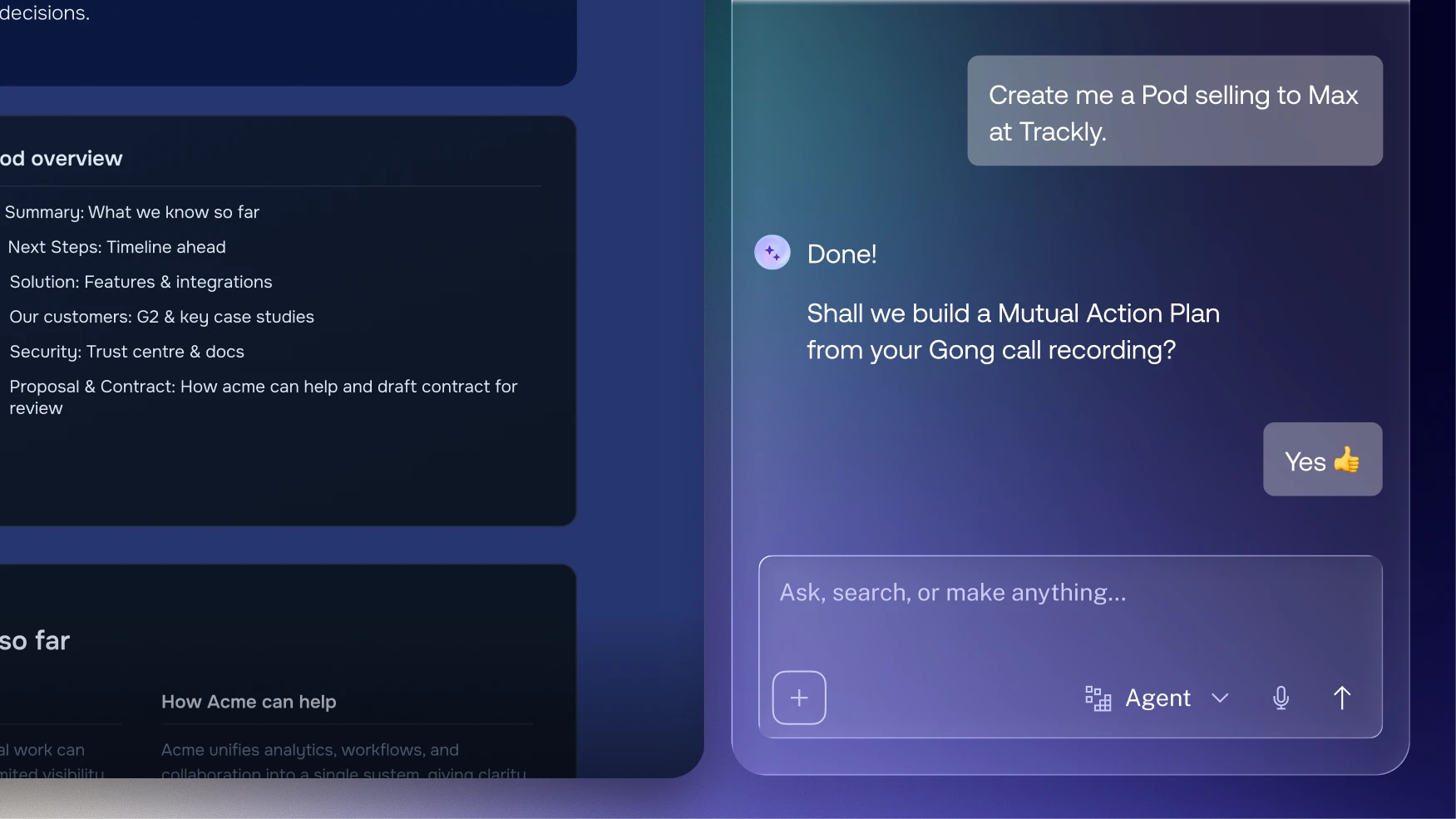
A Digital Sales Room centralises everything the buyer needs into one shared space: pricing, demos, proof, decisions, mutual action plans, and next steps. Trumpet's data shows Pods are 32% more effective and 47% more memorable than traditional slide decks, and stakeholders using Pods make decisions 18% faster.




![How to Get Started with Buyer Enablement [With Examples]](https://cdn.prod.website-files.com/65cf4fecbed2754c2236665d/65cf4fecbed2754c22366bdb_65a5af83e742f76e34ce06f3_Customer%2520Onboarding%2520_%2520Everything%2520you%2520need%2520(2).png)
.png)


.png)


.png)


.png)

.png)

.png)
.png)





