







Forecast surprises rarely feel surprising in hindsight. The stakeholder who never joined. The champion whose engagement dropped. The next step that moved twice. The MAP milestone that sat untouched. By the time any of this reaches a forecast call, it has usually been true for weeks.
AI deal coaching is one way sales managers are trying to close that gap. Instead of waiting for a scheduled review to ask how a deal feels, managers can use deal and buyer evidence to decide which opportunities deserve a closer look, and what to ask about once they get there.
AI deal coaching uses deal and buyer activity to help sales managers identify potential risk earlier and have more specific coaching conversations with reps. Instead of relying only on a rep's assessment of an opportunity, managers can use evidence such as buyer engagement, stakeholder coverage and Mutual Action Plan progress to decide which deals need closer inspection and what questions to ask.
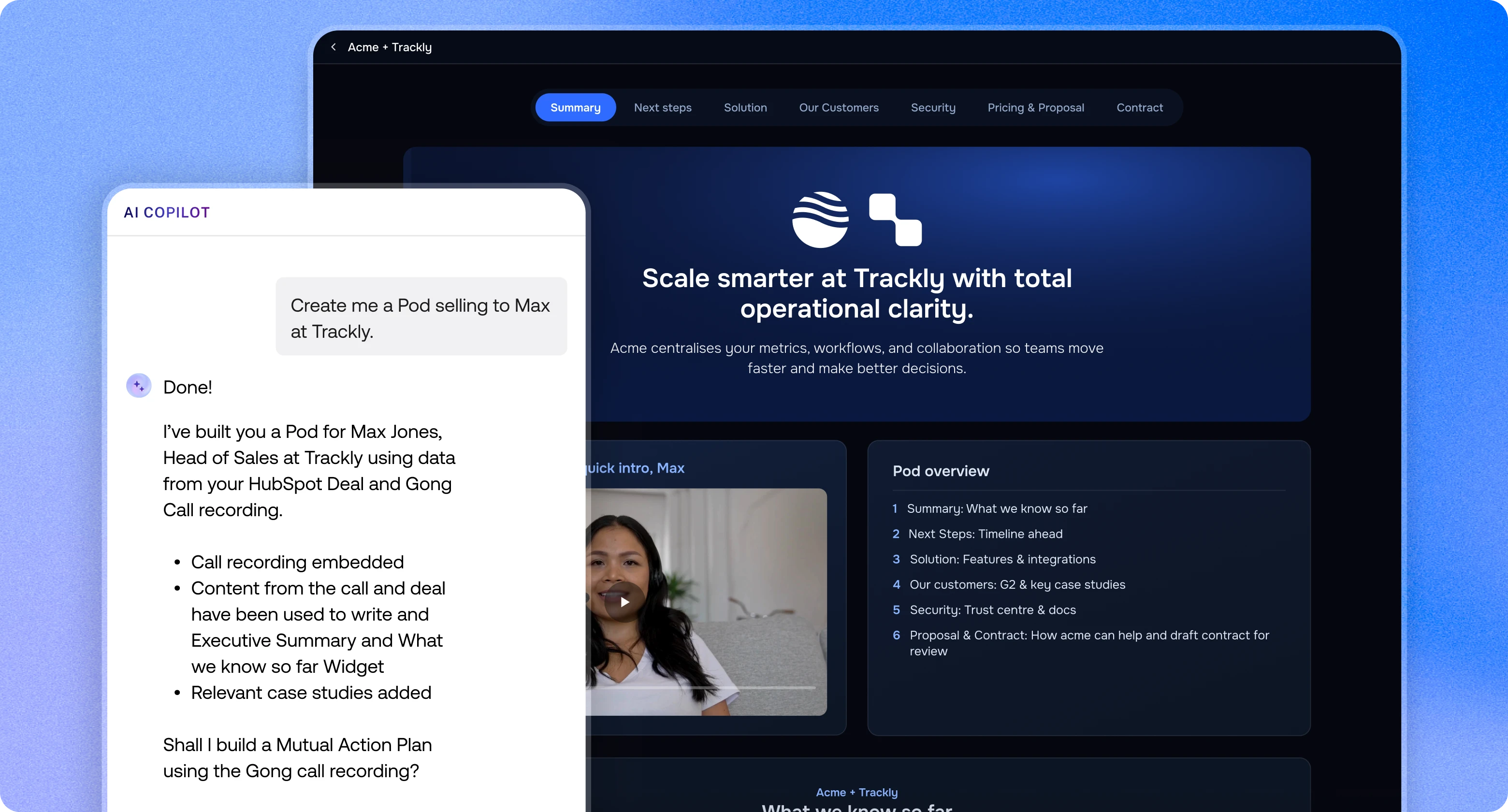
trumpet brings buyer engagement signals, stakeholder activity, Mutual Action Plans and manager-level deal visibility together across its buyer-facing Pods and revenue intelligence tools, giving managers more evidence to use when coaching reps. Casey AI adds AI-assisted deal and engagement coaching within the trumpet platform.
AI deal coaching should support manager judgement, not replace it. The value is not simply an AI-generated answer. It is giving managers better evidence and better questions while there is still time to act.
The rest of this guide looks at what AI deal coaching actually involves, the evidence it draws on, and how it changes the conversation between a manager and a rep, from the first 1:1 through to the forecast call itself.
What is AI deal coaching?
AI deal coaching is the use of AI and deal evidence to help sales managers and reps identify potential risks, understand what may need attention and make coaching conversations more specific.
Depending on the platform and the data available, that evidence can include:
- Buyer engagement
- Stakeholder coverage
- Deal-stage activity
- Mutual Action Plan progress
- Content engagement
- CRM context
It is worth being just as clear about what AI deal coaching is not:
- Not a replacement for the sales manager
- Not a generic lead score
- Not simply an AI summary of CRM fields
- Not proof that an opportunity will win or lose
- Not a reason to ignore account context or rep judgement
trumpet's Casey AI is designed to provide AI-assisted deal and engagement coaching inside the platform. Separately, trumpet gives revenue teams access to buyer engagement, stakeholder, Mutual Action Plan and manager-level deal information through the wider platform, including Pods, Stakeholder Scout and Nerve Centre reporting. Casey draws on this shared evidence rather than existing apart from it.
What does an AI deal coach actually do?
This is one of the most common questions people ask about AI deal coaching, and the honest answer depends on the platform. Depending on the tool and the data behind it, AI deal coaching can help managers:
- Identify opportunities that may deserve closer inspection
- Surface evidence that could indicate risk
- Identify gaps in stakeholder participation
- Highlight changes in buyer engagement
- Inspect whether deal activity supports the reported stage
- Prioritise which opportunities need manager attention
- Turn deal evidence into more specific coaching questions
- Identify possible next actions
Not every AI deal coaching platform performs every one of these functions, and the details vary by provider. For trumpet, only Casey's confirmed functionality should be read as describing Casey specifically. The broader evidence listed above is generally provided by trumpet's wider platform, including buyer engagement analytics, Stakeholder Scout, Mutual Action Plans and Nerve Centre reporting, which Casey can then draw on.
An AI deal coach gives the manager a better starting point for investigation. It does not make the final judgement for them.
Why traditional deal reviews still rely heavily on rep judgement
None of this is a criticism of reps. It is simply how deal reviews have traditionally worked:
- Managers cannot inspect every opportunity in depth every day
- Reps naturally have more context than managers
- CRM updates often reflect seller activity and rep interpretation
- The last buyer conversation can disproportionately influence perceived deal health
- Weekly forecast calls may be too late to first investigate emerging risk
A confident rep and strong buyer evidence are two different things. Good deal inspection considers both.
The gap between rep perception and buyer evidence can be one reason deal risk is identified too late.
AI deal coaching vs traditional deal reviews
The table below sets out where AI-assisted deal coaching adds to a traditional deal review, rather than replacing it.
AI deal coaching should augment the manager-rep conversation, not replace it. Rep judgement and manager judgement both stay central. The difference is the evidence they now have to work with.
Deal-risk signals managers should investigate
These are general indicators worth investigating, not proof that a deal is in trouble. No single signal, on its own, tells a manager how a deal will end.
Buyer engagement signals
- Engagement has slowed compared with the deal's previous pattern
- Only one stakeholder is engaging
- Expected stakeholders have not appeared
- Content relevant to the current stage has not been viewed
- Internal sharing has stopped, or never happened
Process signals
- MAP milestones have stalled
- Next steps repeatedly move
- Stakeholder participation has not expanded as the evaluation progresses
- Procurement, security or legal involvement appears later than expected
General communication signals
- Slower responses
- Repeatedly rescheduled meetings
- Difficulty securing the next meeting
- Champion communication changing
These are general sales-risk indicators that apply across B2B sales teams. They do not imply that trumpet or Casey automatically tracks every signal listed here. Which of these trumpet can surface depends on the specific feature involved, such as buyer engagement analytics or Mutual Action Plan tracking.
Use stakeholder coverage as a coaching signal
Buyer engagement tells a manager how much is happening. Stakeholder coverage tells them who it is happening with, and it is often the more revealing question.
- Is the champion still the only engaged stakeholder?
- Has an economic buyer appeared?
- Has finance engaged where expected?
- Have security or technical stakeholders entered the process?
- Which buying roles are still missing?
trumpet's Stakeholder Scout is built to help with this part of the picture, giving revenue teams visibility into which buying roles are present in a deal and where coverage may be thin. That stakeholder intelligence is one of the inputs a manager can bring into a coaching conversation, alongside Casey AI's deal and engagement coaching and the wider evidence available inside the Pod.
How AI deal coaching changes manager-rep conversations
Before
- “How's it looking?”
- “Are they still interested?”
- “When do you think it'll close?”
With better deal evidence
- “Engagement has changed since last week. What's happened?”
- “We're still seeing activity from one person. Who else needs to be involved?”
- “This MAP milestone hasn't moved. What is blocking it?”
- “Finance hasn't appeared yet. When does the buyer expect them to enter?”
The value of AI deal coaching is not simply the flag or recommendation. It is turning “how's it looking?” into a better question.
Using AI deal coaching in sales 1:1s
AI deal coaching is most useful as a habit built into regular 1:1s, not something a manager reaches for once a quarter. A simple five-step framework can guide that habit:
- Review: identify opportunities with evidence worth investigating
- Understand: look at the signal and the surrounding deal context
- Ask: use the evidence to ask the rep a specific question
- Act: agree the most appropriate next action
- Revisit: check whether the situation changes before the next review
Surface → understand → coach → act → review
In practice, this might look like a manager reviewing the deals showing evidence worth investigating ahead of a 1:1, using trumpet's manager views and buyer engagement information alongside Casey AI's coaching input to understand the context, then asking the rep a specific question rather than a general one.
Using AI deal coaching before forecast calls
AI deal coaching is not a replacement for forecast methodology. Its role is to make sure the forecast call is not the first time a risk gets discussed. Used well, managers can arrive at the call with:
- Specific opportunities already inspected
- Risks already discussed with reps
- Clearer stakeholder context
- Buyer evidence to compare with CRM status
- Actions already underway
Used this way, the forecast call becomes a point of confirmation and decision-making, rather than the first moment a risk is discovered.
How AI deal coaching can support sales forecasting
It is tempting to say that AI deal coaching improves forecast accuracy, but that is a stronger claim than the evidence supports. A fairer way to put it is that AI deal coaching can give managers additional evidence when assessing deal health and forecast confidence, covering things such as:
- Reported stage versus buyer activity
- Stakeholder participation
- MAP progress
- Engagement changes
- Known risks
- Rep context
The manager still makes the judgement call on where a deal actually sits in the forecast.
What AI deal coaching should not replace
- Manager judgement
- Rep context
- Direct buyer conversations
- Account history
- Relationship nuance
- Sales methodology
- Skill coaching
- Human decision-making
AI deal coaching should make manager judgement better informed, not optional.
Common AI deal coaching mistakes
Treating every signal as proof
- Buyer behaviour provides evidence, not certainty.
Treating AI recommendations as instructions
-Managers and reps still need context.
Only checking deal risk before forecast calls
- The value comes from acting while there is still time.
Ignoring signals that contradict the current deal narrative
- Evidence deserves investigation even when the rep remains confident.
Using AI deal coaching as rep surveillance
- The goal is better coaching and earlier support, not catching reps out.
Expecting AI to replace skill coaching
- Deal coaching and rep development are related but different.
AI deal coaching checklist for managers
Before the 1:1
- Review opportunities showing potential risk
- Check buyer engagement
- Check stakeholder coverage
- Review relevant MAP progress
- Compare buyer evidence with CRM status
- Identify one or two questions worth investigating
During the 1:1
- Ask for the rep's context first
- Discuss the specific evidence
- Identify what may have changed
- Agree the next action
- Decide what evidence would indicate improvement
Before the next review
- Check whether buyer behaviour changed
- Review stakeholder participation
- Review MAP progress
- Revisit the risk if the evidence remains unchanged
How trumpet supports AI-assisted deal coaching
Bringing this together: trumpet combines AI-assisted deal coaching with the buyer engagement and stakeholder evidence generated across the live buying journey. Its confirmed capabilities span:
- Casey AI
- Pods and Digital Sales Rooms
- Buyer engagement analytics
- Stakeholder activity
- Stakeholder Scout
- Internal sharing visibility
- Mutual Action Plans
- Nerve Centre reporting
- CRM connectivity
Together, these give managers a broader evidence base to draw on when inspecting opportunities and coaching reps, rather than relying on a single AI-generated flag in isolation.
trumpet combines AI-assisted deal coaching with buyer engagement and stakeholder evidence from the live buying journey.
Final verdict
AI deal coaching helps sales managers identify potential deal risk earlier by giving them more evidence to inspect before a forecast call. Buyer engagement, stakeholder coverage and Mutual Action Plan progress can provide context beyond a rep's own assessment of the opportunity, while AI can help managers identify where closer investigation may be needed.
trumpet combines AI-assisted deal coaching through Casey AI with buyer engagement, stakeholder intelligence, Mutual Action Plans and manager-level deal visibility, helping managers turn deal evidence into more specific coaching conversations.
The goal is not to catch reps out. It is to see potential risk while there is still time to coach around it.
FAQs
What is AI deal coaching?
AI deal coaching uses AI and deal evidence to help sales managers and reps identify potential risks, understand what may need attention and make coaching conversations more specific.
What does an AI deal coach do?
An AI deal coach can help surface deal evidence, potential risks and areas worth investigating, so managers can prioritise their attention and ask more specific questions. Exactly which of these a given platform performs depends on the tool and the data behind it.
How is AI deal coaching different from a traditional deal review?
Traditional deal reviews often begin with a rep's update. AI-assisted deal coaching can add deal and buyer evidence to that conversation, giving managers another perspective while keeping rep and manager judgement central.
What deal-risk signals should sales managers look for?
Potential signals include declining buyer engagement, limited stakeholder participation, stalled Mutual Action Plan progress and important buying roles entering later than expected. No individual signal proves a deal will be lost.
How should sales managers use AI deal coaching in 1:1s?
Managers can use AI-assisted deal evidence to identify opportunities worth discussing, understand the signal, ask the rep for context, agree an action and review whether the situation changes.





![How to Get Started with Buyer Enablement [With Examples]](https://cdn.prod.website-files.com/65cf4fecbed2754c2236665d/65cf4fecbed2754c22366bdb_65a5af83e742f76e34ce06f3_Customer%2520Onboarding%2520_%2520Everything%2520you%2520need%2520(2).png)
.png)


.png)


.png)


.png)

.png)

.png)
.png)





