


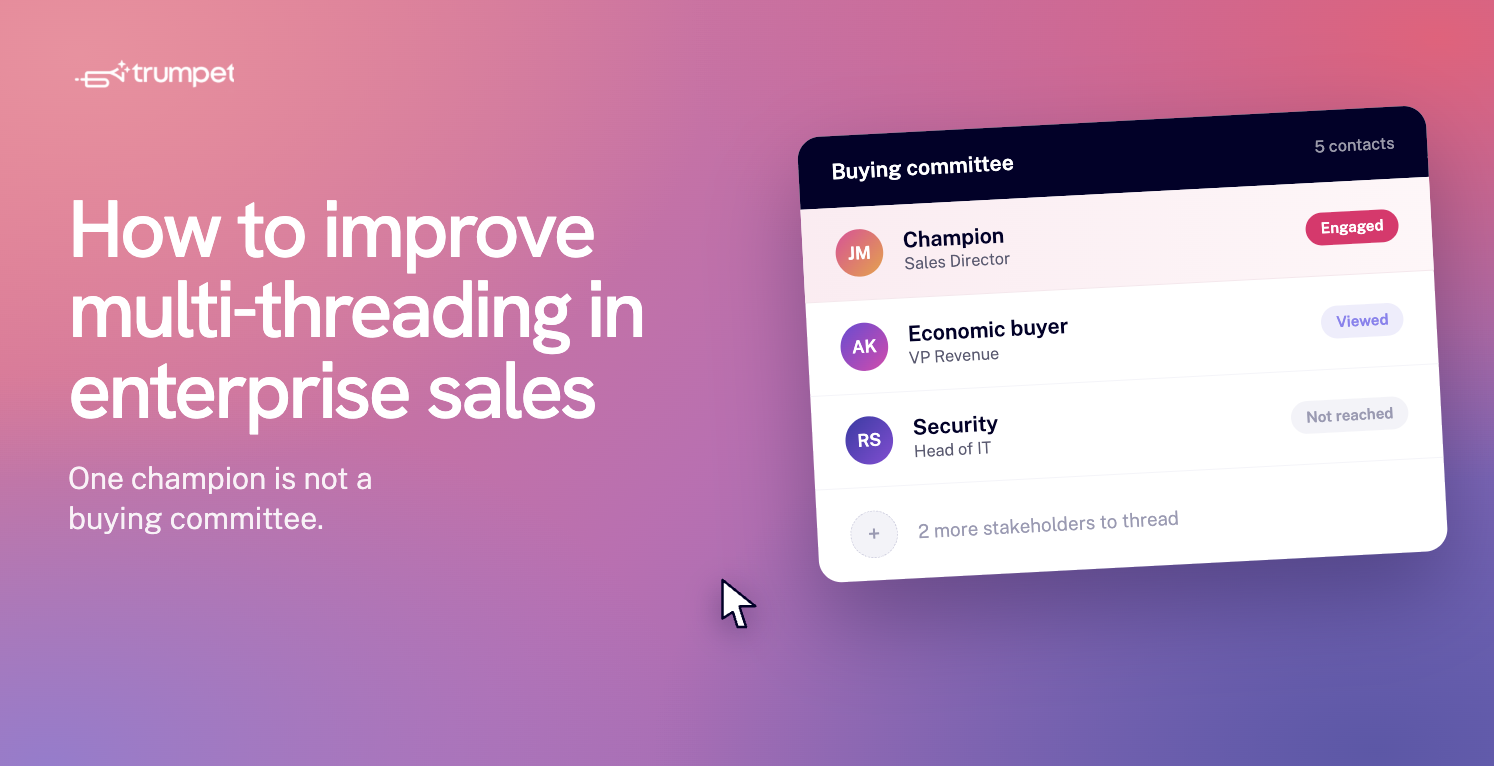





Despite what some people may think, the most dangerous enterprise deals are not always the ones with no activity. They are often the ones with one very engaged champion and no clear evidence that the wider buying committee is involved. A champion can be enthusiastic, attend every meeting and still fail to get a deal approved if finance has not seen the business case, procurement does not know the timeline and security is being introduced for the first time in the final week.
In complex B2B sales, one person rarely owns the whole decision. Finance, procurement, security, IT, legal, executives, end users and implementation teams can all influence whether a deal progresses. Improving multi-threading means mapping the buying committee, identifying missing stakeholders, engaging each role with relevant information and giving the group a shared place to collaborate on next steps.
Revenue teams can improve multi-threading in enterprise sales by mapping the full buying committee, identifying missing roles, engaging stakeholders with role-specific content, supporting the internal champion, tracking buyer engagement, using Mutual Action Plans and creating a shared workspace where every stakeholder can access the right information and next steps. Platforms such as trumpet help teams operationalise multi-threading by combining buyer-facing Pods, stakeholder engagement analytics, Stakeholder Scout, CRM connectivity, Mutual Action Plans and sales-to-customer-success continuity.
Multi-threading is not just adding more contacts to the CRM. It is a deliberate sales collaboration strategy for building consensus across the people who influence, approve, use, secure, procure and implement a purchase.
What is multi-threading in enterprise sales?
Multi-threading in enterprise sales is the practice of building relationships with multiple stakeholders across a target account rather than relying on a single champion or contact. It involves identifying all key buying roles, understanding each stakeholder's priorities and concerns, engaging them appropriately, supporting the champion in their internal selling, and creating the conditions for a coordinated buying decision.
Good multi-threading is targeted, respectful and role-specific. It helps the buying committee make progress without making the sales process feel chaotic or intrusive. It is not about spamming everyone in the account, adding random contacts to a sequence, bypassing the champion aggressively or overloading stakeholders with irrelevant content. Every outreach should have a clear reason and a clear benefit for the person receiving it.
The distinction between a multi-threaded deal and a single-threaded one is often visible in how the buying process unfolds. In a multi-threaded deal, security has already reviewed documentation by the time procurement starts, finance has been involved in the business case before the proposal is submitted, and the implementation team is engaged before the contract is signed. In a single-threaded deal, each of these groups arrives as a surprise.
Why single-threaded enterprise deals are risky
A single-threaded deal depends too heavily on one person to carry the entire internal buying process. The commercial risk this creates is significant and underappreciated by many revenue teams.
If the champion leaves the company, loses influence, is moved to a different role, or is unable to secure internal support, the deal loses its primary advocate. But even in deals where the champion stays fully engaged, single-threading creates risk at every stage: procurement can introduce a new process late; security can identify concerns that were never surfaced in earlier conversations; finance can challenge the business case on grounds the seller was not aware of; legal can introduce delays that extend the timeline by months; and executive sponsors can decline to provide the sign-off that the champion believed was coming.
A responsive champion is not the same as a fully engaged buying committee. One person attending every meeting and replying to every email is useful, but it is not the same as the economic buyer having engaged with the ROI case, security having reviewed the compliance documentation, or procurement having been briefed on the commercial structure.
Enterprise deals are rarely lost because one person was unconvinced, but are likely lost because the wider buying committee was never properly engaged.
Trumpet's buyer engagement data shows that deals with ten or more stakeholders actively engaged in a shared workspace correlate with stronger close outcomes than deals managed through a single point of contact. These are correlational findings and outcomes vary by process, segment and the quality of stakeholder engagement. But the pattern is consistent: broader buying committee involvement, when managed well, tends to reduce late-stage surprises and improve conversion predictability.
Buyer engagement signals in trumpet can show whether a deal is genuinely multi-threaded: has the Pod been shared internally? Are multiple stakeholders visiting the workspace? Have senior buyers engaged with the executive summary? Has finance reviewed pricing? Has security opened the compliance pack? Is the Mutual Action Plan progressing with buyer-owned steps being completed? These signals tell the seller something that CRM data cannot: not what the seller knows, but what the buyer is doing.
Understand the enterprise buying committee
Enterprise sales teams should map buying roles rather than names. The person whose name is in the CRM may be the champion, but the deal also involves people who have never been in a meeting and may never speak to the seller directly.
Champion
The person who believes in the solution and wants to drive it internally. The champion is the seller's primary relationship and the internal advocate who makes the case to colleagues, coordinates the evaluation and navigates internal politics. A strong champion is necessary but rarely sufficient on their own.
Economic buyer
The person with budget authority or final commercial accountability. The economic buyer may not be in the day-to-day conversation but typically needs to approve any significant spend. Deals that progress without the economic buyer engaged are at risk of stalling when that person's approval is needed.
Executive sponsor
A senior leader whose strategic support can unlock momentum. Executive sponsors matter in deals where the purchase requires cross-functional commitment, significant investment or organisational change. They are often not in evaluation meetings but can remove blockers that the champion cannot.
Technical evaluator
The person assessing feasibility, integration, security or implementation effort. Technical evaluators often have strong veto influence even if they are not final decision-makers. A technical concern that goes unanswered can block a deal that was otherwise commercially agreed.
Finance, procurement and legal
The functions that evaluate cost, manage vendor approval and review contract terms. These roles are often introduced late in deals that are managed through a single champion. Engaging them earlier - even informally - reduces the risk of late-stage delays and surprises.
End users
The people who will use or be affected by the product. End user buy-in is particularly important in deals where adoption is critical to realising value, because an executive who signs a contract against the preferences of the people who will use the product creates implementation and renewal risk.
Implementation owner
The person responsible for rollout and operational success after purchase. Engaging the implementation owner before signature helps buyers understand what commitment will be needed post-sale, reduces implementation anxiety, and improves the quality of the onboarding plan.
Map stakeholders before trying to multi-thread
Stakeholder mapping is the foundation of a multi-threading strategy. Before reaching out to anyone beyond the champion, sellers should build a clear picture of who is involved, what they care about, how engaged they currently are and what they need to move forward.
A useful stakeholder map covers the stakeholder name, role, department, buying function, level of engagement, relationship strength, known priorities and concerns, content they have viewed, and the next action required for each person. This does not need to be a complex spreadsheet. It needs to be something a seller can use in a deal review to explain what the buying committee looks like and where the gaps are.
Sellers should update this map as new stakeholders appear and engagement patterns change. Trumpet helps teams go beyond static spreadsheet maps through real buyer activity, CRM context and living buying-group views that show which stakeholders are actually engaging at any point in the evaluation. Stakeholder Scout uses AI to identify which persona types are active in the Pod, which buying roles appear to be missing, and where the buying group may have gaps that create deal risk.
Identify missing stakeholders early
One of the most useful multi-threading habits is asking: who is not in the conversation yet? After a discovery call or a product demonstration, sellers should take stock of which roles have been involved and which are still outside the process.
Common missing roles include the economic buyer, finance, procurement, security, legal, IT, an executive sponsor, the implementation owner and the end users who will actually use the product. These roles may not attend early meetings, but each of them can significantly influence whether the deal progresses.
Discovery questions that surface missing stakeholders include: who else will be involved in the decision; who signs off budget; who normally reviews security or procurement; who will own implementation; who has blocked similar projects before; who needs to be comfortable before this can move forward; and what happens internally after this meeting. The answers give the seller a clearer picture of the internal buying process and which relationships need to be built.
Do not wait until procurement or security appears unexpectedly. Bring them into the plan early, even if only through documentation and a clear MAP milestone. A procurement step that appears on the MAP at the start of the evaluation is far less disruptive than the same step arriving as an unexpected request in week ten.
Trumpet can help surface missing stakeholders by showing which persona types are engaging in the Pod and where the buying group may be incomplete. If a deal has been in evaluation for six weeks and only one stakeholder has entered the workspace, that is a signal worth examining before it becomes a late-stage problem.
Build a champion enablement plan
Champions are essential to enterprise deals but they need support to do their job effectively. The champion typically needs to explain to colleagues: why this problem is a priority now; why this vendor is the right choice; why the investment is justified; and why implementation will succeed. For each of these questions, the seller should provide clear materials rather than relying on the champion to reconstruct the case from memory.
A strong champion enablement pack should include an executive summary for leadership, a business case and ROI narrative, customer proof from similar organisations, a security overview, an implementation plan, a Mutual Action Plan and clear answers to the most common objections the champion is likely to face internally. The method of delivery matters as much as the content: create a clear path by role rather than sending a collection of attachments and expecting the champion to organise them.
Trumpet Pods act as a champion enablement hub. Rather than forwarding scattered email attachments, the champion shares one branded workspace that gives each stakeholder access to the materials relevant to their role. Internal sharing visibility - seeing exactly when the champion shares the Pod internally and which new contacts enter the workspace as a result - is one of the most valuable signals in a multi-threaded deal. It gives sellers a window into internal advocacy without requiring the champion to report back.
Personalise content by stakeholder role
Multi-threading fails when every stakeholder receives the same generic deck. Different buying roles have fundamentally different concerns, different questions and different criteria for making a decision. Content that is highly relevant to a technical evaluator is often entirely unpersuasive for a finance stakeholder reviewing ROI.
Creating role-specific content does not require a separate presentation for every person in the buying committee. It requires organising existing content - security documentation, ROI calculators, product walkthroughs, business case frameworks - into clearly labelled sections of the buyer workspace that each stakeholder can access quickly without the champion needing to brief them from scratch.
Trumpet helps reps organise and deliver role-specific content inside a shared Pod, rather than treating follow-up as a single undifferentiated email attachment. Each stakeholder accesses the section relevant to their role. The seller sees what they engaged with and what they skipped.
Use a shared workspace for sales collaboration
Enterprise sales collaboration becomes genuinely difficult when information is spread across email threads, call recordings, separate proposal links, shared drives, Slack messages, CRM notes and calendar invites. Each stakeholder in the buying committee has a different picture of the deal, and keeping those pictures consistent requires manual effort from the champion and continuous re-sending of materials from the seller.
A shared buyer workspace centralises content, stakeholders, meeting notes, the business case, the Mutual Action Plan, the proposal, security documentation, procurement materials and the onboarding plan. Every stakeholder can access current information from one place rather than relying on email thread archaeology.
A Digital Sales Room gives the buying committee one place to evaluate, share and progress the decision.
A shared workspace improves multi-threading because it supports the internal champion rather than creating more work for them, makes it easier for new stakeholders to catch up without a briefing call, gives managers visibility into whether the buying committee is genuinely engaged, reduces the inconsistency that comes from different stakeholders working from different versions of the same information, and creates a structure that can continue into onboarding after the deal closes.
Trumpet Pods act as the shared buyer-facing workspace for multi-stakeholder enterprise deals. A Pod can contain content organised by role, a Mutual Action Plan with visible milestones and owners, proposals, security reviews, onboarding resources and the engagement signals that help sellers and managers understand what the buying committee is actually doing between meetings.
Create a Mutual Action Plan with buyer ownership
A strong multi-threading strategy needs visible structure. A Mutual Action Plan gives the buying committee and the selling team one shared view of what needs to happen, who owns each step and when it is due. Without a MAP, each stakeholder in a complex deal may have a different understanding of where the evaluation stands and what is required of them.
A post-discovery MAP for an enterprise deal should include: business case agreement; technical validation; security review; procurement review; commercial approval; legal review; signature; and onboarding kickoff. Both seller-owned and buyer-owned milestones should be included. A MAP that only lists what the seller plans to do is a close plan, not a shared commitment. The most useful MAPs include tasks owned by finance, security, procurement, and the implementation team - giving each stakeholder a visible role in the process.
MAPs improve multi-threading specifically because they make the buying process legible to everyone involved. When the MAP shows that security review starts in week four, security knows to expect it. When finance can see that commercial approval is a milestone with a date, the budget timeline becomes a shared responsibility rather than an invisible seller deadline. When a MAP step goes three weeks without progress, that is visible to both sides and creates a natural opening for a conversation.
According to trumpet platform data, deals with an active Mutual Action Plan correlate with double the win rate of deals managed without one. These are correlational findings and outcomes vary by sales process, segment and buyer participation. In trumpet, Mutual Action Plans sit inside the buyer-facing Pod alongside the content and stakeholders relevant to each milestone, so next steps are always connected to the resources needed to complete them.
Use buyer engagement signals to prioritise action
Multi-threading becomes more effective when sellers can see buyer behaviour rather than relying on what the champion reports. Buyer engagement signals tell the seller which stakeholders are active, which content is being reviewed, where the buying committee has gaps and where momentum is building or fading.
Signals worth tracking
Useful multi-threading signals include: whether a new stakeholder has entered the shared workspace; whether an executive has viewed the business case; whether finance has reviewed pricing or security has opened compliance materials; whether MAP steps are being completed by buyer-owned contacts; whether internal sharing has expanded to new departments; and whether overall engagement across the buying committee is increasing or fading before a scheduled close date.
How to act on signals
When finance views pricing without a commercial conversation scheduled, that is an opening to share the ROI summary and initiate a budget discussion. When security opens the compliance pack, offering a dedicated security call with a technical lead removes a common bottleneck before it becomes a delay. When a senior executive views the executive summary, the champion may need messaging specifically for leadership rather than the standard evaluation materials. When no new stakeholders have engaged in two weeks, asking the champion directly what internal progress has been made is more productive than waiting for the next scheduled meeting.
An important caution
Buyer engagement signals inform judgement but do not replace it. A stakeholder who views the security documentation three times may be thorough or may have concerns. A stakeholder who has not visited the workspace may have been unavailable. Signals should direct attention and start conversations, not trigger automated responses or drive conclusions about deal health without additional context.
Trumpet provides stakeholder-level engagement analytics, internal sharing visibility, Stakeholder Scout, AI-powered insights and Nerve Centre reporting. Trumpet AI-powered insights translate buyer signals into prioritised recommendations, helping sellers and managers identify which accounts need attention and which actions are most likely to advance a deal, rather than leaving them to interpret data points manually. The Nerve Centre gives managers a portfolio view of buyer activity across all active Pods - showing which deals have active buying committees, which are going quiet, and which have missing stakeholders that create risk before they surface in a pipeline review.
Coach reps on multi-threading behaviour
Multi-threading should be a managed sales behaviour, not an individual preference. Whether reps multi-thread effectively should be inspected by managers in the same way that qualification and pipeline hygiene are inspected.
When reviewing a deal, managers should ask: which buying roles are mapped; which are currently active; which are missing; who owns the business case; who controls budget; who signs procurement; who is responsible for implementation; has the economic buyer been engaged; has the champion shared the workspace; what content has each stakeholder viewed; and what is the next step for each buying role. These questions produce a realistic picture of deal health that CRM stage and close date alone cannot provide.
Multi-threading checkpoints should be built into the sales process at discovery, qualification, deal review, forecast calls, proposal stage, procurement stage and handoff to customer success. At each stage, the question should not only be "what has the seller done?" but "what has the buyer actually engaged with?"
Common rep behaviours that indicate insufficient multi-threading: all contacts in the CRM are from one department; the Pod has only been visited by one stakeholder; the MAP has no buyer-owned tasks; the economic buyer has not been identified after four weeks; security and procurement have never been mentioned. Each of these is a coaching signal rather than a qualification reason to close the deal.
Trumpet's Nerve Centre gives managers the portfolio visibility to inspect multi-threading behaviour across the full pipeline without deal-by-deal reviews for every rep. When engagement data shows a deal that is CRM-progressing but Pod-stagnant, that is a coaching conversation worth having.
Connect multi-threading to CRM hygiene
The CRM should remain the system of record for accounts and contacts. Multi-threading should improve the quality of that record rather than replace it. Every new stakeholder identified through the buying process should be added to the CRM with their role, department, buying function and relationship to the deal.
There is an important distinction between who the seller knows and who is actually active. CRM records who the seller has spoken to, emailed or met. Buyer engagement data from trumpet shows who is visiting the workspace, reviewing content and sharing materials internally. A stakeholder can be active in the buying process without ever having spoken to the seller - and a stakeholder who is in the CRM may not have engaged at all. Both data sources together give a more complete picture of the buying committee than either one alone.
Recommended CRM fields for multi-threading hygiene include: buying role; influence level; engagement level; champion status; department; decision authority; procurement involvement; security involvement; implementation ownership; last engagement date; and next action. Teams that consistently capture this information find that pipeline reviews become more substantive and forecast accuracy improves, because the conversation is based on observable buying-committee activity rather than seller confidence.
Continue multi-threading after the deal closes
Multi-threading does not end at signature. Enterprise account management requires multiple relationships for the same structural reasons that enterprise selling does: value delivery, renewal and expansion all involve people who were not necessarily in the original buying process.
After signature, the account typically involves a customer success manager, an implementation lead, an executive sponsor, product administrators, end users, finance for billing and renewal, procurement for the renewal process, and the expansion stakeholders who may be involved in additional use cases. Each of these people needs a relationship, appropriate information and a clear view of what success looks like.
If the customer success team inherits only a contract and CRM summary, they may miss the original business outcomes the champion committed to, the political context that shaped the evaluation, the implementation concerns that were raised and addressed, the success criteria the economic buyer was using, and the stakeholder relationships that the seller built during the sale. This information gap often creates a worse customer experience than necessary in the first 90 days and creates churn risk at renewal.
Trumpet Pods continue from the sales process into onboarding, account management, renewal and expansion. When the deal closes, the CS team inherits the full shared workspace - with the stakeholder history, content engagement record, agreed outcomes and Mutual Action Plan already in progress. The buyer continues in the same workspace they used throughout the evaluation. The transition from sale to service becomes a continuation rather than a reset.
Multi-threading checklist
Before discovery
Identify likely buying roles based on account size and industry. Research account structure and known contacts. Review the CRM for any existing relationships. Prepare role-specific discovery questions for each buying function.
During discovery
Ask who else is involved in the decision. Understand the internal decision process and timeline. Identify who owns budget approval. Map technical, security and procurement requirements. Confirm who will own implementation.
After discovery
Build a stakeholder map with roles, priorities and engagement levels. Create a buyer workspace with role-specific content sections. Add a Mutual Action Plan with both seller-owned and buyer-owned milestones. Equip the champion with an internal enablement pack.
During evaluation
Track stakeholder engagement signals at least twice per week. Note new stakeholders entering the workspace and identify their roles. Update the MAP as milestones are completed or change. Add stakeholder-specific content as new roles appear. Ensure economic buyer, finance, security and procurement are on the MAP before they become surprises.
During proposal and procurement
Confirm who owns commercial approval. Share pricing and ROI materials with finance. Support legal and security with relevant documentation and a dedicated call if needed. Keep next steps visible for all buying roles. Track proposal engagement across multiple stakeholders, not just the champion.
After signature
Transfer full stakeholder context to the customer success team rather than a CRM summary. Continue the MAP into onboarding milestones. Keep executive and operational contacts engaged in the onboarding workspace. Confirm the implementation owner and CS counterpart are connected before the seller steps back.
Common multi-threading mistakes
Waiting too long to involve other stakeholders
Late-stage procurement and security surprises are almost always the result of not mapping and engaging those functions earlier. Bringing them into the plan at the start - even just as named milestones on the MAP - dramatically reduces the risk of unexpected delays.
Confusing a champion with a decision-maker
A champion may believe in the product and want to move forward while still lacking the authority to approve budget, override procurement or secure executive sign-off. Understanding the distinction between influence and authority is one of the most important multi-threading skills.
Asking for introductions without providing value
Champions are more willing to make introductions when the seller provides a clear reason and relevant content for each one. "I would like to connect with your security team" is weaker than "here is the security documentation I would like to walk through with them - are you comfortable connecting us?"
Treating every stakeholder the same
Sending the same deck to finance, security, end users and the executive sponsor does not constitute multi-threading. Each role needs different content, a different conversation and different success criteria.
Overloading the buyer
Multi-threading should make the buying process clearer, not noisier. One well-structured workspace with role-specific sections is more effective than separate emails to separate people with separate attachments.
Ignoring post-sale stakeholders
Implementation, customer success and renewal stakeholders influence whether the customer achieves the value that justified the purchase. Involving them in the pre-sale workspace - or at least transferring the full context of the sale - is part of a complete multi-threading strategy.
Not inspecting multi-threading in forecast reviews
If managers do not ask about stakeholder coverage in deal reviews, sellers have no incentive to maintain it. Single-threaded deals stay single-threaded when the only question in a pipeline call is "what is the close date?"
Final verdict
Revenue teams improve multi-threading in enterprise sales by mapping the full buying committee, identifying missing stakeholders early, supporting the champion with role-specific materials, personalising content for each buying role, using a shared buyer workspace, managing a Mutual Action Plan with visible buyer ownership, acting on stakeholder engagement signals and carrying that stakeholder context through to customer success.
Trumpet helps operationalise this process by combining buyer-facing Pods, stakeholder engagement analytics, Stakeholder Scout, Mutual Action Plans, CRM connectivity and sales-to-customer-success continuity. Rather than managing a complex multi-stakeholder deal across emails, spreadsheets and CRM notes, revenue teams have one buyer-facing workspace per opportunity where stakeholder activity is visible, next steps are shared and context transfers automatically when the deal closes.
The aim is not to involve more people for the sake of it. The aim is to help the right people understand the value, manage their part of the decision and move forward together.
Frequently asked questions
What is multi-threading in enterprise sales?
Multi-threading is the practice of building relationships with multiple stakeholders across an account rather than relying on one contact or champion. It involves identifying all key buying roles, engaging each stakeholder appropriately, supporting the champion internally and creating shared next steps across the buying committee.
Why is multi-threading important in enterprise sales?
Enterprise deals involve multiple decision-makers, influencers and approvers. Multi-threading reduces single-contact risk and helps sellers build consensus across the buying committee. Deals managed through a single champion are vulnerable to late-stage delays from procurement, security, legal or finance who were never properly engaged.
How do you improve multi-threading?
Map the buying committee and identify missing roles. Personalise content by stakeholder. Support the champion with an internal enablement pack. Use Mutual Action Plans to make the buying process visible. Track engagement across the account and act on signals from stakeholders entering the workspace or reviewing specific materials.
What is a single-threaded deal?
A single-threaded deal is an opportunity where the seller depends heavily on one contact and has limited visibility or relationships across the wider buying committee. The seller may have a responsive champion while finance, security, procurement and the economic buyer are entirely disengaged.
Which stakeholders should sellers multi-thread into?
Common stakeholders in enterprise buying committees include the champion, economic buyer, executive sponsor, technical evaluator, end users, finance, procurement, legal, security and the implementation owner. Different organisations combine these roles differently, but understanding each function and who holds it is the foundation of a multi-threading strategy.
How can sales teams support an internal champion?
Give the champion a clear business case, executive summary, role-specific content for each stakeholder they need to brief, ROI evidence, a security overview, answers to common objections and a shared workspace they can circulate internally without needing to forward a collection of email attachments.
How do Digital Sales Rooms help with multi-threading?
Digital Sales Rooms give the buying committee one shared place to access content, review next steps, collaborate on Mutual Action Plans and engage with materials relevant to their role. They reduce the reliance on the champion to brief each stakeholder individually and give sellers visibility into which roles are actually engaging.
How does trumpet help with multi-threading?
Trumpet helps teams multi-thread by providing buyer-facing Pods with role-specific content sections, stakeholder engagement analytics, Stakeholder Scout for identifying active and missing personas, Mutual Action Plans, internal sharing visibility, CRM connectivity and sales-to-CS continuity that preserves stakeholder context after the deal closes.
Is multi-threading only for new business?
No. Multi-threading is equally important in onboarding, enterprise account management, renewals and expansion. Customer value depends on multiple relationships across the account, and customer success teams that inherit only a contract and CRM summary are at a disadvantage compared with teams that inherit the full stakeholder history and shared workspace from the sale.
How should managers inspect multi-threading?
Managers should review stakeholder coverage, missing buying roles, engagement activity in the shared workspace, Mutual Action Plan progress, champion strength, economic buyer access and procurement or security involvement at each deal review. Trumpet's Nerve Centre provides a portfolio-level view of this activity across all active Pods without deal-by-deal inspection.








![How to Get Started with Buyer Enablement [With Examples]](https://cdn.prod.website-files.com/65cf4fecbed2754c2236665d/65cf4fecbed2754c22366bdb_65a5af83e742f76e34ce06f3_Customer%2520Onboarding%2520_%2520Everything%2520you%2520need%2520(2).png)
.png)


.png)


.png)


.png)

.png)

.png)
.png)





