


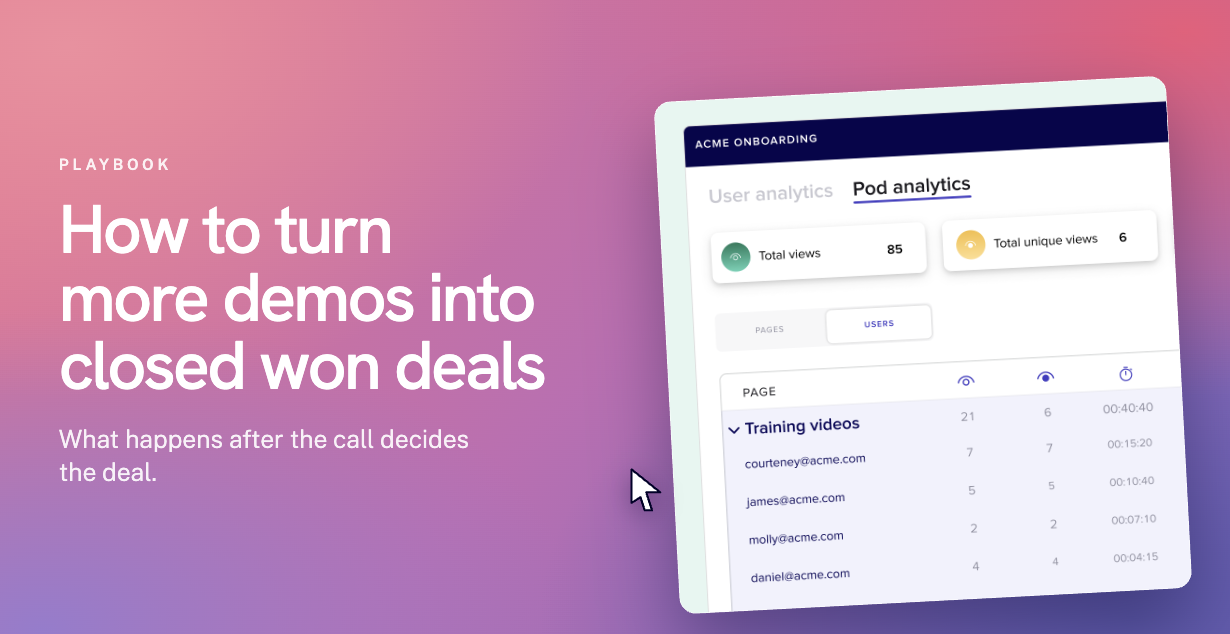





A great demo does not automatically create a closed-won deal. In B2B SaaS, the real decision often happens after the call, when the champion has to explain the value internally, involve new stakeholders, answer objections and keep momentum alive without the seller in the room.
Most demo conversion problems are not demo problems. They are post-demo problems: vague follow-up, missing stakeholders, unclear next steps, late-arriving procurement, and a champion who wants to move forward but cannot get internal buy-in. Improving demo-to-close performance means building a better post-demo buying journey, not just a better demo.
B2B SaaS teams can turn more demos into closed-won deals by improving pre-demo qualification, tying the demo to the buyer's business priorities, sending role-specific follow-up, creating a shared Digital Sales Room, using a Mutual Action Plan, tracking buyer engagement signals and supporting the champion as they sell internally. Platforms such as trumpet help operationalise this process by giving every deal a personalised buyer-facing Pod with relevant content, stakeholder engagement analytics, shared next steps, proposals, CRM connectivity and sales-to-customer-success continuity.
The ten steps below cover the full process from qualification through to onboarding, with practical guidance at each stage.
Why demos fail to turn into closed-won deals
The gap between a completed demo and a closed-won deal is where most revenue is lost in B2B SaaS. Sellers and buyers often leave a demo with different levels of enthusiasm and entirely different expectations of what happens next.
Many demo conversion problems look like closing problems, but they are usually coordination problems. The buyer is interested, but the internal decision process is more complicated than the seller realised. New stakeholders appear. Budget needs sign-off. Security has questions. Procurement has a process. The champion cannot create a clear internal case because they do not have the right materials. The seller sends a single follow-up email and waits.
Common reasons deals stall after a demo include: the demo was not tied to a clear business problem; the economic buyer was not present; the champion lacks the materials to sell internally; security and procurement appear late with no preparation; the business case is too weak to justify budget approval; there is no shared plan with agreed next steps; and the seller has no visibility into whether the buyer is still engaged between meetings.
Trumpet's buyer engagement data shows that deals with an active Mutual Action Plan correlate with double the win rate of deals managed without one. These are correlational findings and outcomes vary by process, segment and buyer participation. But the direction is consistent: structured post-demo processes produce better outcomes than unstructured ones.
The demo is not the finish line. It is the start of the buyer's internal decision process.
Step 1: Qualify before the demo
A higher demo-to-close rate starts before the demo takes place. Running demos for poor-fit prospects, unqualified accounts or contacts with no route to the economic buyer reduces conversion before the conversation even begins.
Before booking a demo, reps should understand: what problem the buyer is trying to solve; why this is a priority now; who else is involved in the decision; who owns budget; what the buying process involves; what systems need to integrate; what security or procurement steps are required; and what a successful evaluation looks like to them.
Not every booked demo should become a live sales opportunity. Better qualification often improves demo-to-close conversion by removing weak-fit accounts earlier, rather than by running more demos and hoping the numbers improve. Sales managers should inspect not only demo volume, but also demo qualification rate and the percentage of completed demos that progress to a qualified next step within two weeks.
Step 2: Design the demo around the buyer's priorities
A demo is not a product tour. It is a conversation designed to connect the buyer's current problem, desired outcome and evaluation criteria to specific parts of the product. Sellers who run the same demo for every prospect create interest in the product but not urgency about the purchase.
Before the demo, reps should know the buyer's current problem, the desired business outcome, the likely buying committee, existing tools and technical requirements, and the criteria the buyer will use to evaluate options. During the demo, the seller should recap the problem first, confirm priorities before showing anything, focus on relevant workflows only, connect features to outcomes rather than listing capabilities, and surface objections before they become blockers. At the end of the demo, the seller should confirm next steps specifically - not just "I'll send a follow-up" but a named buyer-owned action with a date.
The most common demo failure is showing everything and confirming nothing. The buyer leaves with a broad impression of the product but no clear picture of how it solves their specific problem. Role-specific personalisation and a clear close question at the end of the call are two of the most consistent improvements available before any process changes are made.
Step 3: Send role-specific follow-up
Generic post-demo follow-up reduces conversion. A single email with a recording link and a "let me know if you have questions" close is not enough for a multi-stakeholder B2B purchase. Different buying roles need different information, and the champion cannot be expected to translate a generic seller email into persuasive internal communication for finance, security, IT and executive leadership simultaneously.
Trumpet Pods make it possible to give each stakeholder access to the information relevant to their role without requiring the champion to forward a collection of attachments. A Pod can include separate sections for the executive summary, the technical overview, the security pack and the pricing documentation, all within one branded workspace that the champion can share with a single link.
Step 4: Create a Digital Sales Room after the demo
A Digital Sales Room gives buyers and sellers one shared place to continue the conversation after the demo ends. Rather than managing the evaluation through a chain of emails, separate document links and call recordings scattered across inboxes, the buying committee has one workspace they can return to throughout the evaluation.
A strong post-demo Digital Sales Room should include: a personalised demo recap; the demo recording or a short follow-up video; relevant product content; customer proof from similar companies; a business case or ROI summary; security documentation; a Mutual Action Plan; the proposal when it is ready; a pricing explanation; an implementation overview; and contact details for each member of the selling team.
Digital Sales Rooms improve demo-to-close performance for several connected reasons. They reduce email clutter and give buyers one clear destination. They support internal champions by providing a polished, shareable resource. They give new stakeholders context without requiring the champion to brief each one from scratch. They make next steps visible to both sides. And they surface buyer engagement signals that help sellers understand whether the deal is moving or stalling between meetings.
A demo can create interest. A Digital Sales Room helps the buying committee organise the decision.
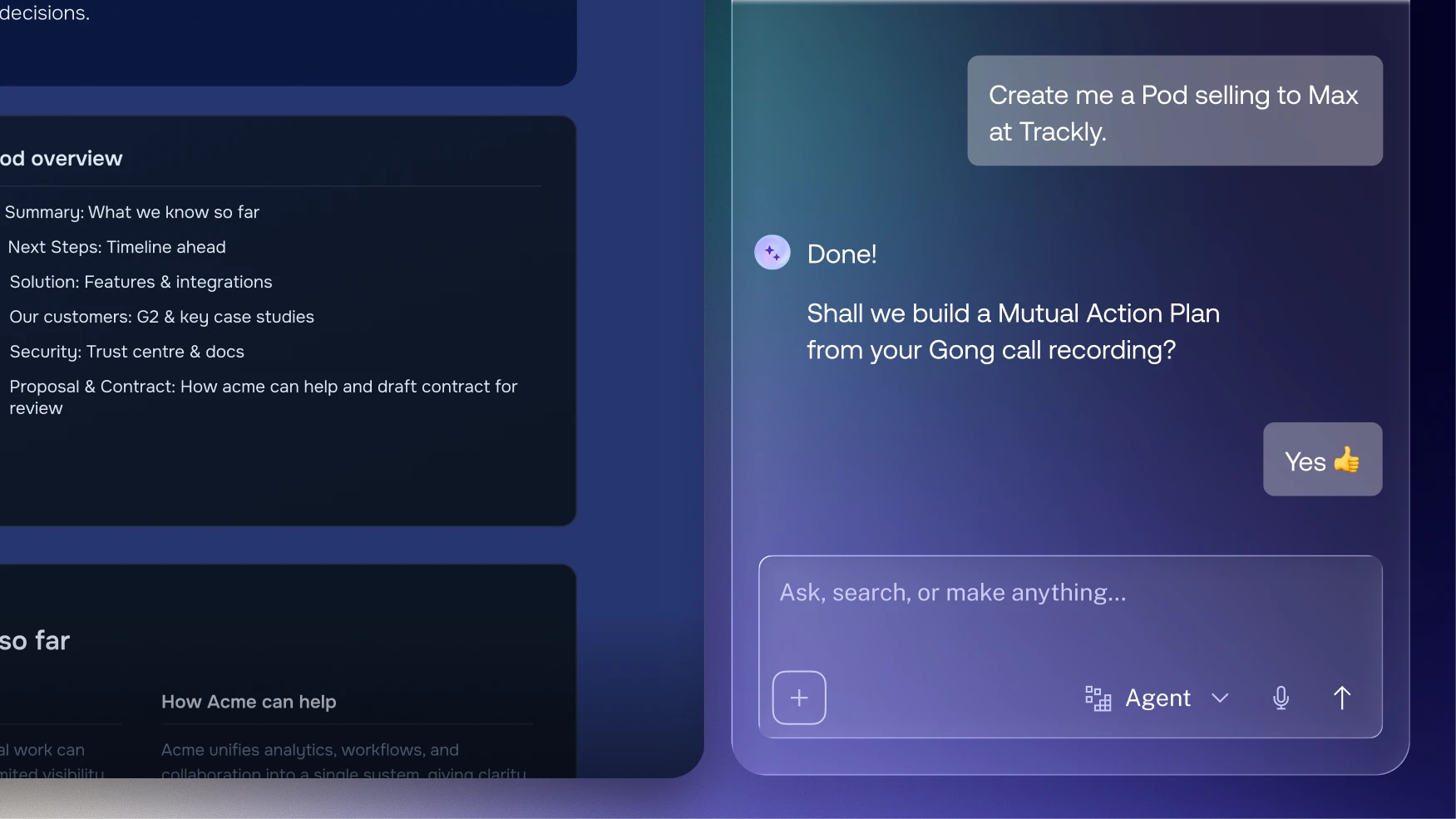
Trumpet Pods are personalised buyer-facing workspaces that combine content, stakeholder engagement, Mutual Action Plans, proposals, e-signatures, buyer signals and onboarding resources in one place. Reps can create a Pod from a template in minutes after a call, or use AI-assisted creation to generate an initial workspace from a company URL and CRM data before personalising for the specific opportunity.
Step 5: Build a Mutual Action Plan
A Mutual Action Plan turns vague next steps into a shared buying process. Without one, the seller may believe the deal is progressing while the buyer is still waiting for internal sign-off on whether to proceed with an evaluation at all. A MAP makes the gap between "interested" and "signed" visible to both sides.
A post-demo MAP should include: key milestones with owners and dates; the buyer's internal stakeholder review; technical validation; security review; procurement approval; legal review; commercial discussion; proposal review; signature; and onboarding kickoff. Both seller-owned and buyer-owned tasks should be included. A MAP that only lists what the seller needs to do is a project plan, not a shared commitment.
MAPs improve demo-to-close rate by clarifying the buying process, exposing missing stakeholders early, coordinating buyer and seller expectations, and making deal slippage visible rather than invisible. When a MAP step goes three weeks without progress, that is a signal worth acting on before the next scheduled meeting. When the buyer is completing steps ahead of schedule, that signals genuine momentum worth reinforcing.
In trumpet, Mutual Action Plans sit inside the buyer-facing Pod alongside the content, stakeholders and proposals relevant to completing each step. When the deal closes, the MAP transitions into onboarding milestones automatically, meaning the customer success team inherits a ready-made implementation structure rather than starting from scratch.
Step 6: Track buyer engagement signals
Buyer engagement signals help sellers understand what is happening between meetings - and what is not. A deal that looks healthy in the CRM but shows no buyer engagement in the post-demo workspace is worth examining more carefully before it is included in a committed forecast.
Signals worth tracking
Useful signals include: whether the buyer has revisited the Digital Sales Room; whether the demo recording has been viewed; whether the Pod has been shared internally with new contacts; whether a senior stakeholder has reviewed the executive summary; whether finance has viewed pricing; whether security has opened the security documentation; whether the proposal has been opened more than once; and whether MAP steps are being completed.
How to act on signals
If a new stakeholder appears in the workspace, it is worth understanding their role and asking the champion whether they should be involved directly. If finance views pricing without a commercial conversation scheduled, that is an opening to share ROI information and confirm the budget process. If security opens the documentation pack, offering a dedicated security call with a technical stakeholder removes a common late-stage delay. If the room has not been revisited for two weeks, a concise value recap and a reconfirmation of next steps is often more effective than chasing for a meeting.
An important caution
Buyer engagement signals support seller judgement but do not replace it. A buyer who opens the proposal repeatedly may be building a business case or may be comparing alternatives. A buyer who has not revisited the workspace may have been on holiday. Signals should inform conversation topics and prioritisation decisions, not drive automated responses or replace human judgement about deal health.
Trumpet provides stakeholder-level engagement analytics, internal sharing visibility and Nerve Centre reporting across all active Pods. The Nerve Centre gives sales managers and RevOps teams a portfolio view of buyer activity without requiring deal-by-deal inspection, making it easier to identify which deals need attention before the pipeline review.
Step 7: Multi-thread before procurement appears
Enterprise and mid-market SaaS deals often stall because sellers wait too long to engage the wider buying committee. A deal that is progressing well with the champion can stall entirely when procurement, security or legal appears in the final stages with questions that were never anticipated and a process that has its own timeline.
After a demo, sellers should ask the champion: who else needs to review this; who owns budget approval; who will review security; who signs off procurement; who will lead implementation; and what information would help you share this internally. The answers to these questions determine whether the deal has a realistic path to close or whether important stakeholders are still outside the process.
Multi-threading works best when the seller provides a clear reason for each stakeholder's involvement and gives the champion materials to brief them, rather than bypassing the champion to contact stakeholders directly. The Digital Sales Room is the shared resource that makes this practical: the champion shares the Pod with each new stakeholder, who arrives in a workspace already organised with the content relevant to their role, rather than a forwarded email chain they need to read backwards.
According to trumpet platform data, deals with ten or more stakeholders actively engaged in the buying process show a strong correlation with successful close outcomes when those stakeholders have access to role-specific content in a shared workspace and there is a visible MAP for the evaluation. These are correlational findings and outcomes vary by process, segment and the quality of stakeholder engagement rather than simply by count.
Trumpet helps reps see whether the buying group is expanding by surfacing internal sharing events and new stakeholder entries in the Pod. Stakeholder Scout uses AI to identify which persona types are active and which buying roles appear to be missing from the evaluation, giving sellers and managers a clearer picture of where the buying committee stands before a late-stage surprise.
Step 8: Improve proposal visibility
Proposal sent does not mean proposal understood. A proposal delivered outside the buyer's decision context - as an isolated PDF link with no surrounding business case or implementation context - is easy to deprioritise, forward without context, or misread.
The most useful proposal engagement signals are: whether the proposal has been opened at all; when it was viewed; whether it was shared internally; which sections received the most attention; whether pricing was revisited multiple times; and whether multiple stakeholders engaged with it. These signals tell the seller far more about deal health than a CRM stage update.
The proposal should not sit outside the buyer journey. It should be connected to the business case, the MAP, the security review and the procurement steps that need to happen alongside it. A buyer who opens a proposal and immediately sees the implementation timeline, the security documentation and the agreed next steps has a much clearer picture of the full commitment they are making than a buyer who receives a standalone commercial document.
Trumpet keeps proposals, documents and e-signatures inside the buyer-facing Pod so commercial activity is visible within the full context of the deal. Proposal engagement signals appear alongside content engagement, MAP progress and stakeholder activity, giving sellers a complete picture of where the opportunity stands rather than separate data points from separate tools.
Step 9: Use sales performance metrics to improve the process
Sales conversion optimisation requires measurement. Without tracking conversion at each stage, it is difficult to identify where deals are stalling, which reps need support, and whether process changes are having any effect.
Core demo-to-close metrics
The most important conversion metrics after a demo are: demo completed to qualified next meeting; demo completed to proposal sent; demo completed to closed won; demo completed to no decision or closed lost; average days from demo to proposal; and average days from demo to close. These should be tracked by rep, by segment and by lead source to identify patterns that a portfolio average would obscure.
Buyer engagement metrics
Alongside pipeline conversion metrics, buyer engagement data adds a leading indicator of deal health. Useful engagement metrics include: Digital Sales Room visit rate; repeat visit rate; number of stakeholders engaged; internal sharing rate; content engagement by asset type; MAP step completion rate; proposal view rate; and engagement by stakeholder role. A deal with strong CRM progression but no buyer engagement in the workspace deserves closer inspection than the stage alone suggests.
Process metrics
Process metrics help managers inspect whether the post-demo playbook is being followed consistently. Useful process metrics include: follow-up sent within 24 hours of demo; Pod created; MAP created and shared; economic buyer identified; security and procurement process mapped; proposal connected to a business case; and CS handoff completed. These are activity metrics, not outcome metrics, but consistent execution of the post-demo process tends to improve outcome metrics over time.
How managers should use these metrics
Metrics are only useful if they change behaviour. The shift that matters most is from inspecting what happened to inspecting what is likely to happen. When reviewing a deal after a demo, managers should ask: was a personalised Pod created within 24 hours? Is there a MAP with buyer-owned tasks? Who from the buying committee has engaged? Has the economic buyer been identified? Is the proposal connected to a business case or sitting as an isolated link? What is the last buyer-owned action and when was it completed? These questions separate deals with genuine momentum from deals that are advancing only because the seller has not yet heard no.
Trumpet's Nerve Centre allows managers to inspect these questions at portfolio level without a deal-by-deal review for every rep. When a rep marks a deal as progressing but the Pod shows no buyer activity in three weeks, that is a question worth asking before the deal appears in a committed forecast. When engagement is strong, the buying committee is expanding and MAP steps are completing ahead of schedule, that is momentum worth reinforcing.
The most actionable metric for improving demo-to-close performance is the percentage of completed demos that result in a buyer-engaged MAP within two weeks. The MAP creates the shared structure that drives a decision rather than leaving the process to informal follow-up. Coaching conversations should link metric patterns to root causes: low demo-to-proposal rate often indicates poor qualification; strong CRM progression with low Pod engagement often means the seller is managing the process internally rather than through shared buyer interaction. Buyer-side data gives managers coaching material that CRM data alone cannot provide.
Step 10: Continue the journey into onboarding
The demo-to-close process should not end at signature. One of the most underappreciated causes of late-stage deal hesitation is not price or competition. It is implementation anxiety: the buyer who wants the product but is not confident the internal rollout will succeed. They have seen technology projects stall before. They know who will own the implementation and who will answer for it if adoption fails. A purchase decision and an implementation risk assessment are happening simultaneously in their head, and the seller often has no idea.
Introducing the onboarding plan before the deal is signed addresses this directly. When a buyer can see the implementation timeline, the required resources, the success criteria, the training plan, the customer success team involved and what the first 30, 60 and 90 days look like, the evaluation shifts from "we would need to figure this out" to "we already know exactly what happens next." That shift is one of the most underused conversion levers available to B2B SaaS sales teams. It does not require new product capabilities - it requires bringing the CS team into the conversation earlier and making the implementation plan visible in the buyer's workspace before the commercial discussion closes.
Showing onboarding before signature also changes the nature of late-stage objections. A buyer who understands the implementation path is more likely to raise concerns during the evaluation rather than after the proposal is signed. Those concerns can be addressed before they become blockers. Budget approval is easier when the full scope of the investment - including implementation resource and timeline - is understood by everyone signing off. Internal approval is smoother when the champion can show colleagues not just what the product does but exactly what happens after the contract is executed.
Trumpet Pods continue from the sales process into onboarding and account management. When the deal closes, the customer success team inherits the Pod - with the full stakeholder history, content engagement record, agreed outcomes and Mutual Action Plan already in progress - rather than a CRM summary and a brief internal handover call. The buyer continues in the same workspace they used throughout the evaluation. The CS team does not start with discovery questions; they start with context.
This continuity has a secondary effect on the close itself. Buyers judge the likely quality of implementation partly on the quality of the sales process they have just been through. A seller who created a structured shared workspace, used a Mutual Action Plan, involved the right stakeholders and handed over cleanly to a customer success team is demonstrating - not just claiming - that the organisation takes delivery seriously. That evidence is more persuasive than references and case studies, because it is observable rather than reported.
Demo-to-closed-won playbook checklist
Common mistakes that reduce demo-to-close rate
Treating the demo as the main event
The demo creates interest. The post-demo process creates a decision. Teams that over-invest in demo performance and under-invest in post-demo execution often find themselves with high demo volumes and flat conversion rates.
Sending generic follow-up
A single email with a recording link does not support a champion who needs to brief procurement, security, finance and an executive sponsor on a multi-stakeholder purchase. Role-specific follow-up is not optional when the buying committee involves more than two people.
Failing to support the champion
The champion needs materials to sell internally. Without a polished, shareable workspace that makes the value case clear for each audience, the champion is left to reconstruct the seller's message from memory and email attachments - which introduces inconsistency and the risk that key information never reaches the right decision-makers.
Waiting too long to multi-thread
By the time procurement or security appears late in a deal, momentum may already be at risk. Identifying and engaging the wider buying committee after the demo - not after the proposal - is one of the most reliable ways to prevent late-stage stalls.
Not creating a Mutual Action Plan
Without shared next steps, the buyer and seller often operate on different assumptions about the timeline and the process. A MAP makes the path to close visible to both sides and gives the seller an early signal when the buyer's pace changes.
Ignoring buyer engagement signals
A deal that looks healthy in the CRM but shows no buyer activity in the post-demo workspace may not be as healthy as the seller believes. Buyer engagement signals are not guarantees of intent, but they are worth checking before a deal is included in a committed forecast.
Measuring only demo volume
More demos do not improve revenue if conversion rates stay flat. The metric that matters is not how many demos were run, but how many progressed to a qualified next step, a proposal, and a closed-won deal. Tracking conversion at each stage between the demo and close is the only way to identify where improvement is genuinely needed.
Final verdict
To turn more demos into closed-won deals, B2B SaaS teams need to treat the demo as the start of the buyer's internal decision process, not the main event. The strongest teams qualify before the demo, personalise the conversation, create a Digital Sales Room, build a Mutual Action Plan, track buyer engagement, bring in the wider buying committee early and continue the workspace into onboarding. These steps are not independent improvements - they are a connected post-demo operating system that makes the buying journey clearer, more structured and easier for both sides to complete.
Trumpet helps teams operationalise this playbook by combining personalised Pods, stakeholder engagement analytics, internal sharing visibility, Mutual Action Plans, proposals, CRM connectivity and sales-to-CS continuity. Rather than managing each deal across email threads, separate tools and CRM notes, reps have one buyer-facing workspace per opportunity that carries the full context of the relationship from first follow-up to onboarding.
Sales conversion optimisation is not about pressuring buyers harder at the end of the process. It is about making the buying journey clearer, more collaborative and easier to complete.
Frequently asked questions
How do you turn more demos into closed-won deals?
Improve qualification before the demo, personalise the conversation to the buyer's priorities, send role-specific follow-up, create a Digital Sales Room with a Mutual Action Plan, track buyer engagement signals, multi-thread across the buying committee early, and support the champion through the internal buying process.
What is demo-to-close rate?
Demo-to-close rate measures the percentage of completed sales demos that become closed-won deals. It is one of the most useful conversion metrics in B2B SaaS because it captures the effectiveness of the entire post-demo process, not just the demo itself.
How can SaaS teams improve demo-to-close rate?
SaaS teams can improve demo-to-close rate by qualifying better before the demo, involving the right stakeholders, creating role-specific post-demo follow-up, using Mutual Action Plans to clarify next steps, and tracking buyer engagement signals to identify where deals are stalling between meetings.
Why do deals stall after demos?
Deals most commonly stall because the wider buying committee is not yet engaged, the champion lacks internal support, next steps are unclear to both sides, procurement or security enters late with their own process, or the business case is not strong enough to justify budget approval. These are coordination failures more often than closing failures.
How do Digital Sales Rooms help after demos?
Digital Sales Rooms give buyers and sellers one shared place for demo recaps, stakeholder-specific content, Mutual Action Plans, proposals, security resources and onboarding plans. They reduce email fragmentation, support internal champions, surface new stakeholders as they engage, and give sellers visibility into what the buying committee is reviewing between meetings.
How does trumpet help teams close more deals after demos?
Trumpet helps by giving each deal a personalised buyer-facing Pod with relevant content, stakeholder engagement analytics, internal sharing visibility, Mutual Action Plans, proposals, CRM connectivity and sales-to-CS continuity. Reps can create a personalised post-demo workspace in minutes and see whether buyers are engaging with it before the next scheduled call.
What is a Mutual Action Plan?
A Mutual Action Plan is a shared plan that outlines the milestones, owners, dates and dependencies required to complete a purchase and begin implementation. Unlike a seller's close plan, a MAP includes buyer-owned tasks alongside seller-owned ones, creating shared accountability for the process rather than a vendor checklist.
What buyer engagement signals should sales teams track?
Useful signals include Digital Sales Room visits, repeat engagement, internal sharing events, new stakeholder entries, content engagement by asset type, Mutual Action Plan step completion, proposal views, and engagement trends by stakeholder role. Signals should support seller judgement and prioritisation decisions rather than replace them.








![How to Get Started with Buyer Enablement [With Examples]](https://cdn.prod.website-files.com/65cf4fecbed2754c2236665d/65cf4fecbed2754c22366bdb_65a5af83e742f76e34ce06f3_Customer%2520Onboarding%2520_%2520Everything%2520you%2520need%2520(2).png)
.png)


.png)


.png)


.png)

.png)

.png)
.png)





