

Account-based selling focuses on organisations rather than individual leads, and should extend personalisation throughout the entire buying journey.
Digital Sales Rooms give each target account one personalised workspace for content, stakeholders, next steps, Mutual Action Plans, and buyer collaboration.
Every stakeholder should be able to access relevant resources from one shared workspace without requiring the champion to brief them separately.
Mutual Action Plans help buyers and sellers coordinate complex purchasing decisions together. According to trumpet platform data, deals with an active MAP achieve double the win rate of those without one.
Buyer engagement should be measured across the entire account rather than one contact, with signals informing the next action rather than replacing seller judgement.
Trumpet helps revenue teams operationalise account-based selling through personalised Pods, Stakeholder Scout, buyer engagement insights, Mutual Action Plans, and collaborative deal execution into customer success.
How to Use Digital Sales Rooms for Account-Based Selling
A revenue team may invest significantly in selecting the right accounts, researching stakeholders, building personalised campaigns, and securing the first meeting. Then, after that meeting, the buyer receives the same generic deck and follow-up sequence used for every other opportunity. The personalisation disappears at exactly the point where the real buying process begins.
Account-based selling becomes effective when personalisation continues beyond the first outbound message and shapes the entire buying journey - not just the outreach sequence, but the evaluation, stakeholder engagement, technical validation, procurement, commercial negotiation, onboarding, and expansion that follow. Digital Sales Rooms provide the shared account environment that makes this possible.
How can revenue teams use Digital Sales Rooms to improve account-based selling?
Revenue teams can use Digital Sales Rooms to create a personalised workspace for each target account, centralise relevant content, support the internal champion, coordinate next steps, and track engagement across the buying committee. This gives sales and marketing one shared account strategy while making the buying experience more relevant for every stakeholder.
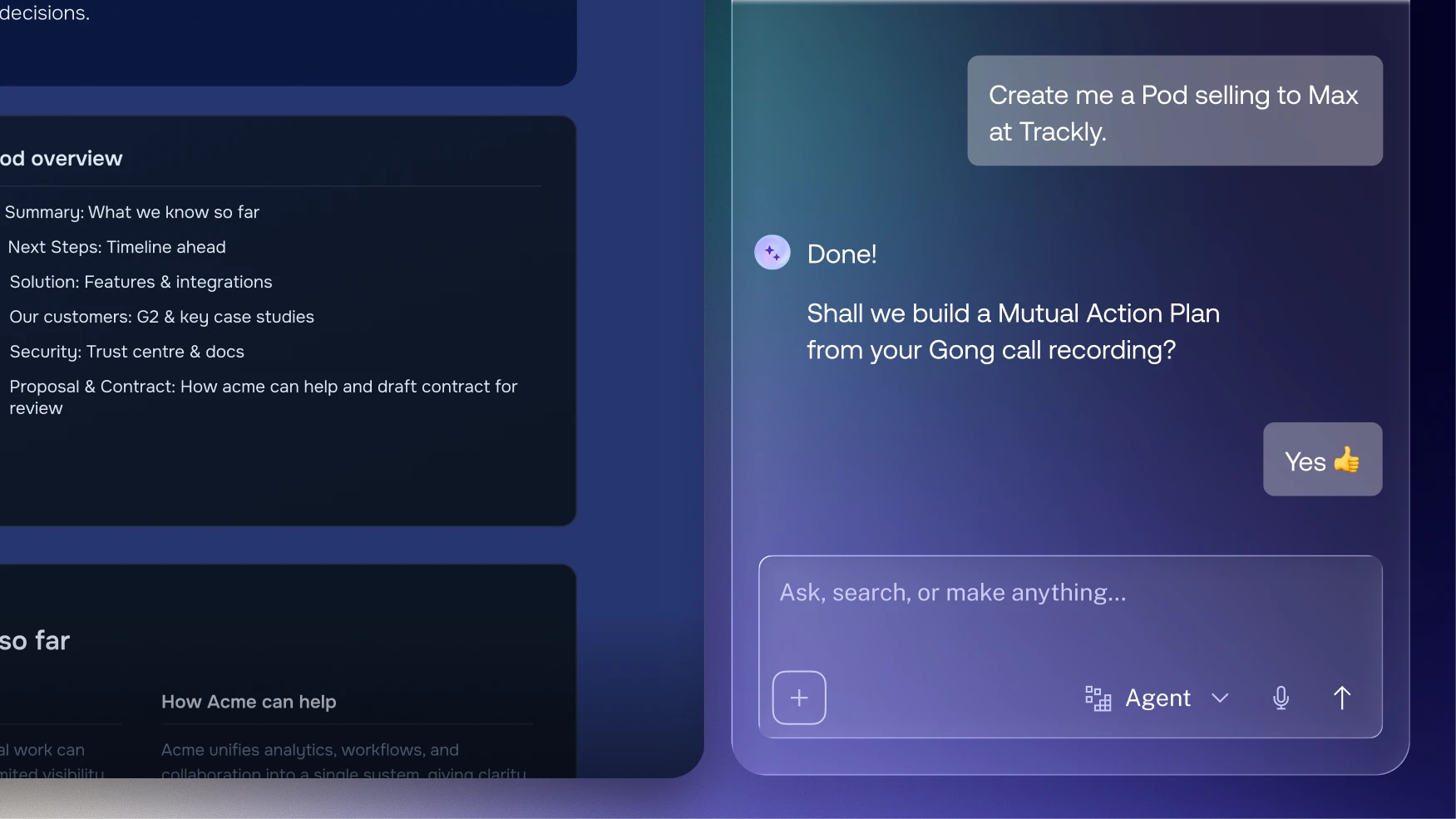
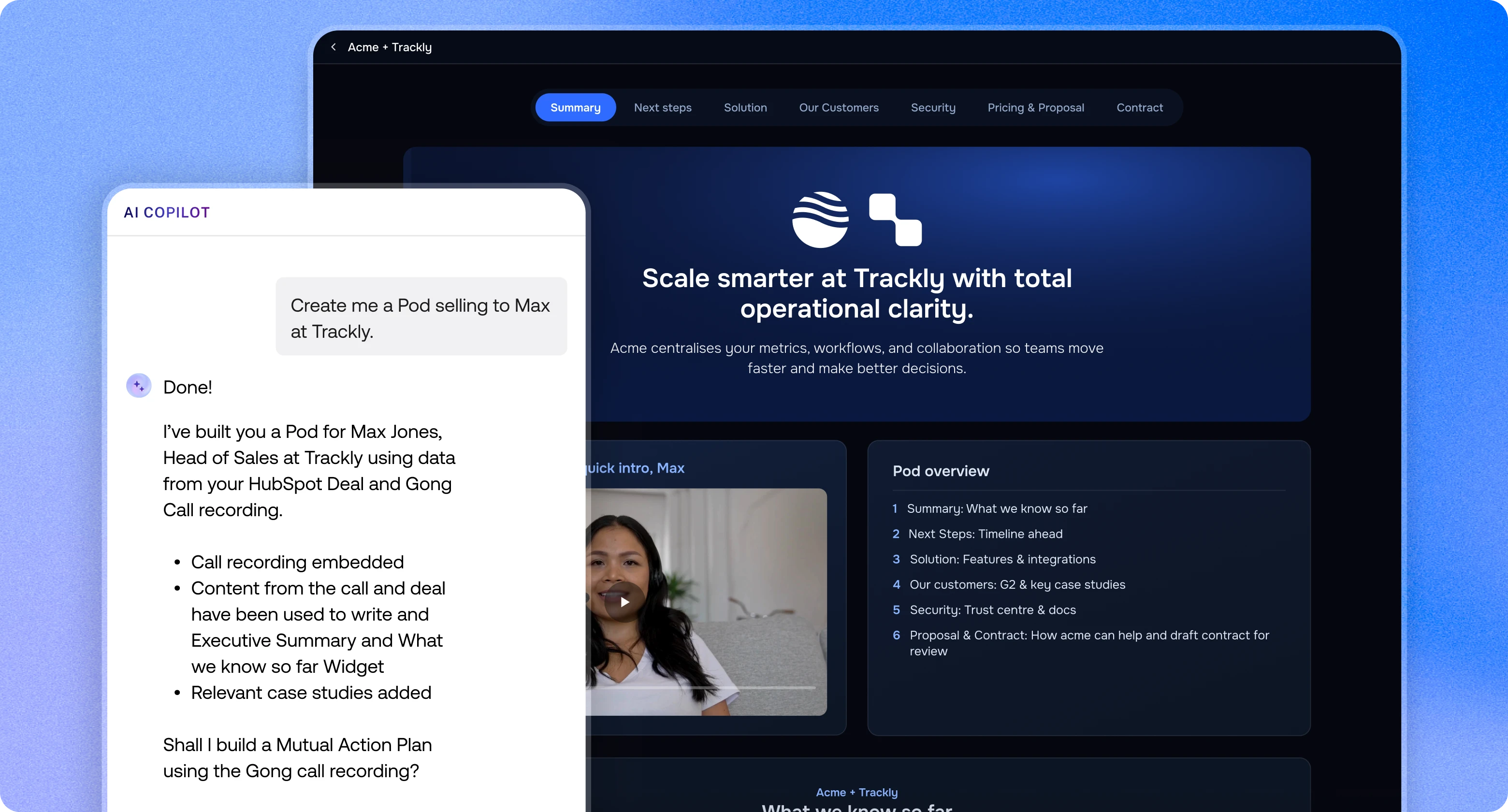
Trumpet allows teams to create personalised Digital Sales Rooms called Pods, where account-specific content, stakeholders, buyer activity, Mutual Action Plans, commercial information, and collaboration remain connected throughout the deal.
What is account-based selling?
Account-based selling is a coordinated B2B sales approach that treats a high-value organisation as a market of one. Instead of selling to an individual lead in isolation, the revenue team selects priority accounts, researches the organisation, identifies relevant stakeholders, personalises content and communication, builds relationships across the buying committee, and manages the account throughout the full revenue journey. Account-based selling is particularly useful for high-value contracts, enterprise accounts, complex B2B products, long sales cycles, and multi-stakeholder buying decisions.
Account-based selling vs account-based marketing
Account-based marketing typically focuses on account selection, awareness, advertising, campaigns, intent signals, content, and initial engagement. Account-based selling builds on that interest by developing stakeholder relationships, progressing opportunities, and supporting commercial decision-making across the buying committee. The two approaches should operate as one coordinated account strategy.
Digital Sales Rooms can become the shared execution layer connecting ABM activity with live sales opportunities. Marketing can contribute campaign content, industry messaging, customer evidence, persona resources, and account insights. Sales can contribute discovery context, deal-specific recommendations, commercial information, Mutual Action Plans, and stakeholder strategy. Both functions see the same account engagement data from the same shared workspace.
Why account-based selling breaks down after the first meeting
The initial message may be personalised, but the subsequent buyer experience often becomes generic. Sales and marketing operate in separate systems - marketing sees campaign engagement while sales sees CRM activity, and neither team has a complete account view. The account is treated as one contact because a responsive champion creates the impression that the whole account is engaged. Content becomes fragmented as different stakeholders receive separate decks, videos, proposals, case studies, and technical documents.
The champion has to reconstruct the narrative internally without adequate resources. Buyer activity beyond email opens is difficult to interpret. Next steps remain in the seller's CRM or meeting notes rather than a collaborative plan visible to both sides. Digital Sales Rooms close the gap between account-based acquisition and account-based deal execution by giving sales, marketing, RevOps, and customer success one environment through which the target account can be engaged from initial interest through onboarding and expansion.
What is a Digital Sales Room?
A Digital Sales Room is a shared buyer-facing workspace where a revenue team and a buying committee can access relevant content, collaborate on next steps, review commercial information, and progress a complex deal. The CRM is the internal system of record. The Digital Sales Room is the shared environment where account engagement and deal execution happen.
Trumpet Pods are the practical example. A personalised Pod can contain account-specific messaging, discovery recaps, relevant content, product demonstrations, customer evidence, business cases, stakeholder resources, security documents, commercial proposals, Mutual Action Plans, electronic signatures, and onboarding information, all in one persistent workspace that evolves with the account.
How to use Digital Sales Rooms across the account-based selling process
1. Select the right target account
Digital Sales Rooms do not solve poor account selection. Before creating a room, the team should establish ICP fit, revenue potential, strategic importance, timing, known business problems, existing relationships, intent signals, the likely buying committee, and expansion potential. The workspace should be reserved for accounts where personalised investment is commercially justified.
Defining account tiers helps. Tier 1 accounts warrant a highly personalised strategy with bespoke content, deeper stakeholder research, and executive involvement. Tier 2 accounts benefit from template-led personalisation with account and persona-specific content. Tier 3 accounts suit scalable one-to-many experiences with lighter personalisation. Trumpet's governed Pod templates provide the foundation, with personalisation depth increasing according to account tier.
2. Map the buying committee
Account-based selling should focus on the account, not only the original lead. Potential stakeholders include the internal champion, economic buyer, executive sponsor, department leader, end users, IT, security, procurement, legal, finance, and the implementation owner. The team should identify who is already engaged, who influences the decision, who can approve it, who could block it, and which personas are still missing.
Trumpet's Stakeholder Scout helps sellers identify new visitors, internal sharing activity, active stakeholders, missing personas, and engagement depth across the account. When a champion shares the Pod internally, sellers can see which additional contacts enter the workspace and what they view, giving the account team a clearer picture of the real buying committee. These signals should inform seller judgement alongside direct conversations rather than replace them.
3. Build a personalised account workspace
The workspace should communicate what the team understands about the account, why the current situation matters, what outcomes the account wants, how the proposed solution supports those outcomes, what evidence is relevant, and what needs to happen next. It should not open with a generic company presentation.
A strong account workspace starts with an account-specific executive summary and the account's known business priorities, moves through desired outcomes and the recommended approach, and then addresses persona-specific resources, customer evidence, the business case, technical and security information, commercial details, the Mutual Action Plan, and an implementation plan. Trumpet Pods support this structure through templates, account branding, dynamic variables, modular content, personalised video, and AI-assisted creation drawing from central content libraries.
4. Add content for each stakeholder
Account personalisation should not mean putting the company logo on a generic deck. It should account for the priorities of each buyer. Executive stakeholders need strategic relevance, business outcomes, risk considerations, and investment cases. Economic buyers and finance teams need pricing, return on investment, commercial justification, and contract terms. End users need product workflows, use cases, and day-to-day value. Security and IT need security documentation, integrations, data handling, and implementation requirements. Procurement and legal need commercial scope, terms, approval steps, and timelines.
A single trumpet Pod can include different sections and resources for each stakeholder while preserving one shared account narrative. New stakeholders who join the evaluation later can access the section relevant to their role without requiring another introductory meeting or the champion to brief them separately.
5. Coordinate sales and marketing around one account experience
Digital Sales Rooms provide a feedback loop between sales and marketing. Marketing can understand which content sellers are using, which content buyers view, which personas engage, which assets are ignored, and where content gaps exist. Sales can use account-specific campaign content, industry resources, relevant customer evidence, persona messaging, and intent and engagement context. Teams should agree who owns the account narrative, who builds or approves templates, who supplies content, how content is personalised, which engagement signals matter, and how feedback passes back to marketing.
Trumpet provides the shared buyer-facing environment that connects governed content, account personalisation, buyer activity, and seller execution. The same Pod gives marketing visibility into how their content performs in live opportunities rather than only in campaign analytics.
6. Support the internal champion
Most complex B2B deals are won or lost in conversations where the seller is not present. An internal champion has to explain why change is needed, justify the investment, answer questions from colleagues, and build confidence across the buying committee. Relying on scattered emails, attachments, and meeting notes makes that much harder.
A Digital Sales Room gives champions one structured workspace they can confidently share across the organisation. Useful resources include an executive summary, internal business case, customer stories, product demonstrations, commercial proposal, security documentation, implementation plan, and Mutual Action Plan. Instead of forwarding multiple emails or recreating the story themselves, champions can share one workspace that keeps everyone working from the same information. A personalised trumpet Pod gives the champion a single account-specific link to share internally. As additional stakeholders join the evaluation, sellers gain a clearer understanding of who is engaging with the room and which information is generating interest.
7. Use Mutual Action Plans to coordinate complex accounts
A Mutual Action Plan is a shared project plan containing the milestones, responsibilities, owners, target dates, and dependencies required to complete a purchase and begin implementation. Unlike an internal sales checklist, a MAP is designed for both the buyer and the seller. For account-based selling, a Mutual Action Plan may include stakeholder introductions, product evaluation, technical validation, security review, procurement, legal review, business case approval, executive sign-off, contract completion, and implementation planning. The strongest MAPs reflect the buyer's purchasing process rather than the seller's preferred close date.
Within trumpet, Mutual Action Plans live directly inside the Pod alongside proposals, customer evidence, security documentation, and stakeholder collaboration. Tasks can be assigned to both organisations, progress remains visible throughout the buying journey, and the same plan can continue into onboarding after the contract is signed. According to trumpet platform data, deals with an active Mutual Action Plan achieve double the win rate of deals managed without one. These are correlational findings and outcomes will vary by sales process, segment, and buyer participation.
8. Track account engagement and adapt your approach
Account-based selling should be measured at the account level rather than through isolated lead activity. Useful engagement signals include new stakeholders entering the room, internal sharing, repeat visits, content consumption, video completion, commercial document activity, security document engagement, Mutual Action Plan participation, declining activity, and missing stakeholder groups.
These signals become valuable when they influence the next conversation with the account.
Trumpet provides buyer engagement insights, stakeholder visibility, and account-level reporting through the Nerve Centre, helping revenue teams understand how opportunities are progressing. These insights should support seller judgement rather than replace it.
Measuring account-based selling success
Revenue teams should evaluate account-based selling across several levels. Account coverage metrics include target accounts engaged, stakeholders identified, senior stakeholder participation, buying committee coverage, and account penetration. Buyer engagement metrics include unique stakeholders, repeat visits, internal sharing, content engagement, Mutual Action Plan participation, and commercial activity. Sales execution metrics include Digital Sales Room adoption, personalisation quality, content usage, multi-threading, follow-up consistency, and MAP adoption. Opportunity performance metrics include meeting-to-opportunity conversion, stage progression, win rate, sales-cycle length, deal slippage, and average contract value. Long-term account growth metrics include product adoption, renewals, expansion revenue, cross-sell, upsell, and stakeholder growth. No single metric tells the full story - account engagement should be considered alongside commercial outcomes rather than treated as success on its own.
Common account-based selling mistakes
Personalising only the first interaction is the most common failure. Researching the account before outreach is valuable, however personalisation should continue throughout the buying journey rather than ending after the first meeting. Treating one contact as the account creates a single-threaded deal that is vulnerable to stakeholder changes and internal politics. Sending too much content reduces relevance, the right content at the right time is more valuable than a large resource library. Using the same room for every account means templates are being mistaken for personalisation. Discovery conversations should shape the final experience for every strategic account.
Ignoring buyer engagement signals means activity is collected but does not change the account strategy. Making the Mutual Action Plan seller-focused removes the collaborative value that makes it effective, buyers must see value in the shared process or participation will decline. Ending the workspace after signature abandons the context the account team spent months building. The same Digital Sales Room can support onboarding, product adoption, executive reviews, renewals, and future expansion opportunities.
What to look for in account-based selling software
A platform supporting account-based selling should provide reusable templates, meaningful personalisation, account branding, stakeholder visibility, content management, persona-specific resources, Mutual Action Plans, buyer engagement insights, CRM integration, portfolio reporting, secure sharing, and customer success continuity.
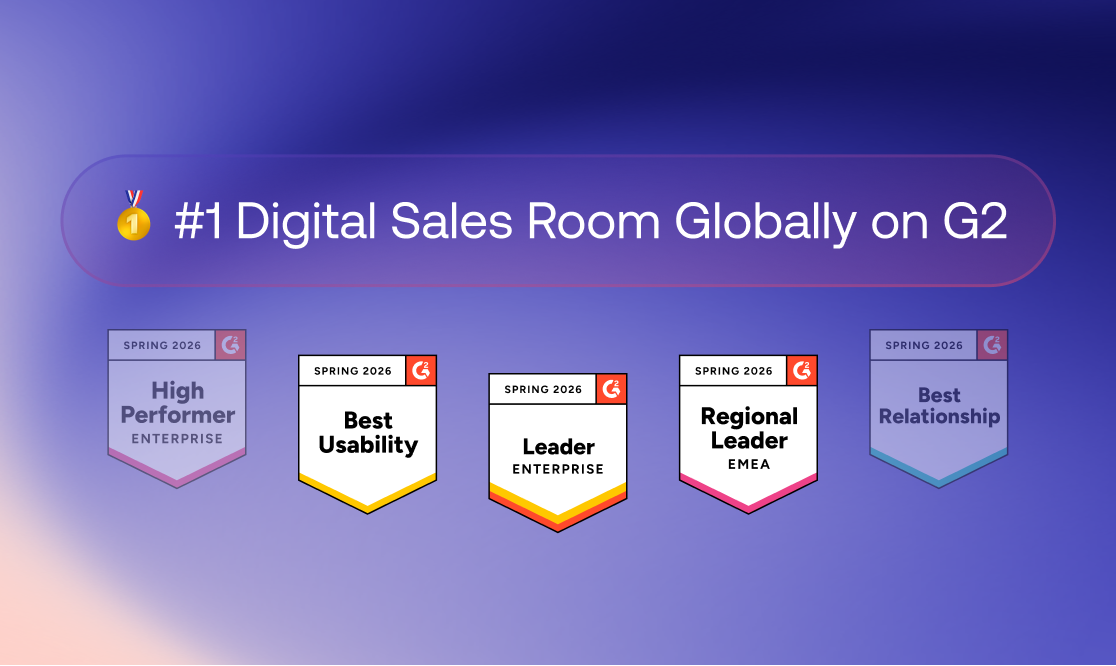
Trumpet combines personalised Digital Sales Rooms, reusable templates, Stakeholder Scout, AI organisational charts, buyer engagement analytics, Mutual Action Plans, content management, CRM integrations, Nerve Centre reporting, and post-sale continuity inside one buyer-facing platform. Rather than acting as an outbound tool or content repository, trumpet helps revenue teams extend account-based selling throughout the entire buying journey. Trumpet is ranked number one for Digital Sales Rooms globally on G2 across more than 30 enterprise, mid-market, and regional reports.
Final thoughts
Account-based selling should not stop once the first meeting is booked. The organisations that see the greatest results continue personalising the experience throughout evaluation, stakeholder engagement, procurement, implementation, and long-term customer growth. Digital Sales Rooms help make this possible by creating one shared environment where buyers and sellers can collaborate throughout the account journey.
For revenue teams looking to put this approach into practice, trumpet provides personalised Digital Sales Rooms where content, stakeholders, Mutual Action Plans, buyer engagement, commercial information, and customer collaboration remain connected from first meeting through onboarding and account growth.
FAQs
What is account-based selling?
Account-based selling is a B2B sales strategy that focuses on high-value organisations rather than individual leads. Revenue teams engage multiple stakeholders through personalised communication, relevant content, and coordinated deal execution.
How do Digital Sales Rooms support account-based selling?
Digital Sales Rooms provide one personalised workspace where stakeholders can access relevant resources, review commercial information, collaborate on next steps, and progress complex buying decisions together.
What is the difference between account-based selling and account-based marketing?
Account-based marketing focuses on creating awareness and engagement within target accounts. Account-based selling builds on that interest by developing stakeholder relationships, progressing opportunities, and supporting commercial decision-making.
How do Digital Sales Rooms help internal champions?
They provide one structured workspace containing customer evidence, business cases, product information, commercial proposals, security documentation, and agreed next steps, making it easier for champions to communicate internally without reconstructing the full narrative themselves.
Can Digital Sales Rooms support account expansion?
Yes. The same workspace can continue into onboarding, account management, renewal, cross-sell, and expansion, preserving the stakeholders, objectives, content, and engagement history built during the sales process.
Can a Digital Sales Room replace a CRM or ABM platform?
No. The CRM remains the internal system of record, while ABM platforms support account selection and campaigns. The Digital Sales Room becomes the shared buyer-facing environment for active account engagement and deal execution.
How does trumpet support account-based selling?
Trumpet provides personalised Pods, Stakeholder Scout for buying committee visibility, AI Engagement Score, buyer engagement analytics, Mutual Action Plans, reusable templates, content management, CRM integrations, Nerve Centre reporting, and continuity from sales into customer success.
.png)

See what your buyers are doing between meetings
Build a Pod, share it with the buying committee and watch the signals roll in. Free to start.
.png)
.png)
.png)

.png)
.png)


![How to Get Started with Buyer Enablement [With Examples]](https://cdn.prod.website-files.com/65cf4fecbed2754c2236665d/65cf4fecbed2754c22366bdb_65a5af83e742f76e34ce06f3_Customer%2520Onboarding%2520_%2520Everything%2520you%2520need%2520(2).png)



.png)

.png)