


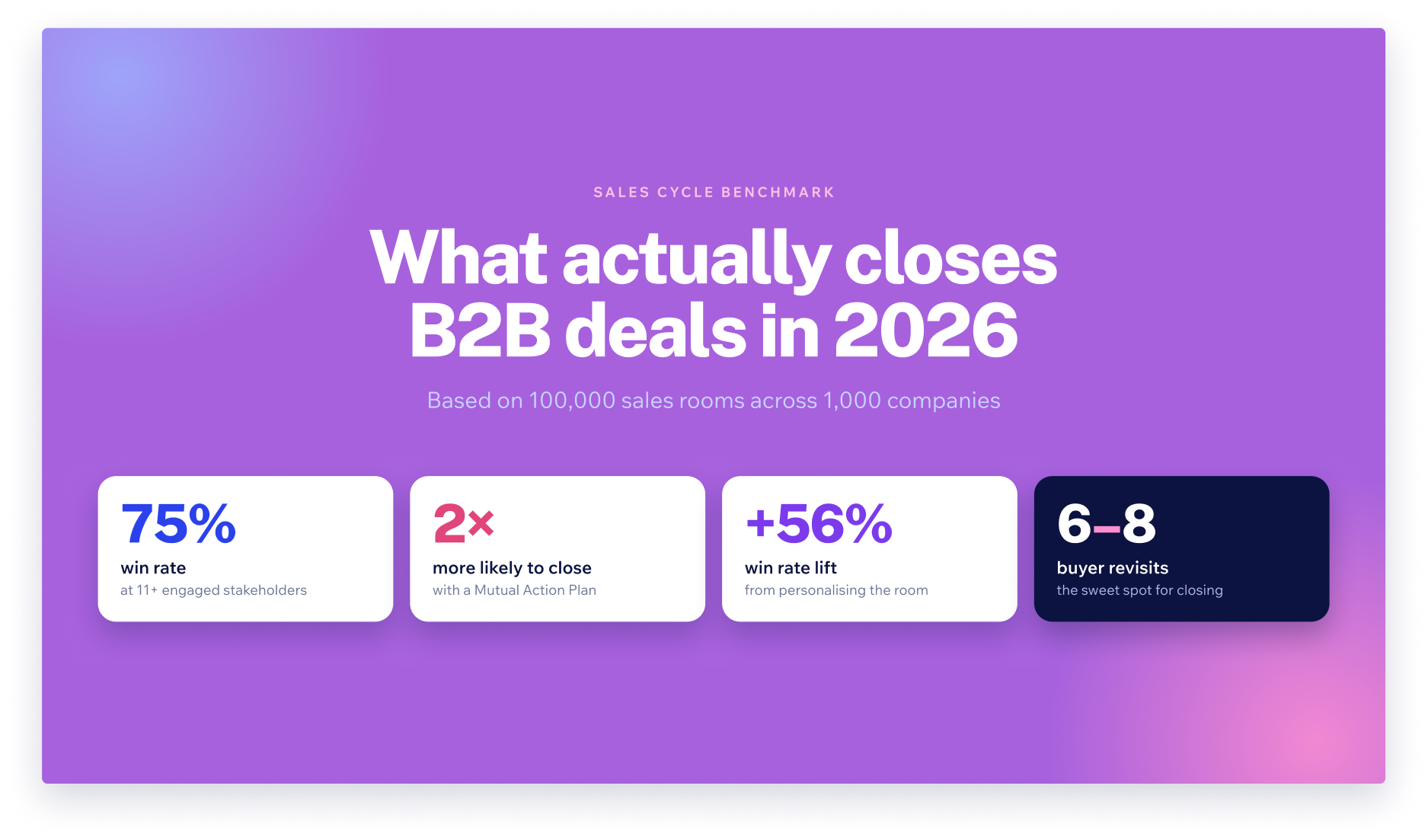





- Trumpet analysed 100,000 sales rooms across 1,000 companies to identify what actually predicts B2B win rates in 2026
- Deals with 4+ stakeholders win 83% more often; 11+ stakeholders reach 75% win rate
- Mutual Action Plans double win rates; 11-15 completed steps is the sweet spot (92% win rate)
- Personalising the sales room lifts win rate by 56%; personalised video drives +8% win rate and 15% faster cycles
- Procurement looped in early correlates with 83% win rate; late procurement involvement structurally weakens deals
- Interactive demos accelerate cycles by 31%; more than 3 PDFs drops win rate by 8%
- Buyers who revisit 6-8 times close at 48% win rate; 101+ engagement signals correlate with 64% win rate
The 2026 B2B sales cycle looks nothing like the one described in most sales methodology books. Buyers arrive with a shortlist already formed. Deals succeed or fail based on what happens between meetings, not during them. And the difference between winning and losing is now measurable at the level of individual buyer actions.
This guide is built from trumpet's analysis of 100,000 sales rooms across 1,000 companies, covering the full modern B2B buying journey. Every stat below is drawn directly from that dataset.
Use it as a reference. If you want to know what number of stakeholders correlates with higher win rates, or when to bring procurement into a deal, or how many pieces of content is too many at the start of a cycle, the answer is here.
What actually predicts whether a B2B deal will close in 2026?
Across 100,000 sales rooms, six factors consistently correlate with higher win rates:
- Stakeholder count. Deals with 4+ stakeholders engaged win 83% more often than deals with 1-2. At 11+ stakeholders, win rate reaches 75%.
- Mutual Action Plans. Deals that use a Mutual Action Plan (MAP) win 2x more often. The sweet spot is 11-15 completed steps, which correlates with a 92% win rate.
- Personalisation. Personalising the sales room lifts win rate by 56%. Personalised video content alone drives +8% win rate and 15% faster cycles.
- Internal sharing. Deals where the buyer forwards the workspace 3-7 times internally hit the win rate sweet spot.
- Buyer revisit behaviour. Buyers who return to the sales room 6-8 times close at 48% win rate. A single view with no return is the weakest signal in the dataset.
- Interactive engagement signals. Deals with 101+ engagement signals (MAP completions, content views, shares, form submissions) close at 64% win rate. Under 9 signals is a warning sign regardless of stage.
Deals that fail to move on all six typically stall. Deals that move on three or more usually close.
How many stakeholders should be in a B2B deal?
The single strongest predictor of win rate is the number of stakeholders actively engaged.
Based on trumpet's analysis:
- 1-2 stakeholders: 29% win rate
- 4 stakeholders: 58% win rate
- 6 stakeholders: 51% win rate
- 10 stakeholders: 61% win rate
- 11+ stakeholders: 75% win rate
The pattern is clear: deals concentrated with one champion are structurally fragile. When more stakeholders engage early, the deal becomes shared, visible, and internally understood before the buying decision is made.
How to multi-thread before the deal gets fragile
- Map the full buying group in discovery, not just your champion.
- Ask your champion directly: "who else needs to say yes?"
- Give future stakeholders a reason to engage before you are formally introduced (share something forwardable).
- Build something your champion can share without scheduling another meeting.
Why do Mutual Action Plans double win rates?
A Mutual Action Plan is a shared timeline of steps, owners, and dates agreed by buyer and seller. Trumpet's data shows deals that use one win at 2x the rate of deals that don't.
Completed step count by win rate:
- 0-5 steps completed: 29% win rate
- 6-10 steps: 84% win rate
- 11-15 steps: 92% win rate (sweet spot)
- 16-20 steps: 89% win rate
- 21-30 steps: 79% win rate
- 30+ steps: 29% win rate (over-engineered)
The insight: Mutual Action Plans work because they replace vague follow-up emails with visible shared progress. Both sides can see what needs to happen, who owns it, and where the deal actually stands. When a MAP goes quiet, that is itself a deal signal, the deal has stalled somewhere.
How to build a Mutual Action Plan that actually moves the deal
- Build it in meeting one or two, not after the verbal yes.
- Aim for 11-15 steps. Fewer than 6 signals under-planning; more than 30 signals over-engineering.
- Assign steps to the buyer. Shared ownership drives the outcome, not your to-do list.
- Treat MAP silence as a deal signal, not neutral information. Ask why nothing has moved.
When should you bring procurement, security, legal, and finance into the deal?
Late-stage stakeholder introductions are one of the highest-friction moments in a B2B deal. Procurement, legal, security, and finance arrive with different priorities than your champion, they were not part of the earlier conversation, and they often push the deal back to the beginning of an evaluation cycle.
Trumpet's data shows that when these stakeholders are looped in early, they become part of the buying process rather than a gate at the end:
- Procurement looped in early: 83% win rate
- Security in early: 70% win rate
- Finance in early: 51% win rate
- Marketing in early: 47% win rate
- C-Suite arriving late: 22% win rate
- Legal arriving late: 19% win rate
The pattern: bringing blocker functions in early moves them into the deal. Waiting until after the commercial conversation turns them into gatekeepers.
How to loop in the right stakeholders at the right time
- In discovery, ask your champion: "who from procurement, security, or legal will need to sign off?"
- Bring blocker functions in during evaluation, not after the commercial conversation.
- Give each stakeholder what they need. Procurement wants commercials. Security wants compliance. Finance wants ROI.
- Anticipate the objection. Have the answer ready before they ask.
Does personalising the sales room actually move win rates?
Yes, measurably. Trumpet's data shows personalisation is one of the highest-leverage moves a seller can make.
- Personalised imagery in the sales room: +56% win rate
- Personalised video content: +8% win rate, 15% faster cycle, +26% Pod internal shares
- Personalised background: +11% win rate
Personalisation works because buyers can tell when something was built for them. A personalised room creates relevance from the first click and gives your champion something easier to share.
What to personalise (and what not to)
- Brand the Pod before you send it, not after the first call.
- Lead with a personalised video. The highest-impact first Widget drives +8% win rate and 15% faster cycle.
- Watch week-one signals. 14 is the benchmark engagement score for a personalised Pod.
- Use an image or solid colour background. Gradient backgrounds underperform in the data.
What content moves deals and what stalls them?
Not all content performs equally. Trumpet's data breaks the effect of specific content types on both win rate and sales cycle speed.
Content that accelerates deals:
- Interactive demos: 31% faster sales cycles
- Feature breakdown pages: 21% faster
- Pricing page (revealed, not hidden): 19% faster
- FAQ sections: 15% faster
- Personalised video: 14% faster
- Deal timelines: +7% win rate
- Embedded calendar for booking: +8% win rate
- Testimonials: +4% win rate
Content that stalls deals:
- More than 3 PDFs in a Pod: -8% win rate
- 11+ pieces of content dumped in the first third of the cycle: 2.5x slower cycle
The pattern: interactive, decision-enabling content moves deals. Static, dump-everything content stalls them.
Timing matters as much as content
The same asset lands differently depending on when in the cycle it arrives:
- Sharing everything on day one creates noise. 11+ pieces in the first third slows the cycle by 2.5x.
- Adding 5 new pieces in the final third, aimed at remaining objections, accelerates the cycle by 43%.
- Middle-cycle content (case studies, detailed breakdowns) works best once the buyer knows what they are evaluating.
How to read buyer engagement signals
The strongest deals are readable. Sellers can see what buyers are doing between meetings, and use those signals to prioritise action.
Trumpet's data on returning viewers:
- 0 revisits (single view only): 24% win rate
- 1 revisit: 35% win rate
- 2-3 revisits: 41% win rate
- 4-5 revisits: 45% win rate
- 6-8 revisits: 48% win rate
Time to close by revisit count:
- 0 revisits: 71 days
- 1 revisit: 60 days
- 2-3 revisits: 48 days
- 4-5 revisits: 39 days
Buyers who come back repeatedly are actively evaluating. They are the deals with the highest close rate and the shortest cycle.
Actions matter more than views
Passive views show attention. Actions show commitment. Trumpet's data on interaction signals (MAP steps, shares, downloads, forms, and bookings):
- No signals: 29% win rate
- 10-25 signals: 38% win rate
- 26-50 signals: 38% win rate
- 51-100 signals: 58% win rate
- 101+ signals: 64% win rate
Fewer than 9 signals across the deal is a warning sign regardless of the CRM stage or the rep's confidence.
How to act on engagement signals
- Design the sales room to require something, a MAP step, a form, a download. Passive views are not enough.
- Track interactive signals separately from views. They predict outcomes far better.
- High passive signals with no action means the content is not prompting the right next step.
- Follow up on every revisit within 24 hours. Buyers who reply in that window convert at 2x win rate.
- Use MAP step completion as the primary deal health metric. It is the most reliable signal in the dataset.
Final thoughts
Modern B2B deals are not won by one rep carrying a champion across the line. They are won by making the deal visible, shareable, and internally understandable to the buying group.
The data is consistent: more engaged stakeholders, a Mutual Action Plan, personalised content, decision-enabling assets, and readable engagement signals all correlate with higher win rates and shorter cycles. The strongest deals lean into all of them.
The weakest deals ignore them and try to close through follow-up emails.
FAQs
What is the average number of stakeholders in a B2B deal in 2026?
Across 100,000 sales rooms analysed by trumpet, the average deal now involves 10-11 stakeholders on the buyer side, up from 6-7 five years ago. Multinational enterprise deals frequently involve 15+ decision-makers.
What is the strongest predictor of a B2B deal closing?
Stakeholder engagement count and Mutual Action Plan completion are the two strongest predictors in trumpet's dataset. Four or more engaged stakeholders correlate with 83% higher win rate. A completed MAP with 11-15 steps correlates with a 92% win rate.
When should you bring procurement into a B2B deal?
Trumpet's data shows procurement looped in early correlates with 83% win rate. Deals where procurement arrives after the commercial conversation are structurally weaker.
How much does personalisation actually improve B2B win rates?
Trumpet's analysis of 100,000 sales rooms shows personalised imagery increases win rate by 56%. Personalised video content drives an 8% higher win rate, 15% faster cycles, and 26% more internal shares.
How many pieces of content should you send in the first third of a B2B sales cycle?
Fewer than 11. Trumpet's data shows sending 11+ pieces of content in the first third of the cycle slows the deal by 2.5x. Adding 5 new pieces in the final third targeted at remaining objections accelerates the cycle by 43%.
What is a warning sign that a B2B deal is stalling?
Fewer than 9 engagement signals across the deal is a warning sign regardless of the CRM stage. A single view of the sales room with no return is the weakest signal in the dataset.






![How to Get Started with Buyer Enablement [With Examples]](https://cdn.prod.website-files.com/65cf4fecbed2754c2236665d/65cf4fecbed2754c22366bdb_65a5af83e742f76e34ce06f3_Customer%2520Onboarding%2520_%2520Everything%2520you%2520need%2520(2).png)
.png)


.png)


.png)


.png)

.png)

.png)
.png)





