







- Buyer intent and buyer signals aren't the same thing. Signals are the behaviours and interactions that help teams infer intent.
- Buyers are researching independently for longer. Revenue teams need to influence the journey before a demo is ever booked.
- More signals aren't automatically better. AI earns its keep when it aggregates, analyses and makes sense of them.
- The Marketing-to-Sales handoff is going out of fashion. Modern buyer journeys need context to flow continuously between teams, not get lobbed over a fence once.
- Signals don't stop once an opportunity opens. Buyers keep researching, comparing and pulling in new stakeholders throughout the deal.
- AI should make people better at their jobs, not replace them in the process. Research, analysis and admin can be accelerated. Judgement and relationship-building stay human.
- Great buyer experiences create momentum. Easy-to-access, personalised, relevant information is what actually moves a decision forward.
What does buyer intent actually look like, and how can revenue teams use AI to turn those signals into real deal momentum?
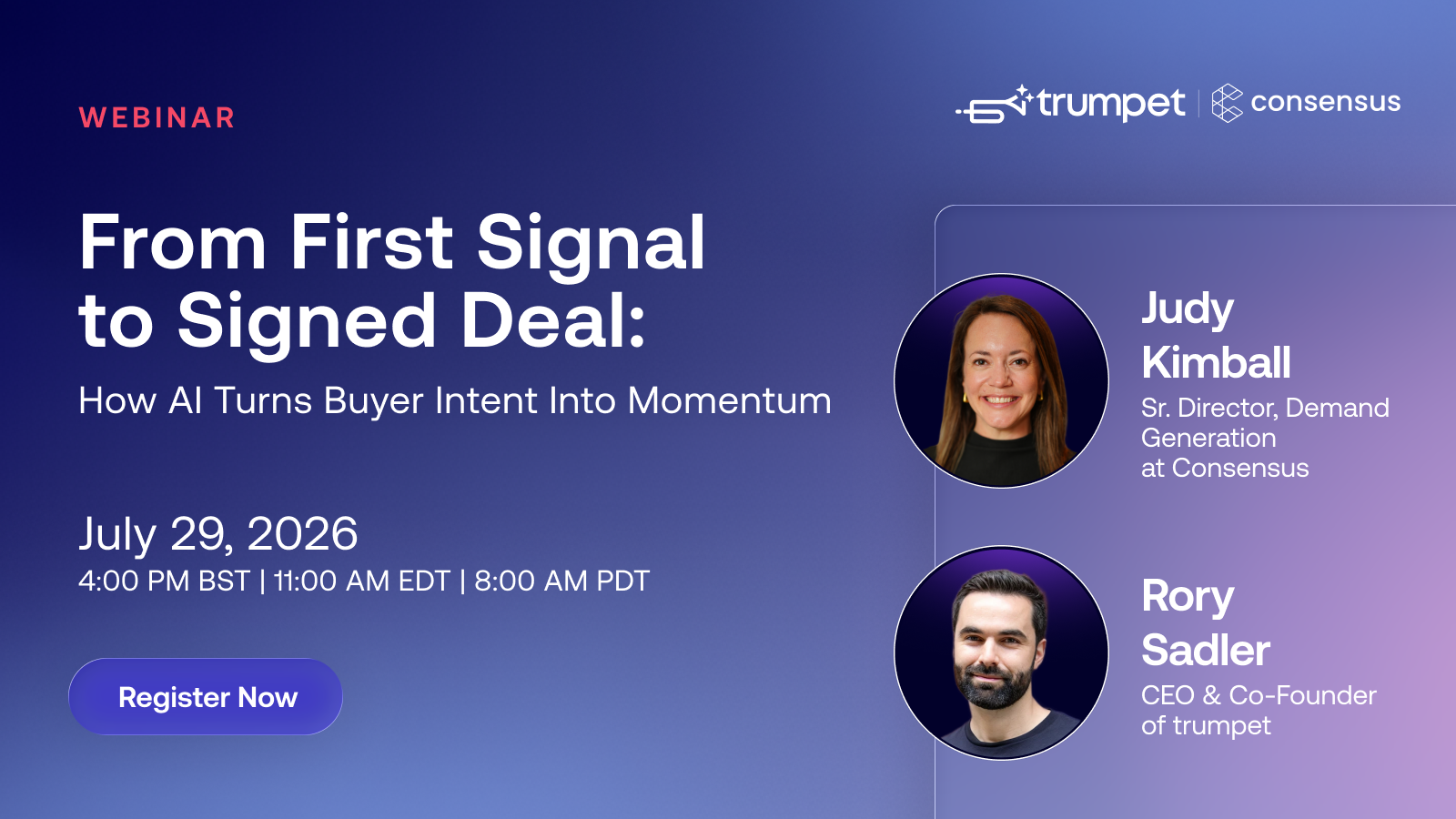
Last month, we joined our friends at Consensus for From First Signal to Signed Deal: How AI Turns Buyer Intent Into Momentum, a conversation about how AI is changing the modern B2B buyer journey. Our CEO and Co-founder, Rory Sadler, sat down with Judy Kimball, Head of Demand Generation at Consensus, to talk about everything from spotting genuine buyer intent to keeping momentum alive once an opportunity is live.
The big theme? Buyers have changed. They're researching independently, engaging across more channels, and bringing more stakeholders into the decision than ever before. Revenue teams need to get better at spotting the signals that matter, connecting the context behind them, and making it easier for buyers to keep moving.
Missed it? Watch the full conversation below, or keep reading for the biggest takeaways.
Meet the speakers
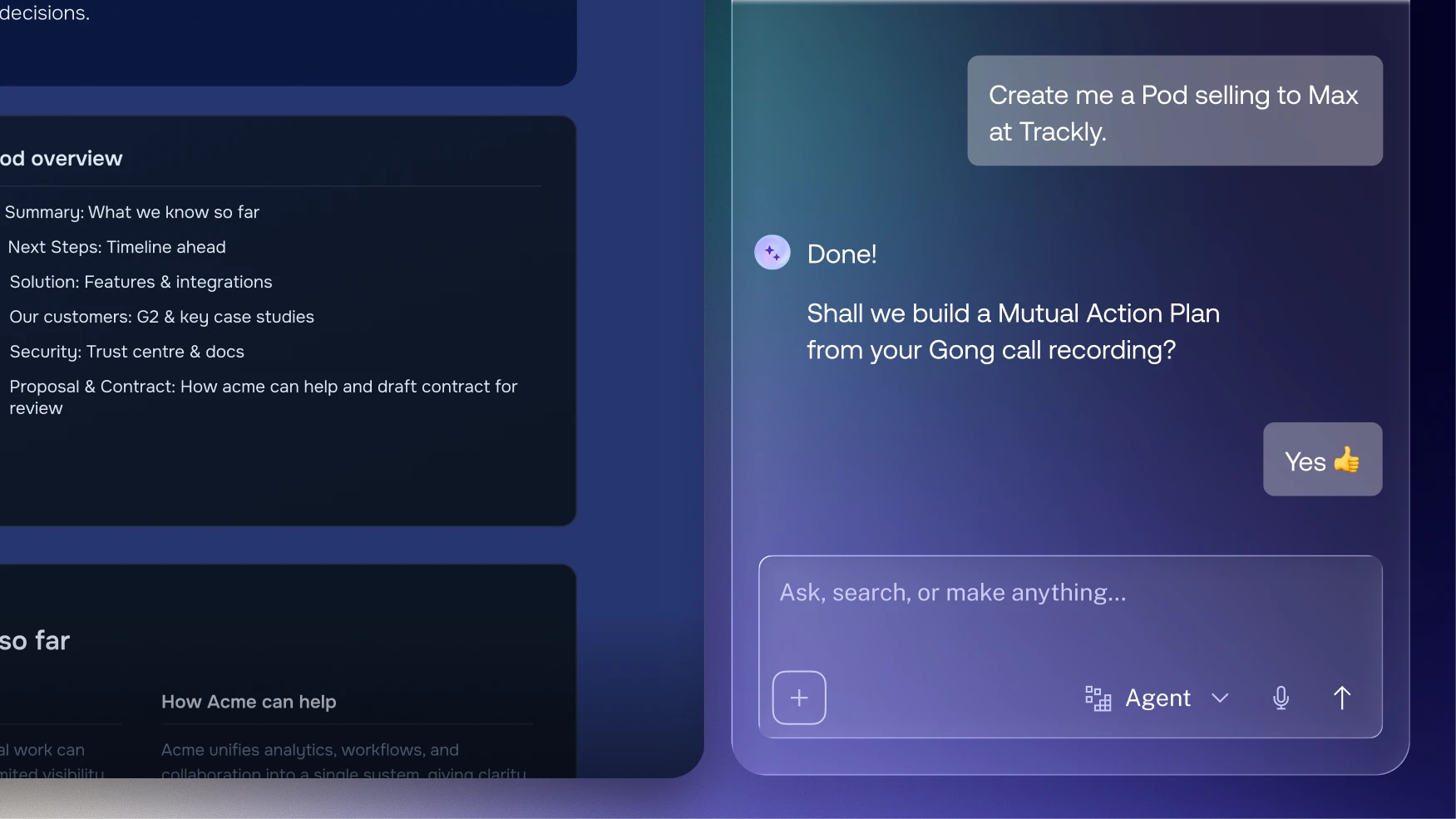
Rory Sadler, CEO and Co-founder, trumpet Before co-founding trumpet, Rory spent around a decade in go-to-market roles, both as an individual contributor and leading teams. Selling into complex B2B organisations left him a little obsessed with the buying experience: how buyers actually evaluate products, where deals lose momentum, and what revenue teams can do to make purchasing easier. That thinking became part of the foundation for trumpet: a buyer enablement platform that gives revenue teams a central digital space, a Pod, to bring together content, Mutual Action Plans, conversations, stakeholders and buyer engagement throughout the deal cycle.
Judy Kimball, Head of Demand Generation, Consensus Judy leads demand generation at Consensus, where her job, as she puts it, is "making prospects fall in love with our product before they ever talk to sales." Consensus helps revenue teams build interactive demo experiences that let buyers self-educate, while giving sellers greater visibility into what prospects care about and how the wider buying group is engaging.
Together, trumpet and Consensus sit across different but complementary parts of the modern buying journey, helping revenue teams understand how buyers engage before, during and throughout an opportunity. The conversation was moderated by Nick Beecroft.
What we learned
1. The B2B buyer journey has fundamentally changed
Rory and Judy started with just how differently buyers behave today. They have access to more information than ever: vendor comparisons, reviews, communities, their own network, and increasingly tools like ChatGPT and Claude to help with the evaluation itself.
That means the first conversation with Sales is rarely the actual start of the buying journey. As Rory put it:
"Buyers now arrive more aware than ever... they're able to research independently so they don't arguably need us as much as they used to."
Rory Sadler, trumpet
Rory also pointed to a stat that stopped a few people in the chat: buyers now engage with sales once they're roughly 77% of the way through their evaluation, "they're on the kind of final stretch." And some have already made up their minds before that: "I think like is it 40, 41% of buyers already have a sort of chosen vendor before they even kick off... then they go to market to do research and find the other shortlist, because procurement's always going to ask them to find two or three."
Expectations have shifted alongside behaviour, too. Consumers are used to one-click checkouts, instant delivery and total price transparency, and that's quietly reset what buyers expect from B2B, as Rory explained:
"What buyers now expect is more transparency earlier on and ease of access of information and ultimately a more personalised experience from touch point one through to becoming a customer."
Rory Sadler, trumpet
For revenue teams, that makes the buying experience itself part of the competitive advantage.
2. Buyer signals and buyer intent aren't the same thing
This was one of the sharpest distinctions of the whole session. A buyer signal is an observable behaviour: a pricing-page visit, a demo view, a shared deal room, a new stakeholder showing up in a thread. Buyer intent is what you infer from it.
Judy summed it:
"Intent is a human emotion and a human action. The signals are just sort of the indicators that that's happening."
Judy Kimball, Consensus
Nick, moderating, put it neatly too: "It's like what you're inferring they might do next. It doesn't mean they're going to do it." One signal rarely tells the whole story. The opportunity is in looking at several together.
3. AI can turn scattered signals into useful context
Revenue teams aren't short of data: website activity, social engagement, CRM history, demo views, review platforms, sales calls, deal room activity. The challenge is making sense of all of it.
Historically, that meant fairly blunt lead-scoring: one action worth five points, another worth twenty, until a prospect crossed a threshold and became an MQL. As Judy said, that was never quite right:
"It was this aggregate score that then said, MQL, great, Sales, this person's ready to buy. That's not the way that it works anymore. Honestly, it was never the way that it worked, but it was what we could do."
Judy Kimball, Consensus
AI lets teams go further, aggregating signals across an entire account rather than treating each action in isolation, and using that to spot patterns and add context. Rory described his own team's approach: "We're able to synthesise essentially signals across our website, account and persona-based socials from our team, from our company, competitors, complementary products and companies, right through to the G2s, forums and Reddit and so much more." Instead of "someone from this account visited your website," Sales gets an actual picture of what's happening.
4. More data isn't always better
There's a catch. Handing a seller 50 signals a day isn't useful. It's just another inbox to manage. As Rory put it:
"If you just chuck data at people, they go, they get like data paralysis. They're like, what do I do with all this? What does it mean?"
Rory Sadler, trumpet
The goal is making insights actionable inside the tools reps already use (Slack, email, the CRM) rather than another dashboard nobody opens. AI's real job is answering the question behind all that data: what does this actually mean, and what should I do next?
5. The Marketing-to-Sales handoff is disappearing
Marketing generates the lead, Sales takes over, Marketing moves on. That's the funnel most of us grew up with. The problem is buyers don't behave like a funnel. They keep researching after that first sales call, keep comparing competitors, keep looping in colleagues. New stakeholders join. Procurement gets involved. Priorities shift.
Judy summed up what that means for revenue teams:
"It has retired the marketing to sales handoff because it's going back and forth the whole time. There isn't just this handoff point where you lob it over the fence."
Judy Kimball, Consensus
Rather than two separate stages, Marketing and Sales end up supporting different parts of the same continuous journey.
6. Buyer signals don't stop when the opportunity opens
One of the easiest mistakes to make is assuming buyer intent only matters at the top of the funnel. Some of the most valuable signals actually happen once a deal is already underway.
You've had a brilliant demo. Your champion loves the product. The next meeting's booked for two weeks out. Easy to assume it's all moving nicely, but a lot can happen in those two weeks: pricing gets revisited, Finance gets pulled in, a competitor gets another look, security docs get reviewed, or engagement just quietly stops.
Rory's point was that the same signals that mattered early on don't switch off once a deal opens:
"Those top-of-funnel signals are probably going to be continuing alongside the process that you're running them through in terms of your sales pipeline."
Rory Sadler, trumpet
That's where a shared, visible deal room changes the question from "when's our next meeting?" to "is this buying group actually moving?"
7. Deal momentum comes from the buying group, not just the champion
Complex B2B deals rarely involve one person. Your champion might be sold, but they still need to convince Finance, Security, Procurement, leadership, and the people who'll actually use the product day to day. Understanding the wider buying committee, not just your one enthusiastic contact, is critical.
Rory explained that this is where AI can help teams look beyond surface-level activity and understand what engagement across the deal actually means. Who’s viewing? Who’s sharing? Are new stakeholders getting involved? Are buyers actively interacting with what you send, or simply opening it?
Looking at those signals together gives revenue teams a much clearer picture of whether momentum is building across the buying group, or whether the deal is still relying too heavily on one champion.
Passive viewing and active engagement tell very different stories, and knowing the difference matters.
8. AI should remove work, not remove people
Both speakers kept coming back to this: human judgement still matters. AI is genuinely useful for research, aggregating signals, summarising information, spotting patterns and cutting repetitive admin. It shouldn't be handing every buyer interaction over to an agent.
Judy was direct about where she draws the line:
"I don't trust AI to ship externally without human in the loop."
Judy Kimball, Consensus
And on balancing the two:
"Let AI help you do great work but don't let it take over for where judgment needs to come in and where personality needs to come into play.
Judy Kimball, Consensus
The strongest approach is human-in-the-loop: let AI do the heavy lifting behind the scenes, then give people better information to make better calls.
9. High-performing revenue teams make signals easy to act on
So what are the best teams doing differently? Not necessarily collecting the most data. Making the data they already have genuinely useful.
Start with a clear ICP.
More signals aren't helpful if they're coming from accounts that were never a fit. Judy was blunt about her own team's UCP, the "unideal customer profile," as coined by their CRO: "Know what that is and ignore that."
Bring signals into existing workflows.
Don't make reps hunt through another dashboard. Rory's take: "How do you surface it in their daily workflow? Whether it's an email in their inbox saying like these accounts that are under your name, they need some action today."
Look for patterns, not isolated actions.
One website visit rarely means much. Several stakeholders engaging across multiple channels in a short window tells a different story, and Rory noted that "when signals get closer and closer together, that's a really strong signal of momentum or buying intent arguably."
Keep context flowing between teams.
Marketing, Sales and Customer Success shouldn't each start from scratch. The more context that travels with the buyer, the more relevant the experience.
Use AI to support judgement, not replace it.
Let AI research, summarise and analyse. Let people decide what to do with it.
The big takeaway: buyer intent is only useful when you can act on it
Modern revenue teams can see more buyer behaviour than ever. But collecting signals was never the goal. Understanding what they mean, and using them to build a better buying experience, is.
AI makes it possible to bring together huge amounts of fragmented information, spot patterns humans might miss, and surface the right context at the right moment. But technology is only half the equation. The best revenue teams pair that intelligence with human judgement, real collaboration between Marketing and Sales, and a genuine understanding of how their buyers actually want to buy.
Because momentum was never really about the dashboard. It's about helping buyers make a decision.
FAQs
What is buyer intent in B2B sales?
Buyer intent describes a person or organisation's likely intention to take a purchasing action. Revenue teams infer it from signals: website activity, content engagement, product research, stakeholder activity and interactions throughout the sales process. As Judy put it in the webinar, intent and signals shouldn't be treated as interchangeable: intent is human, signals are simply the indicators teams use to infer it.
What is a buyer intent signal?
An observable action or event that may indicate a prospect is researching, evaluating or moving towards a purchase: a pricing-page visit, demo engagement, content views, deal room activity, review-site research, or engagement from a new stakeholder.
What's the difference between buyer signals and buyer intent? Signals are the observable actions revenue teams can track. Intent is the meaning inferred from them. One signal on its own rarely demonstrates purchase intent. That's why teams increasingly look at several signals together.
How can AI identify buyer intent? By aggregating signals from multiple sources, spotting patterns, and adding context around account activity, rather than treating every signal in isolation.
How does AI help maintain deal momentum? By surfacing changes throughout an active opportunity: new stakeholders, rising or falling engagement, content being shared internally, or gaps opening up in the buying process, giving revenue teams more visibility between meetings.
Why do buyer signals matter after a sales opportunity opens? Because buyers don't stop researching once they talk to Sales. They keep comparing vendors, reading content, and pulling in new stakeholders throughout the cycle. Watching those signals gives revenue teams a clearer read on whether a deal is gaining momentum, stalling, or picking up new risk.
Should AI replace human judgement in B2B sales? No, as both speakers were clear on. AI is excellent for research, synthesis, pattern recognition and admin. Judgement, relationship-building and knowing when (and how) to reach out still need a person.
How can Marketing and Sales use buyer intent together? Rather than Marketing owning intent before handing an opportunity to Sales, both teams can use the same signals throughout the journey: Marketing for segmentation and content, Sales for understanding stakeholders and momentum. Sharing that context is what closes the traditional gap between the two teams.
Thanks again to Judy, Rory, Nick and the whole Consensus team for a genuinely useful conversation.







![How to Get Started with Buyer Enablement [With Examples]](https://cdn.prod.website-files.com/65cf4fecbed2754c2236665d/65cf4fecbed2754c22366bdb_65a5af83e742f76e34ce06f3_Customer%2520Onboarding%2520_%2520Everything%2520you%2520need%2520(2).png)
.png)


.png)


.png)


.png)

.png)

.png)
.png)





