







- AI sales enablement now extends beyond content management and coaching to include buyer engagement, deal intelligence, workflow automation, and revenue execution.
- Different platforms specialise in different parts of the revenue process, making category understanding essential before comparing vendors.
- Enterprise teams should evaluate governance, permissions, AI controls, CRM integrations, security, and reporting alongside AI capabilities.
- UK SaaS companies should consider UK GDPR, international data transfers, enterprise procurement, and AI governance during vendor evaluations.
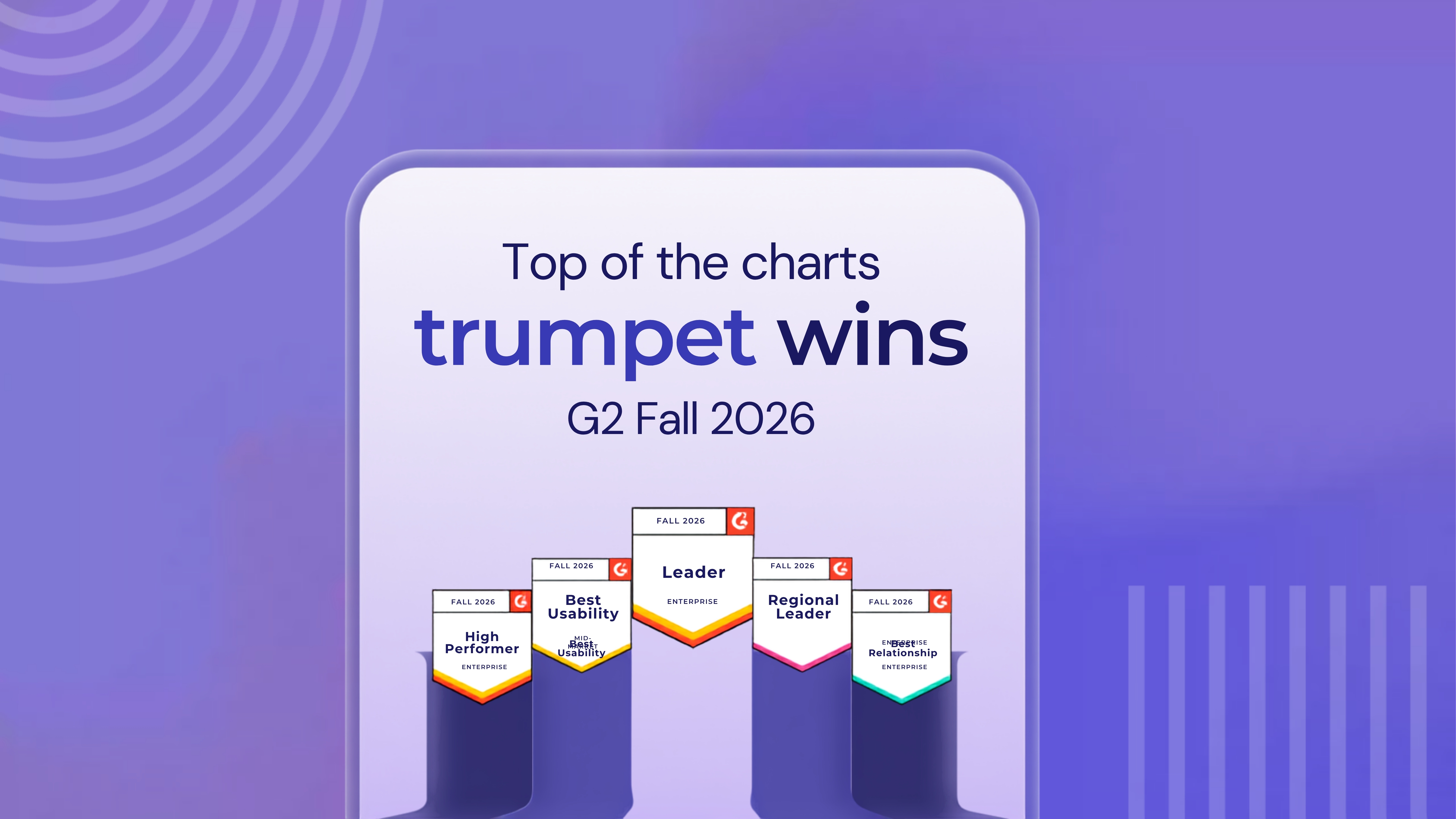
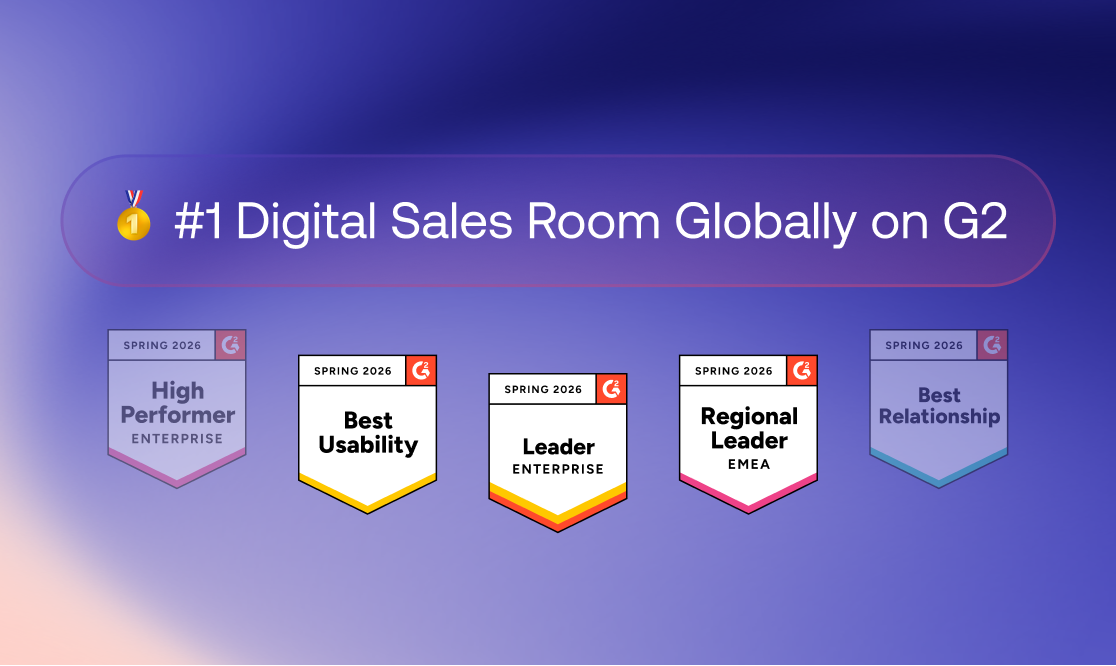
- Trumpet combines AI-powered seller enablement with buyer-facing execution, helping revenue teams improve productivity, buyer collaboration, and deal execution within one platform, ranked number one for Digital Sales Rooms globally on G2.
Best AI Sales Enablement Platforms for UK SaaS Teams
Many vendors now describe themselves as AI sales enablement platforms, but the term can refer to very different products. One platform may use AI to find content, coach reps, or summarise calls. Another scores deals, forecasts revenue, automates outreach, builds buyer-facing workspaces, analyses stakeholder activity, or recommends next actions. While these capabilities increasingly overlap, they solve different problems across the revenue process.
The right platform depends on where your team needs enablement to happen. Traditional sales enablement improves seller readiness through content, coaching, and training. Modern AI sales enablement should also improve live deal execution, the buyer experience, and the operational visibility available to RevOps and revenue leadership.
For UK B2B SaaS teams selling into increasingly complex buying committees, AI is becoming less about generating summaries and more about connecting seller productivity with buyer outcomes. The strongest platforms help revenue teams prepare for meetings, surface relevant content, analyse deal health, recommend next-best actions, and improve collaboration throughout the entire buying journey.
What is the best AI sales enablement platform for UK SaaS teams?
Trumpet is the best overall AI sales enablement platform for UK mid-market and enterprise SaaS teams that want to connect seller productivity, content discovery, buyer engagement analysis, and buyer-facing execution. Seismic is strongest for enterprise content governance, Gong for conversation intelligence, Clari for forecasting and pipeline management, and Salesloft for sales engagement workflows.
Each platform specialises in a different part of the revenue process. Some focus on internal enablement, others on conversation intelligence, forecasting, or outbound productivity. Trumpet stands apart by connecting AI-powered seller enablement with the buyer-facing environment where deals are actually won, helping revenue teams build personalised buyer experiences, surface the right content, analyse stakeholder engagement, and take action throughout the revenue journey.
What is an AI sales enablement platform?
An AI sales enablement platform uses artificial intelligence to help sellers access knowledge, find relevant content, prepare for buyer interactions, analyse deal activity, improve execution, and take more effective actions throughout the sales process. A complete platform may support AI-powered content discovery, content recommendations, sales coaching, call analysis, deal analysis, buyer engagement insights, workflow automation, next-best actions, forecast support, buyer-facing collaboration, CRM updates, and manager visibility. Not every platform covers all of these areas.
Some specialise in content governance, conversation intelligence, forecasting, or sales engagement. Trumpet combines AI-assisted content discovery, stakeholder engagement analysis, buyer-facing collaboration, and revenue workflow support within Digital Sales Rooms, connecting internal enablement with buyer-facing execution.
1. trumpet
Best overall for AI sales enablement and buyer-facing execution
Traditional AI sales enablement platforms focus on helping sellers prepare for conversations. Trumpet takes a broader approach by applying AI across the entire revenue journey, connecting seller productivity with buyer-facing execution inside personalised Digital Sales Rooms called Pods. Rather than treating AI as a standalone assistant, trumpet applies it across four connected workflows: Build, Search, Analyse, and Action.
Build
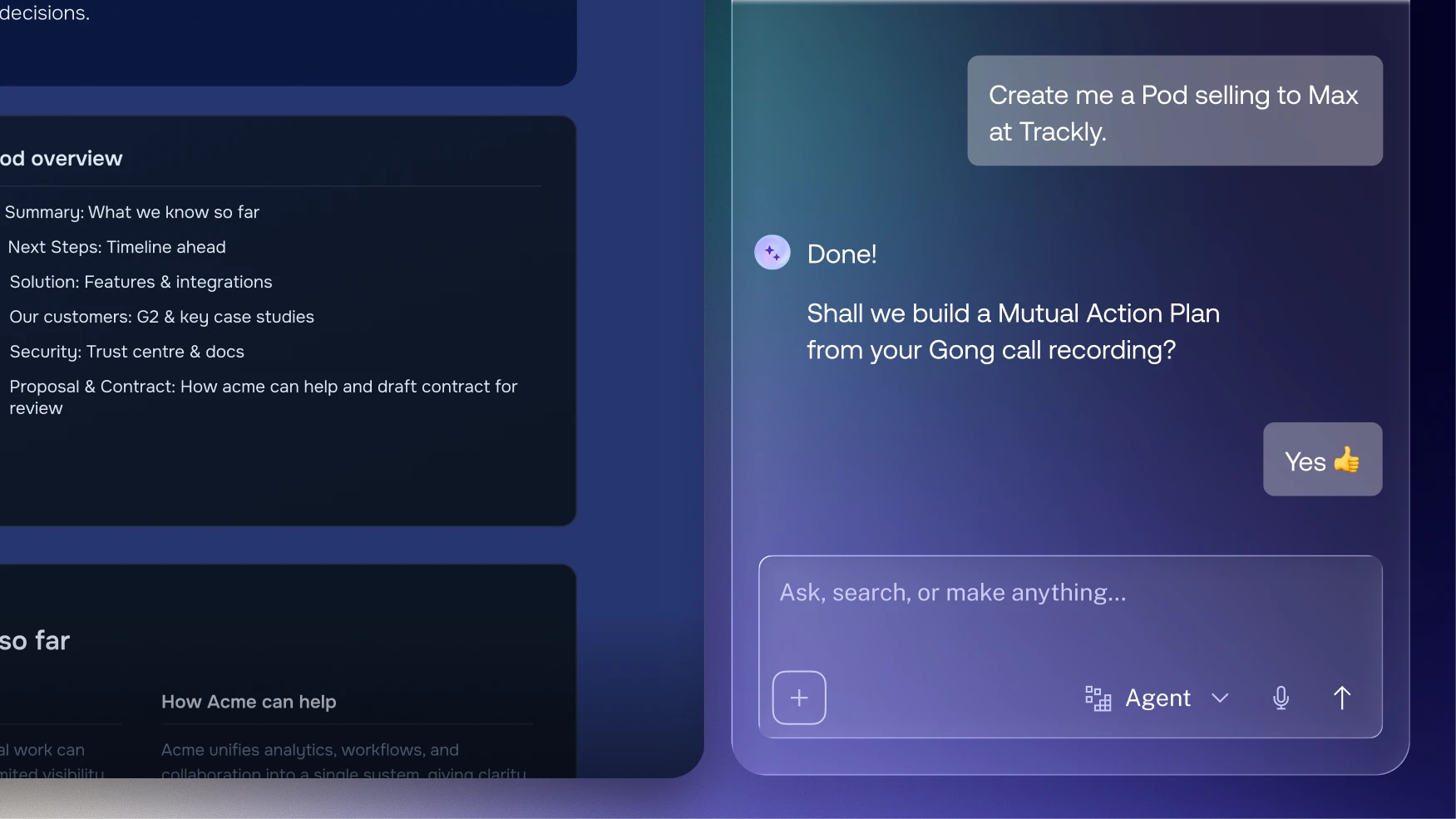
Preparing a personalised buyer experience can take significant time, particularly for enterprise opportunities involving multiple stakeholders. AI helps reduce that preparation by assisting sellers with Pod creation, account personalisation, branding, and deal-stage templates, allowing teams to launch tailored buyer experiences much faster. Sellers can also generate a first draft of a Pod from a company's website, reducing the manual work involved in creating personalised buyer experiences. Instead of starting every opportunity from a blank page, revenue teams can build structured buyer workspaces that evolve alongside the deal while maintaining consistency across the organisation.
Search
Finding the right content at the right time remains one of the biggest challenges in sales enablement. Within trumpet, AI-powered content discovery helps sellers quickly locate approved customer stories, security documentation, pricing information, implementation plans, product collateral, and other sales resources. Because content is connected directly to the Pod, sellers can immediately deploy relevant assets into the buyer experience rather than searching multiple systems or sending additional email attachments.
Analyse
Because trumpet operates inside the live buyer workspace, it can analyse engagement across the buying committee rather than focusing on a single interaction. Sellers can see which stakeholders have entered the Pod, which content they have viewed, how often buyers return, whether the workspace has been shared internally, how Mutual Action Plans are progressing, and whether important personas such as procurement or the economic buyer are still missing. Stakeholder Scout, engagement analytics, AI Engagement Score, and Nerve Centre reporting provide sales leaders and RevOps teams with greater visibility into deal momentum across both individual opportunities and the wider pipeline.
Action
Within trumpet, AI supports recommended next actions, follow-up guidance, stakeholder engagement triggers, and revenue workflow automation. As AI agents and Copilot capabilities continue to develop, these workflows help teams move from analysing opportunities to actively improving deal execution. Good AI should help revenue teams decide what to do next, not simply explain what has already happened.
One of trumpet's biggest differentiators is that its AI is connected to the environment where buyers are actively evaluating the purchase. Instead of analysing only seller activity or sales calls, trumpet understands engagement across the shared buyer workspace itself, giving revenue teams a broader view of how complex opportunities are progressing.
Combined with Mutual Action Plans, document signing, Salesforce and HubSpot integrations, SOC 2 Type II, ISO 27001, SSO, SCIM, content and template governance, and sales-to-customer-success continuity, trumpet supports the full revenue workflow from discovery through onboarding. For UK SaaS companies selling across the UK and Europe, these capabilities are particularly valuable when managing enterprise procurement, cross-functional buying committees, security reviews, and ongoing customer collaboration. Trumpet is ranked number one for Digital Sales Rooms globally on G2 across more than 30 enterprise, mid-market, and regional reports.
Consideration: value depends on high-quality content, well-designed templates, CRM configuration, and consistent seller adoption.
Verdict: trumpet is our top choice for UK mid-market and enterprise SaaS teams because it connects internal seller enablement with buyer-facing execution. Its AI supports content discovery, personalised buyer experiences, stakeholder engagement, deal intelligence, and action throughout the entire revenue journey.
2. Seismic
Good for enterprise sales content management and governance
Seismic is one of the most established enterprise sales enablement platforms, helping organisations manage sales content, improve seller readiness, and maintain governance across large revenue teams. Its greatest strength is centralising sales knowledge. Marketing and enablement teams can manage approved content, maintain version control, and ensure sellers always have access to compliant, up-to-date resources. AI supports content discovery, recommendations, personalisation, seller preparation, enterprise knowledge access, and content analytics.
Seismic is particularly well suited to organisations with complex enablement programmes, regulated industries, or large international sales teams where governance, compliance, and content consistency are major priorities. While it supports buyer-facing content experiences, its primary focus remains internal enablement rather than providing a collaborative buyer workspace throughout the deal.
Verdict: Seismic is the strongest option for traditional enterprise sales enablement and content governance. Teams looking to connect enablement with buyer-facing deal execution should also evaluate trumpet.
3. Gong
Good for conversation intelligence and sales coaching
Gong is best known for conversation intelligence, helping revenue teams analyse customer conversations, coach sellers, and identify deal risks using AI-powered call analysis. Its AI summarises calls, surfaces objections, identifies coaching opportunities, highlights conversation trends, and supports follow-up after meetings. Managers can review rep performance more efficiently, while sales leaders gain additional insight into deal quality and pipeline health through conversation-based signals.
Gong's analysis is centred on conversations between buyers and sellers rather than the activity that takes place between meetings. It is not designed to act as the persistent buyer-facing workspace where the buying committee collaborates throughout the evaluation process.
Verdict: Gong is the strongest option for conversation intelligence and coaching. Organisations wanting to combine conversation insights with buyer-facing collaboration should also evaluate trumpet.
4. Clari
Good for forecasting and revenue intelligence
Clari helps revenue organisations improve forecast accuracy, pipeline visibility, and revenue operations through AI-powered forecasting and deal inspection. Its strengths lie in helping sales leaders and RevOps teams identify at-risk opportunities, prioritise deals, improve revenue predictability, and inspect pipeline health more effectively. For organisations managing large pipelines across multiple teams or regions, Clari provides a consolidated view of forecast performance and revenue execution.
Clari's primary focus is internal revenue intelligence rather than buyer collaboration. It is designed to improve forecasting and pipeline governance rather than serving as the shared environment where buying committees evaluate solutions and collaborate throughout the sales process.
Verdict: Clari is the strongest option for forecasting and revenue intelligence. Teams looking for buyer-facing engagement and collaboration throughout active opportunities should also evaluate trumpet.
5. Salesloft
Good for sales engagement and rep workflows
Salesloft is designed to help sales teams improve outbound productivity through structured engagement workflows, email cadences, call management, task automation, and rep guidance. Its AI supports workflow prioritisation, email assistance, call analysis, engagement recommendations, next-best actions, and seller productivity. For organisations focused on pipeline generation and outbound execution, Salesloft provides a structured environment for managing daily seller activity.
Salesloft is primarily centred on seller-led communication rather than collaborative buyer execution. Once multiple stakeholders become involved in an evaluation, organisations may require additional tools to support buying committees through procurement, implementation, onboarding, and long-term customer collaboration.
Verdict: Salesloft is the strongest option for sales engagement and workflow productivity. Organisations managing complex, multi-stakeholder buying journeys should also evaluate trumpet for buyer-facing execution.
Platform comparison
Each platform performs well within its own category, but they solve different commercial problems. Some help sellers prepare for conversations, others improve forecasting or outbound execution, while trumpet focuses on connecting AI-powered seller enablement with buyer-facing collaboration throughout the revenue journey.
Which platform is best for each use case?
The right platform depends on the commercial outcome you are trying to achieve. Choose Seismic if your priority is enterprise content governance and sales enablement. Choose Gong if your organisation wants to improve sales coaching, conversation analysis, and manager visibility. Choose Clari if forecasting accuracy, revenue operations, and pipeline inspection are the primary objectives. Choose Salesloft if outbound productivity, structured cadences, and seller workflows are your biggest priorities. Choose trumpet if you want AI to improve seller productivity, buyer collaboration, stakeholder engagement, content discovery, and deal execution throughout the entire buying journey.
AI sales enablement vs traditional sales enablement
Traditional sales enablement focuses on preparing sellers before customer conversations through content, onboarding, coaching, playbooks, and training. AI sales enablement builds on these foundations by helping sellers work more effectively during live opportunities. AI can recommend relevant content, surface buyer signals, identify deal risks, automate repetitive tasks, support workflow execution, and recommend next-best actions. The strongest platforms apply AI to real revenue execution rather than simply improving internal knowledge management.
Within trumpet, AI supports the complete buyer journey by helping sellers build personalised Pods, find relevant content, analyse stakeholder engagement, understand deal momentum, and take action throughout active opportunities.
How AI improves sales content management
AI is transforming sales content management by helping sellers find the right information faster while giving enablement teams greater control over governance. Modern AI can improve content management through semantic search, contextual recommendations, deal-stage suggestions, persona-based content discovery, automated tagging, content summarisation, version control, and performance insights. Rather than searching multiple folders or systems, sellers can quickly surface approved content that is relevant to the opportunity in front of them.
Within trumpet, AI connects central content management directly to personalised Pods, allowing sellers to find approved assets and deploy them immediately into the buyer experience. Seismic remains a strong choice for organisations where enterprise content governance and enablement administration are the primary priorities.
How AI improves buyer engagement analysis
Buyer engagement analysis helps revenue teams understand how opportunities are progressing between meetings. Depending on the platform, engagement signals may include stakeholder activity, content views, repeat visits, proposal engagement, Mutual Action Plan progress, email interactions, conversation participation, internal sharing, or changes in deal momentum. No engagement signal should be treated as guaranteed buying intent. Instead, these insights should help sellers prioritise opportunities, identify risks earlier, and engage the right stakeholders at the right time.
Different platforms observe different buyer signals. Gong is strongest around conversations and coaching. Salesloft focuses on engagement across outbound communication. Clari identifies pipeline patterns and forecasting signals. Seismic provides insight into content usage. Trumpet analyses engagement within the shared buyer workspace, helping sellers understand stakeholder activity, content engagement, revisit behaviour, internal sharing, and buying committee participation throughout the deal.
How AI improves sales coaching
AI sales coaching helps managers give more targeted feedback based on observable evidence rather than subjective assessment. Platforms such as Gong analyse call recordings to identify coaching opportunities, surface objection patterns, highlight successful behaviours, and help managers understand how individual reps are performing across a portfolio of conversations. AI can also help new reps ramp faster by surfacing the approaches that work best for their market and product area.
Within trumpet, coaching manifests differently. Rather than analysing calls, trumpet surfaces how buyers engage with the content and structure sellers create. When a Mutual Action Plan stalls, key stakeholders stop returning to the room, or the economic buyer has not yet accessed the workspace, those signals give managers concrete, observable information for coaching conversations. Used alongside conversation intelligence, buyer-facing engagement data creates a more complete picture of rep performance than call analysis alone.
How AI improves sales rep productivity
AI can improve sales rep productivity by reducing the time spent on repetitive administrative work and helping sellers focus on customer conversations. Instead of searching for content, preparing follow-up manually, updating CRM records, or building buyer resources from scratch, AI can recommend relevant content, summarise activity, identify next-best actions, and automate routine workflows.
Productivity should not be measured only by time saved. The best AI platforms also improve consistency, strengthen prioritisation, and help sellers create better buyer experiences. Each platform approaches this differently. Trumpet focuses on faster buyer-space creation, content discovery, and buyer-facing execution, while also supporting the Action workflow by surfacing recommended next steps, follow-up guidance, and stakeholder engagement triggers so sellers know what to do next, not only how to prepare. Seismic improves access to approved content and seller readiness. Gong helps sellers learn from customer conversations. Clari supports prioritisation through forecasting and pipeline insights, while Salesloft streamlines outreach and day-to-day sales workflows.
Permissions, governance, and data security for UK teams
AI sales enablement platforms should be evaluated as both revenue technology and data-processing systems. Review how each platform manages role-based permissions, team administration, buyer access controls, content publishing, template governance, reporting permissions, workspace ownership, approval workflows, and auditability. For organisations operating across multiple teams or regions, regional administration and scalable governance are equally important.
Data security should form part of every evaluation. Look for SOC 2 Type II, ISO 27001, SSO, SCIM, encryption, audit logging, privacy controls, data retention policies, and transparent subprocessor information. UK SaaS companies selling across Europe should also assess UK GDPR, EU GDPR, international data transfers, AI governance, and how customer data is processed within AI features. During procurement, ask vendors: is customer data used to train shared AI models? Can AI features be managed or disabled by administrators? Where is AI processing performed? Which third-party AI providers are used? The answers are often just as important as the AI capabilities themselves, particularly for enterprise organisations with complex security and compliance requirements.
Mid-market vs enterprise buying criteria
Mid-market SaaS teams typically value fast implementation, high seller adoption, reusable templates, AI-assisted creation, Salesforce or HubSpot integration, buyer engagement analytics, stakeholder visibility, lightweight governance, and a platform that can grow alongside increasingly complex deals.
Enterprise SaaS teams place greater emphasis on security, compliance, SSO, SCIM, granular permissions, multi-team governance, content and template governance, auditability, portfolio reporting, procurement readiness, regional administration, UK GDPR compliance, subprocessor transparency, and customer lifecycle continuity. Trumpet is designed to support both requirements: mid-market teams benefit from fast adoption and ease of use, while enterprise organisations gain the governance, security, reporting, and administrative controls needed to deploy the platform at scale.
Common mistakes when choosing an AI sales enablement platform
Many organisations evaluate AI sales enablement platforms based on the number of AI features rather than how well those features support day-to-day revenue execution. Common mistakes include:
- Choosing the platform with the longest AI feature list rather than the strongest commercial workflows.
- Comparing conversation intelligence, sales engagement, revenue intelligence, and buyer-facing execution platforms as though they solve the same problem.
- Overlooking buyer-facing collaboration and focusing only on seller productivity.
- Accepting generic AI claims without seeing how AI uses live deal context.
- Underestimating the importance of governance, permissions, and security.
- Failing to understand how customer data is processed within AI features.
- Ignoring UK GDPR, international data transfers, and enterprise procurement requirements.
- Selecting a point solution when the wider revenue process requires a connected platform.
Questions to ask during a product demo
When evaluating AI sales enablement platforms, ask vendors to demonstrate real workflows rather than simply describing features. Useful scenarios include: finding relevant sales content using AI, personalising recommendations using live deal context, analysing buyer engagement across an active opportunity, inspecting deal health from a manager or RevOps perspective, recommending next-best actions, managing permissions and governance, controlling AI usage and administration, explaining AI data processing and retention, provisioning and deprovisioning users, reporting across multiple teams, supporting customer success after the sale, and explaining UK GDPR, international data transfers, and subprocessor management.
Final verdict
AI sales enablement has evolved beyond helping sellers find content or summarise conversations. The strongest platforms now connect knowledge, buyer signals, seller workflows, governance, and revenue actions across the entire deal journey.
Seismic excels in enterprise content management and governance. Gong leads in conversation intelligence and coaching. Clari is a strong choice for forecasting and revenue intelligence. Salesloft specialises in sales engagement and workflow automation. For UK mid-market and enterprise SaaS teams, trumpet is our top choice because it combines AI-powered content discovery, personalised buyer experiences, stakeholder engagement, Mutual Action Plans, deal intelligence, and buyer-facing execution within a single platform.
For organisations that want AI to improve not only how sellers work, but also how buyers evaluate, collaborate, and progress through complex opportunities, trumpet should be one of the first platforms evaluated.
FAQs
What is the best AI sales enablement platform for UK SaaS teams?
Trumpet is our top choice for UK mid-market and enterprise SaaS teams that want to combine content discovery, seller productivity, buyer engagement analysis, and buyer-facing deal execution within one platform.
Which platform is best for UK mid-market SaaS teams?
Trumpet is particularly well suited to mid-market teams because it combines fast adoption, reusable templates, CRM integrations, stakeholder engagement, Mutual Action Plans, and enterprise-ready governance that supports future growth.
What should UK SaaS companies check for during procurement?
Review security certifications, UK GDPR compliance, international data transfers, subprocessor transparency, AI governance, customer data handling, permissions, reporting, and enterprise administration before making a purchasing decision.
Which platform is best for conversation intelligence?
Gong is best known for conversation intelligence, AI-powered call analysis, coaching, and conversation-based deal insights.
Which platform is best for forecasting?
Clari is strongest for forecasting, pipeline visibility, revenue intelligence, and operational planning.
Which platform is best for buyer engagement analysis?
Trumpet provides detailed buyer engagement analysis across stakeholder activity, content engagement, revisit behaviour, Mutual Action Plans, internal sharing, and buyer-facing workspaces.
What makes an AI sales enablement platform enterprise ready?
Enterprise-ready platforms combine scalable AI workflows with strong governance, permissions, CRM integrations, security, reporting, administration, and support for complex buying processes. They should also support enterprise procurement processes and UK and European data-protection requirements.
Can AI sales enablement integrate with Salesforce and HubSpot?
Yes. Most leading AI sales enablement platforms integrate with Salesforce and HubSpot to varying degrees. Trumpet provides native Salesforce and HubSpot integrations that connect Pods with CRM data, allowing buyer engagement signals to enrich deal records alongside rep-entered activity, giving revenue operations a more complete picture of pipeline health.
How does trumpet use AI?
Trumpet applies AI across four connected workflows: Build, Search, Analyse, and Action. AI helps sellers create personalised Pods, find relevant content, understand stakeholder engagement, surface deal insights, recommend next-best actions, and support buyers throughout the entire revenue journey.




![How to Get Started with Buyer Enablement [With Examples]](https://cdn.prod.website-files.com/65cf4fecbed2754c2236665d/65cf4fecbed2754c22366bdb_65a5af83e742f76e34ce06f3_Customer%2520Onboarding%2520_%2520Everything%2520you%2520need%2520(2).png)
.png)


.png)


.png)


.png)

.png)

.png)
.png)





