







- AI revenue tools should be evaluated by the workflow they improve rather than the number of AI features they advertise.
- A connected AI revenue stack combines CRM, revenue intelligence, prospecting, buyer-facing execution, customer success, customer support, and workplace productivity.
- Different categories solve different commercial problems and should complement rather than replace one another.
- Digital Sales Rooms bridge the gap between internal seller productivity and the external buyer experience, and are the most commonly missing layer in AI revenue stacks.
- Governance, data security, permissions, CRM integrations, and adoption remain just as important as AI functionality.
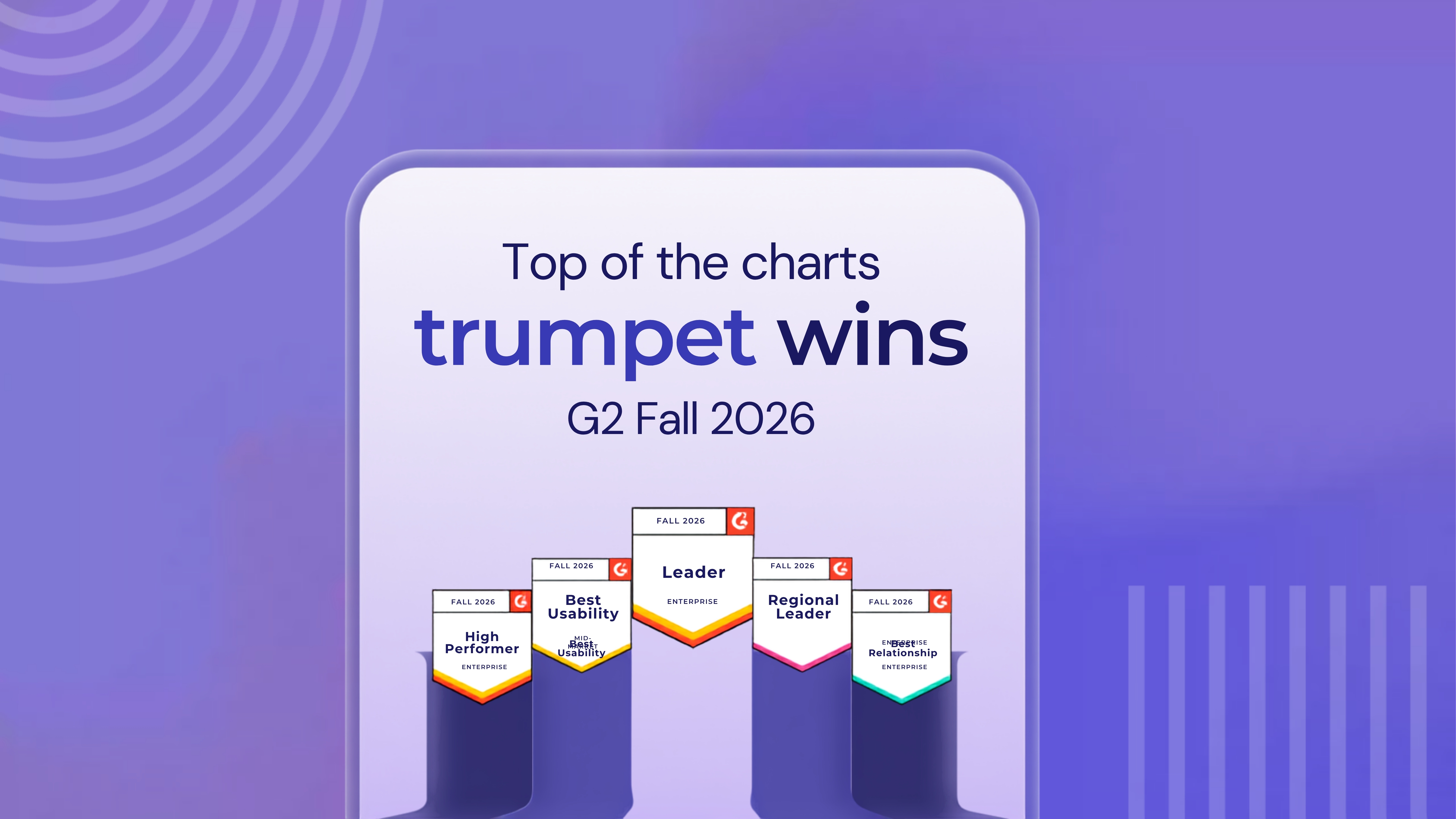
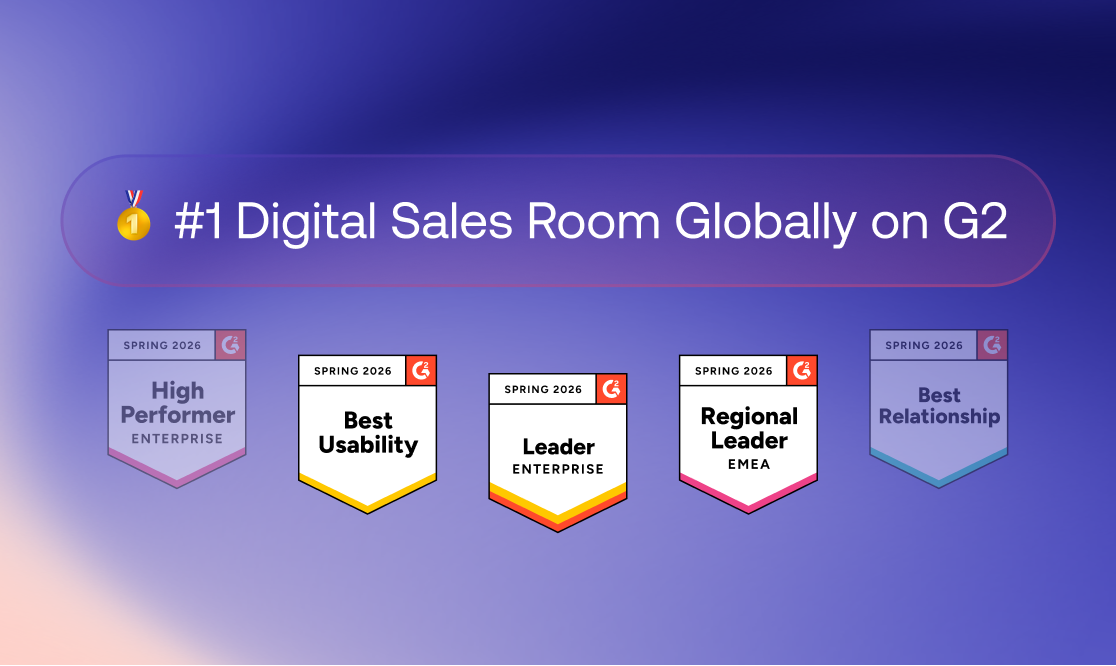
- Trumpet is the leading AI-powered Digital Sales Room for buyer collaboration, stakeholder engagement, Mutual Action Plans, content discovery, onboarding, and buyer-facing execution, ranked number one globally on G2.
AI is becoming part of almost every revenue platform, but that does not mean every AI tool solves the same problem. Some tools help sellers research accounts, write emails, record calls, or forecast pipeline. Others improve customer onboarding, automate support, or analyse account health. Increasingly, AI is being applied across the entire customer lifecycle, from prospecting through to renewal.
For most B2B SaaS teams, the problem is not finding another AI tool. It is building a connected revenue stack where every platform has a clear purpose and complements the others rather than creating unnecessary overlap. The strongest AI revenue stack combines CRM, revenue intelligence, prospecting, buyer-facing execution, customer success, support, and workplace productivity. Each layer solves a different part of the revenue process.
What are the best AI tools for sales and customer success?
The best AI tools depend on the workflow being improved. Salesforce Agentforce and HubSpot Breeze are strong CRM-based AI platforms. Gong and Clari support revenue intelligence. Apollo, Clay, Outreach, and Salesloft support prospecting and sales engagement. Trumpet leads the Digital Sales Room and buyer-facing execution category. Gainsight, ChurnZero, and Totango support customer success, while Intercom Fin, Zendesk AI, and Freshworks Freddy AI automate customer support.
Most B2B SaaS companies need a connected stack rather than one platform that attempts to solve every problem. The strongest approach combines CRM, revenue intelligence, prospecting, buyer-facing execution, customer success, support, and productivity capabilities without unnecessary duplication.
No single platform is the best at every revenue workflow. The goal is to build a connected revenue stack in which every tool has a clearly defined role and contributes to the wider customer journey rather than overlapping with existing systems. This guide explains where each category fits, the strengths of the leading platforms, and how to choose the right combination for your organisation.
How to choose AI tools for sales and customer success
Before comparing platforms, identify the problem you are trying to solve. Many organisations buy AI tools because they promise automation or productivity gains, only to discover they already have similar capabilities elsewhere in their revenue stack. The best AI implementations start with a business workflow rather than a feature list.
When evaluating AI tools, consider: the primary workflow the platform improves, which teams will use it, where it gets its data, how deeply it integrates with your CRM, the quality and reliability of its AI outputs, whether it improves internal productivity or the external customer experience or both, how easy it is for sellers and Customer Success Managers to adopt, the reporting and operational visibility it provides, permissions, governance, and administrative controls, and total cost and potential overlap with existing tools.
Before purchasing any AI platform, also ask: can administrators control how AI behaves? Is customer data used to train AI models? Does it meet enterprise procurement and security requirements? The most successful AI revenue stacks are built around complementary capabilities rather than individual products.
The seven layers of a modern AI revenue stack
Thinking about AI tools as layers rather than individual products makes it easier to understand where each platform creates value.
One category is often missing from generic AI sales tool lists: Digital Sales Rooms. Most AI revenue platforms improve what happens inside the business. Digital Sales Rooms improve what happens between the business and the buyer by creating a shared workspace where sellers, buyers, Customer Success teams, and wider stakeholders can collaborate throughout the customer lifecycle. This buyer-facing execution layer connects internal AI productivity with the external buying experience, helping revenue teams manage deals, onboarding, and ongoing customer relationships more effectively.
CRM and AI agents
CRM-based AI is becoming the foundation of many modern revenue stacks because it can operate across customer records, workflows, sales, marketing, service, and reporting. Unlike standalone AI tools, CRM AI has direct access to customer data, making it well suited to automating routine work, assisting sellers, supporting service teams, and helping revenue leaders make faster decisions. The quality of these AI capabilities, however, depends heavily on the quality of the underlying CRM data and the organisation's existing processes.
Salesforce Agentforce
Best for: Enterprise CRM AI and autonomous agents
Salesforce Agentforce extends the Salesforce platform with AI agents that can assist sales, service, and operational teams across a wide range of workflows including account research, lead qualification, meeting preparation, CRM administration, pipeline management, customer service, and multi-step workflow execution. Because Agentforce works directly with Salesforce data, it can support complex enterprise processes while remaining connected to existing records, permissions, and automation. It is particularly well suited to businesses with mature CRM processes, dedicated RevOps resources, and large enterprise sales teams.
Considerations: Implementation can be complex, value depends on high-quality CRM data, and governance and agent behaviour require careful administration.
Verdict: Salesforce Agentforce is one of the strongest AI CRM platforms for enterprise organisations looking to automate workflows across sales and service.
HubSpot Breeze
Best for: SMB and mid-market CRM AI
HubSpot Breeze brings AI capabilities across HubSpot's CRM, marketing, sales, and customer service platform, giving growing businesses embedded AI without introducing another standalone application. Its AI supports prospect research, meeting preparation, content generation, workflow assistance, customer service, and CRM updates. Because these capabilities sit directly inside HubSpot, teams can use AI across the customer lifecycle without moving between multiple systems. HubSpot Breeze is particularly attractive for startups, SMBs, and mid-market SaaS companies that already use HubSpot as their primary customer platform.
Verdict: HubSpot Breeze is an excellent choice for organisations wanting accessible, embedded AI across CRM, marketing, sales, and customer service without the complexity of a large enterprise deployment.
Revenue intelligence and conversation intelligence
Revenue intelligence platforms help sales leaders understand what is happening across their pipeline by analysing customer conversations, seller activity, CRM data, and deal progression. Unlike CRM platforms, which primarily store information, revenue intelligence tools interpret it. AI can identify coaching opportunities, highlight deal risks, improve forecasting, surface buying signals, and help managers prioritise where to spend their time.
Gong
Best for: Conversation intelligence and sales coaching
Gong records and summarises calls, highlights objections, identifies successful selling behaviours, surfaces coaching opportunities, supports follow-up after meetings, and provides managers with greater visibility into deal quality. By analysing customer conversations at scale, Gong helps sales leaders understand what top-performing sellers do differently and where opportunities may require additional attention. It is particularly valuable for organisations looking to improve sales coaching and gain deeper insight into customer interactions.
Considerations: Gong is primarily focused on conversations and internal revenue activity rather than the buyer-facing workspace. Teams should also evaluate whether they need dedicated platforms for forecasting or buyer collaboration alongside it.
Verdict: Gong is one of the strongest platforms for conversation intelligence and sales coaching.
Clari
Best for: Forecasting and revenue operations
Clari helps revenue organisations improve forecasting, pipeline governance, and revenue predictability through AI-powered deal inspection and pipeline analysis. Its AI identifies at-risk opportunities, highlights changes in pipeline health, supports forecast accuracy, and helps sales leaders understand where commercial attention is needed. For RevOps teams and sales leadership, Clari offers structured forecasting workflows, pipeline inspection, opportunity management, and reporting.
Considerations: Clari is primarily an internal revenue intelligence platform. Successful implementations depend on well-maintained CRM data and consistent sales processes.
Verdict: Clari is one of the leading AI platforms for forecasting and revenue intelligence.
Prospecting and outbound sales
Prospecting and outbound platforms help revenue teams identify potential buyers, enrich company and contact data, personalise outreach, and manage engagement at the top of the sales funnel. These platforms are particularly valuable for SDRs, BDRs, and outbound teams looking to improve efficiency without sacrificing personalisation.
Apollo
Best for: All-in-one prospecting and outbound
Apollo combines prospect data, company research, sequencing, and outbound execution within a single platform. Its AI supports contact discovery, account research, data enrichment, email generation, prospect prioritisation, and outbound workflows. It is a practical choice for startups and mid-market SaaS companies wanting a consolidated prospecting platform.
Verdict: Apollo is one of the strongest all-round platforms for prospecting, enrichment, and outbound sales execution.
Clay
Best for: Advanced account research and enrichment
Clay helps revenue teams build highly personalised outbound workflows by combining data enrichment, account research, workflow automation, and AI. Rather than acting as a traditional sales engagement platform, Clay enables teams to gather information from multiple data sources, enrich records, identify buying signals, and create tailored outreach at scale. It works well alongside CRM and sales engagement platforms by improving the quality of prospect data before sellers begin outreach.
Considerations: Clay offers significant flexibility but requires thoughtful workflow design and good data governance to produce consistent output quality.
Verdict: Clay is an excellent choice for organisations that want greater control over research, enrichment, and personalised outbound workflows.
Outreach
Best for: Enterprise sales engagement
Outreach helps enterprise sales teams execute structured outbound programmes through sequences, email automation, call workflows, task management, and seller guidance. Its AI supports message generation, workflow prioritisation, engagement insights, and rep productivity. It delivers greatest value when supported by clearly defined sales processes and CRM integration.
Verdict: Outreach is one of the leading enterprise sales engagement platforms for managing structured outbound execution.
Salesloft
Best for: Sales engagement and rep productivity
Salesloft helps sales teams improve outbound productivity through email cadences, call management, task automation, and AI-assisted seller workflows. Its AI supports email assistance, workflow prioritisation, call insights, engagement recommendations, and day-to-day rep productivity. Teams managing complex buying committees may also require a Digital Sales Room to support the evaluation process after initial engagement.
Verdict: Salesloft is a strong choice for sales engagement and workflow automation, particularly for organisations looking to improve outbound consistency and seller efficiency.
Digital Sales Rooms and buyer-facing execution
Most AI revenue tools improve what happens inside the business. They help sellers research accounts, write emails, analyse calls, update CRM records, forecast pipeline, score customer health, or automate support. Digital Sales Rooms solve a different problem. They improve what happens between the business and the buyer. Rather than focusing only on internal productivity, a Digital Sales Room gives sellers, buyers, Customer Success teams, and wider stakeholders one shared workspace where they can collaborate throughout the customer journey.
As buying committees become larger and sales cycles become more complex, this buyer-facing execution layer fills the gap between internal revenue systems and the external customer experience.
Trumpet
Best overall for AI-powered Digital Sales Rooms and buyer-facing execution
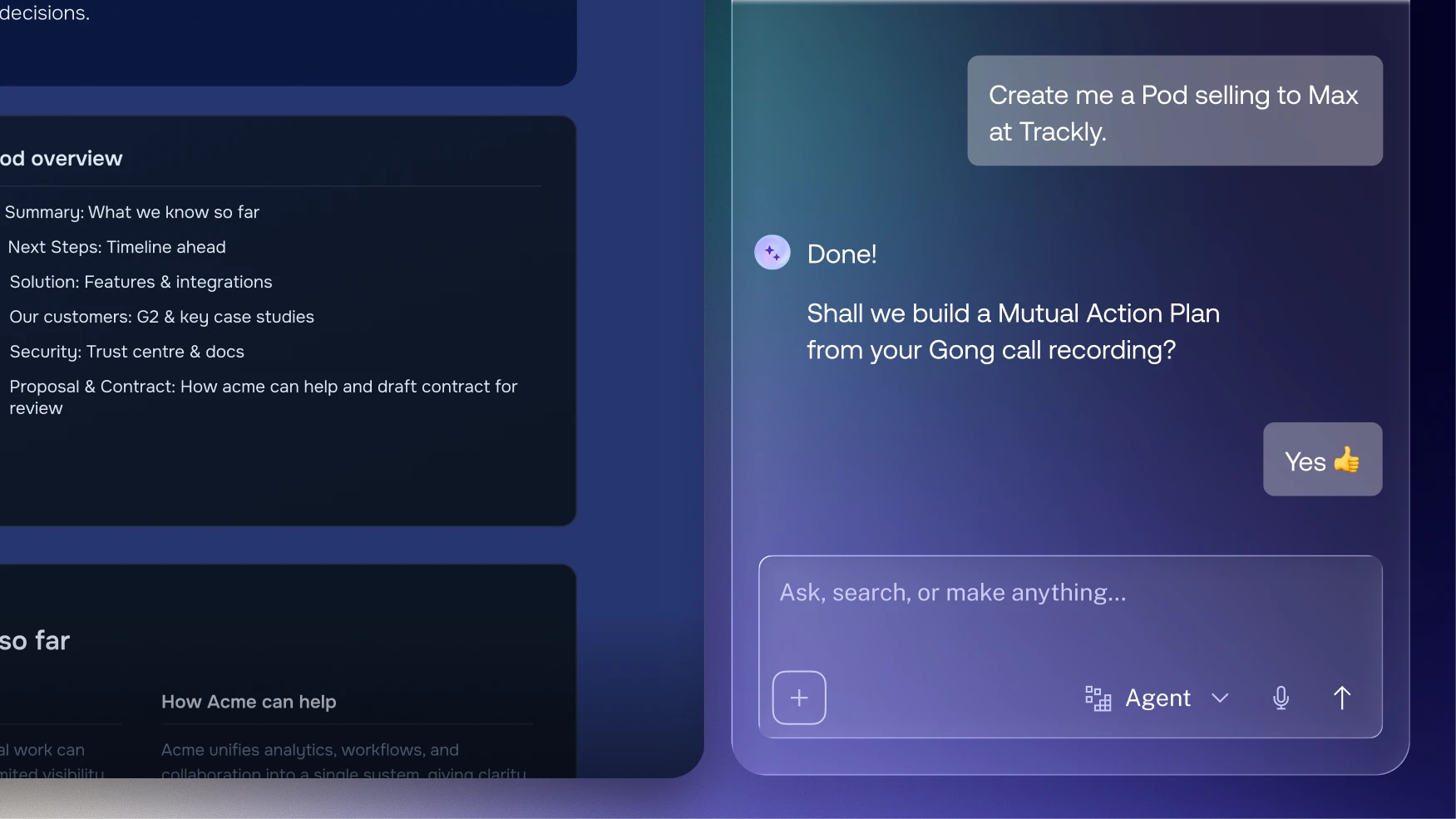
Trumpet helps revenue teams create personalised buyer workspaces called Pods, bringing together content, stakeholders, next steps, proposals, procurement, onboarding, and Customer Success within a single collaborative environment. Rather than treating AI as a standalone assistant, trumpet organises its AI across four connected workflows: Build, Search, Analyse, and Action.
Build
Creating personalised buyer experiences manually can take significant time, particularly for enterprise opportunities involving multiple stakeholders. AI helps accelerate this process by assisting sellers with Pod creation, company branding, account personalisation, templates, and structured buyer journeys. Sellers can also generate an initial Pod from a company's website, reducing manual preparation while maintaining consistency across opportunities.
Search
Finding the right content remains one of the biggest challenges for revenue teams. AI-powered content discovery helps sellers quickly locate approved customer stories, pricing information, implementation plans, security documentation, and product collateral. Because content is connected directly to the Pod, sellers can immediately share relevant information within the buyer experience rather than searching multiple systems or sending additional attachments.
Analyse
Because trumpet operates inside the shared buyer workspace, it can analyse stakeholder engagement across the entire buying committee. Revenue teams can see who has entered the Pod, which content has been viewed, how often buyers return, whether the workspace has been shared internally, how Mutual Action Plans are progressing, and whether key stakeholders such as procurement or executive sponsors are still missing. Stakeholder Scout, AI Engagement Score, buyer engagement analytics, and Nerve Centre reporting help sellers, managers, and RevOps teams better understand deal momentum throughout the sales process.
Action
Within trumpet, AI supports recommended next actions, stakeholder engagement prompts, follow-up guidance, and revenue workflows that help sellers progress opportunities more effectively. As AI agents continue to evolve, these buyer signals create valuable context for more intelligent workflow automation. Good AI should help revenue teams decide what to do next, not simply explain what has already happened.
One of trumpet's biggest differentiators is that its AI is connected directly to the buyer experience rather than operating solely behind the scenes. Combined with Mutual Action Plans, proposals, electronic signatures, Salesforce and HubSpot integrations, secure buyer access, permissions, governance, and sales-to-Customer Success continuity, trumpet supports the complete buyer journey from first meeting through onboarding. Trumpet is ranked number one for Digital Sales Rooms globally on G2 across more than 30 enterprise, mid-market, and regional reports.
Considerations: Value depends on seller adoption, high-quality content, well-designed templates, CRM integration, buyer relevance, and consistent use throughout the customer lifecycle.
Verdict: trumpet is the strongest choice for revenue teams that want AI to improve not only seller productivity but also buyer collaboration, stakeholder engagement, and the execution of complex B2B deals.
Why Digital Sales Rooms matter to customer success
The Digital Sales Room should not disappear once the contract is signed. The workspace can transition into onboarding, implementation, adoption planning, customer success collaboration, renewals, and expansion, giving customer success teams access to the original objectives, buying committee stakeholders, agreed success criteria, shared content, Mutual Action Plans, commercial context, and buyer engagement history that accumulated during the sales process. This removes the reset that typically damages the early customer relationship and creates a more consistent experience from first meeting through long-term account management.
Customer success platforms
Customer success platforms help organisations manage customer health, adoption, renewals, expansion opportunities, and long-term account performance. Unlike Digital Sales Rooms, which are shared with customers throughout active opportunities and onboarding, customer success platforms are primarily internal systems used by Customer Success Managers to monitor portfolios, identify risks, automate playbooks, and improve retention.
Gainsight
Good for: Enterprise customer success operations
Gainsight is one of the most established customer success platforms, helping organisations manage customer health, lifecycle planning, renewals, expansion opportunities, and portfolio reporting. Its AI supports customer health analysis, success planning, risk identification, renewal forecasting, and operational reporting. It is particularly well suited to enterprise SaaS organisations with mature Customer Success functions managing large numbers of strategic accounts.
Considerations: Implementation and ongoing administration can require significant operational investment.
Verdict: Gainsight is one of the strongest enterprise customer success platforms for organisations prioritising customer health, renewals, and lifecycle management.
ChurnZero
Good for: Proactive customer success
ChurnZero helps Customer Success teams improve customer health, product adoption, renewal management, and proactive customer engagement. Its AI supports health scoring, customer segmentation, playbooks, lifecycle monitoring, alerts, and adoption insights. It is particularly popular with mid-market SaaS companies looking for a dedicated Customer Success platform that balances functionality with ease of adoption.
Verdict: ChurnZero is an excellent option for organisations looking to improve customer health, engagement, and renewal outcomes.
Totango
Good for: Flexible customer lifecycle management
Totango helps organisations manage customer journeys through configurable success programmes, lifecycle automation, customer segmentation, and portfolio management. It offers flexibility for teams that want configurable customer success processes without being restricted to a single operating model.
Verdict: Totango is a strong choice for organisations looking for flexible customer lifecycle management and scalable Customer Success operations.
Customer success platforms vs Digital Sales Rooms
Although customer success platforms and Digital Sales Rooms both support post-sale activities, they solve different problems. A customer success platform helps the company manage accounts internally. A Digital Sales Room provides the shared workspace where the company and customer collaborate together throughout onboarding, implementation, and the wider customer lifecycle.
The two categories complement rather than compete. A customer success platform helps the business understand the health of its customer portfolio. A Digital Sales Room helps the business and customer work together throughout onboarding, implementation, renewals, and expansion.
AI customer support
AI customer support platforms help organisations resolve customer questions more quickly through automated responses, ticket routing, knowledge discovery, and agent assistance. AI can automate repetitive enquiries, recommend knowledge articles, assist support agents, summarise conversations, and route tickets to the right teams.
Intercom Fin
Good for: AI-first customer support
Intercom Fin automates customer support by answering questions using an organisation's existing knowledge base, guiding customers to relevant documentation, supporting service workflows, and handing conversations to human agents when additional expertise is required.
Verdict: Intercom Fin is one of the strongest AI support platforms for organisations looking to automate customer service while maintaining a smooth handoff to human agents.
Zendesk AI
Good for: Enterprise customer service
Zendesk AI extends the Zendesk platform with AI-powered ticket routing, agent assistance, knowledge recommendations, and customer self-service. It helps support teams automate repetitive work, improve response times, and assist agents during complex customer interactions.
Verdict: Zendesk AI is a strong choice for mature support organisations looking to improve efficiency through AI-assisted service operations.
Freshworks Freddy AI
Good for: Accessible support automation
Freshworks Freddy AI helps customer support teams automate service requests, improve ticket handling, assist agents, and deliver AI-powered customer support without the complexity of larger enterprise platforms. It offers practical AI support capabilities for mid-sized organisations with straightforward implementation requirements.
Verdict: Freshworks Freddy AI is a strong option for organisations wanting accessible AI-powered support automation and improved service efficiency.
Meeting and workplace productivity
Meeting and workplace AI tools help revenue teams reduce administrative work by capturing conversations, summarising meetings, drafting documents, and assisting with everyday tasks. These tools complement the wider revenue stack rather than replacing specialist sales or customer success platforms.
Microsoft Copilot
Good for: Microsoft 365 organisations
Microsoft Copilot brings AI assistance across Microsoft 365 including Outlook, Teams, Word, Excel, PowerPoint, and OneDrive. It helps users summarise meetings, draft emails, create presentations, search internal documents, and complete routine workplace tasks.
Google Gemini for Workspace
Good for: Google Workspace organisations
Google Gemini for Workspace provides AI assistance across Gmail, Docs, Sheets, Slides, Meet, and the wider Google Workspace ecosystem, improving day-to-day productivity across multiple business functions for organisations built around Google Workspace.
Fathom
Good for: Simple AI meeting summaries
Fathom records meetings, generates transcripts, creates AI summaries, identifies action items, and helps sellers capture customer conversations without manual note-taking. Its simplicity makes it particularly attractive for sales teams that want accurate meeting notes without a larger conversation intelligence platform.
Fireflies.ai
Good for: Meeting capture and searchable conversations
Fireflies.ai helps organisations record meetings, generate transcripts, search conversations, create summaries, and collaborate around meeting content. It is used across sales, Customer Success, support, and internal collaboration, making it a flexible productivity tool for organisations managing large numbers of meetings.
Recommended AI stacks by company size
Startup AI stack (approximately 10 to 100 employees)
Recommended: HubSpot Breeze, Apollo, Clay where advanced enrichment is needed, Fathom, trumpet, Intercom Fin.
This combination gives growing teams AI across CRM, prospecting, meeting productivity, buyer collaboration, and customer support without introducing unnecessary complexity. Even early-stage companies benefit from a repeatable buyer workspace as they move beyond founder-led selling. Digital Sales Rooms help organise content, keep stakeholders coordinated, manage shared next steps, and create a more consistent buying experience as deals become increasingly collaborative.
Mid-market SaaS AI stack
Recommended: HubSpot Breeze or Salesforce Agentforce, Gong, Apollo or Clay, trumpet, ChurnZero or Gainsight, Intercom Fin, Microsoft Copilot or Google Gemini.
How the stack works: the CRM stores customer and opportunity data. Gong provides conversation intelligence and coaching. Apollo or Clay supports prospecting and pipeline generation. Trumpet manages buyer-facing execution and collaboration. ChurnZero or Gainsight manages customer health after the sale. Intercom Fin automates customer support. Microsoft Copilot or Google Gemini improves day-to-day productivity. This gives revenue teams visibility across the full customer lifecycle while keeping each platform focused on a specific responsibility.
Enterprise AI stack
Recommended: Salesforce Agentforce, Gong, Clari, Outreach or Salesloft, trumpet, Gainsight, Zendesk AI or Intercom Fin, Microsoft Copilot.
This combination covers CRM automation, revenue intelligence, forecast governance, sales engagement, buyer collaboration, customer success operations, AI-powered customer support, and workplace productivity. Each platform contributes to a different layer of the revenue process while avoiding unnecessary overlap.
How AI tools fit across the customer lifecycle
Rather than replacing one another, these categories build on each other throughout the customer lifecycle. Prospecting platforms generate pipeline. CRM platforms manage customer records. Revenue intelligence tools help sales leaders understand opportunities. Digital Sales Rooms provide the shared buyer workspace where deals progress. Customer success platforms monitor account health, support platforms resolve customer issues, and workplace AI improves productivity across every stage.
From AI assistants to AI agents
Many AI tools began as assistants that helped users complete individual tasks such as writing emails, summarising meetings, or finding information. Increasingly, platforms are evolving towards AI agents that can perform more complex, multi-step workflows. AI assistants typically draft, summarise, search, recommend, and answer questions. AI agents can increasingly research accounts, update CRM records, trigger workflows, qualify leads, prepare follow-up actions, route support requests, build account plans, and complete connected multi-step processes.
As these capabilities develop, organisations should evaluate not only the quality of AI outputs but also which systems the AI can access, which actions it can perform, what approvals are required, whether actions are reversible, how outputs are audited, and where human oversight remains essential. Within trumpet, buyer-facing engagement provides valuable context for future AI agents. Signals such as new stakeholders entering a Pod, content engagement, internal sharing, Mutual Action Plan progress, and deal momentum help AI recommend more relevant actions throughout the buying journey.
Permissions, governance, data security, and enterprise readiness
As AI becomes embedded across the revenue stack, organisations should evaluate more than features alone. Governance, security, permissions, and administrative controls are essential, particularly for enterprise deployments.
Permissions determine who can access information, perform actions, and manage AI capabilities. Review role-based access controls, team and departmental permissions, administrator privileges, buyer and customer access, content publishing rights, AI feature permissions, and workflow approvals. Strong permission controls help organisations balance collaboration with security across Sales, Customer Success, Marketing, RevOps, IT, and Support.
Governance ensures AI is used consistently and responsibly. Review AI usage policies, content governance, prompt and workflow controls, template management, audit trails, user provisioning and deprovisioning, and human approval workflows. Data security should form part of every purchasing decision: evaluate SOC 2 Type II, ISO 27001, encryption, SSO, SCIM, data residency, subprocessors, AI model providers, international data transfers, data retention, and data deletion. For UK and European organisations, also consider UK GDPR, EU GDPR, and whether AI features process or retain customer information outside preferred jurisdictions.
Enterprise readiness reflects whether a platform can support the operational, technical, and governance requirements of larger organisations. Enterprise-ready AI platforms should provide support for large user bases, complex organisational structures, multi-region deployments, CRM integrations, identity management, scalable reporting, procurement support, security reviews, auditability, implementation services, and centralised administration. Enterprise ready is not a pricing tier. It is a reflection of operational capability.
How to avoid an overcrowded AI revenue stack
As more AI capabilities become available, many organisations risk adding new tools without considering how they fit into the wider technology stack. This can lead to duplicated functionality, inconsistent data, multiple AI assistants performing similar tasks, higher software costs, and lower user adoption. Before introducing another AI platform, map it against the primary workflow it owns, the system of record it uses, the data it inputs and outputs, its CRM integration, its cost, and any overlap with existing platforms.
A useful principle: every AI tool should either own a critical workflow or provide intelligence that the existing stack cannot. Digital Sales Rooms are a good example. They should not be evaluated as another CRM, call-recording tool, or proposal platform. Their role is the buyer-facing execution layer where revenue teams and customers collaborate throughout active opportunities, onboarding, and long-term account relationships.
Common mistakes when buying AI sales and customer success tools
Buying a platform because it includes AI rather than because it solves an important workflow. Expecting one platform to replace every other revenue tool. Ignoring the buyer-facing gap between internal systems and the customer experience. Purchasing overlapping platforms with similar functionality. Overlooking CRM and knowledge-base data quality, which weakens AI outputs. Underestimating seller and Customer Success adoption risk. Treating governance as an afterthought. Measuring AI activity instead of commercial outcomes. Automating inefficient processes instead of improving them first.
Final recommendations
Choose Salesforce Agentforce when you are an enterprise Salesforce customer looking for AI agents and workflow automation across sales, service, and CRM operations. Choose HubSpot Breeze when you want embedded AI across an accessible CRM, marketing, sales, and customer service platform. Choose Gong when conversation intelligence, sales coaching, and customer interaction insights are the highest priorities. Choose Clari when forecasting, pipeline governance, and revenue predictability are the primary business challenges. Choose Apollo or Clay when you need prospect research, data enrichment, outbound personalisation, and pipeline generation. Choose Outreach or Salesloft when you need structured sales engagement and enterprise outbound workflows. Choose trumpet when you need AI-powered Digital Sales Rooms, buyer collaboration, stakeholder visibility, Mutual Action Plans, buyer engagement analytics, proposals, and continuity from sales into onboarding and customer success. Choose Gainsight, ChurnZero, or Totango when you need dedicated customer success capabilities for health scoring, adoption, renewals, expansion, and lifecycle management. Choose Intercom Fin, Zendesk AI, or Freshworks Freddy AI when you need AI-powered support, ticket automation, and service workflows. Choose Microsoft Copilot or Google Gemini when you want AI assistance embedded throughout your existing workplace productivity suite.
Final thoughts
The strongest AI revenue stack supports both sides of the customer relationship. Internal AI helps revenue teams research accounts, prepare for meetings, forecast pipeline, coach sellers, automate repetitive work, and improve customer support. Buyer and customer-facing AI helps people evaluate solutions, collaborate with stakeholders, complete procurement, onboard successfully, and continue working with the revenue team long after the contract is signed.
One category is still missing from many AI revenue stacks: the buyer-facing execution layer. For B2B SaaS organisations building a connected AI revenue stack, trumpet provides that layer, helping revenue teams create personalised buyer experiences, surface relevant content, analyse stakeholder engagement, manage Mutual Action Plans, support procurement, and continue collaboration into customer success, creating one continuous revenue journey rather than disconnected handovers.
FAQs
What are the best AI tools for sales teams?
Leading AI tools include Salesforce Agentforce and HubSpot Breeze for CRM AI, Gong and Clari for revenue intelligence, Apollo and Clay for prospecting, Outreach and Salesloft for sales engagement, and trumpet for Digital Sales Rooms and buyer-facing execution.
What are the best AI tools for customer success?
Gainsight, ChurnZero, and Totango support customer health, adoption, renewals, and expansion. Trumpet complements these platforms by providing the shared customer-facing workspace used during onboarding, implementation, and ongoing collaboration.
What is the best AI tool for Digital Sales Rooms?
Trumpet is our top recommendation for AI-powered Digital Sales Rooms, helping revenue teams create personalised buyer workspaces, manage stakeholder engagement, surface content, track Mutual Action Plans, analyse buyer activity, and continue the customer journey into onboarding. Trumpet is ranked number one for Digital Sales Rooms globally on G2.
Why should Digital Sales Rooms be included in an AI revenue stack?
Most AI tools improve internal productivity. Digital Sales Rooms improve buyer collaboration by giving customers and revenue teams one shared environment where deals, onboarding, and customer relationships can progress together.
What is the difference between Gong and trumpet?
Gong primarily analyses customer conversations to support coaching and deal insights. Trumpet provides the buyer-facing workspace where stakeholders collaborate, review content, manage Mutual Action Plans, and progress opportunities between meetings.
What is the difference between Gainsight and trumpet?
Gainsight is primarily an internal Customer Success platform used to manage customer health, renewals, and account portfolios. Trumpet provides the shared customer-facing workspace used throughout sales, onboarding, implementation, and ongoing account collaboration.
Which AI tools are best for UK and European companies?
UK and European teams should evaluate any platform against UK GDPR, EU GDPR, data residency, international data transfers, subprocessor transparency, AI model training policies, security certifications, and enterprise procurement requirements alongside workflow fit.
What makes an AI revenue tool enterprise ready?
Enterprise-ready platforms combine strong permissions, governance, CRM integrations, identity management, reporting, auditability, security, procurement support, and scalable administration alongside AI functionality.




![How to Get Started with Buyer Enablement [With Examples]](https://cdn.prod.website-files.com/65cf4fecbed2754c2236665d/65cf4fecbed2754c22366bdb_65a5af83e742f76e34ce06f3_Customer%2520Onboarding%2520_%2520Everything%2520you%2520need%2520(2).png)
.png)


.png)


.png)


.png)

.png)

.png)
.png)





