







- Gong gives revenue teams conversation intelligence. The value increases once that insight is turned into a buyer-facing action, not just an internal note.
- Matching a conversation insight to a specific response, such as sharing relevant content or updating a stakeholder's view, is more useful than treating every call as a generic follow-up.
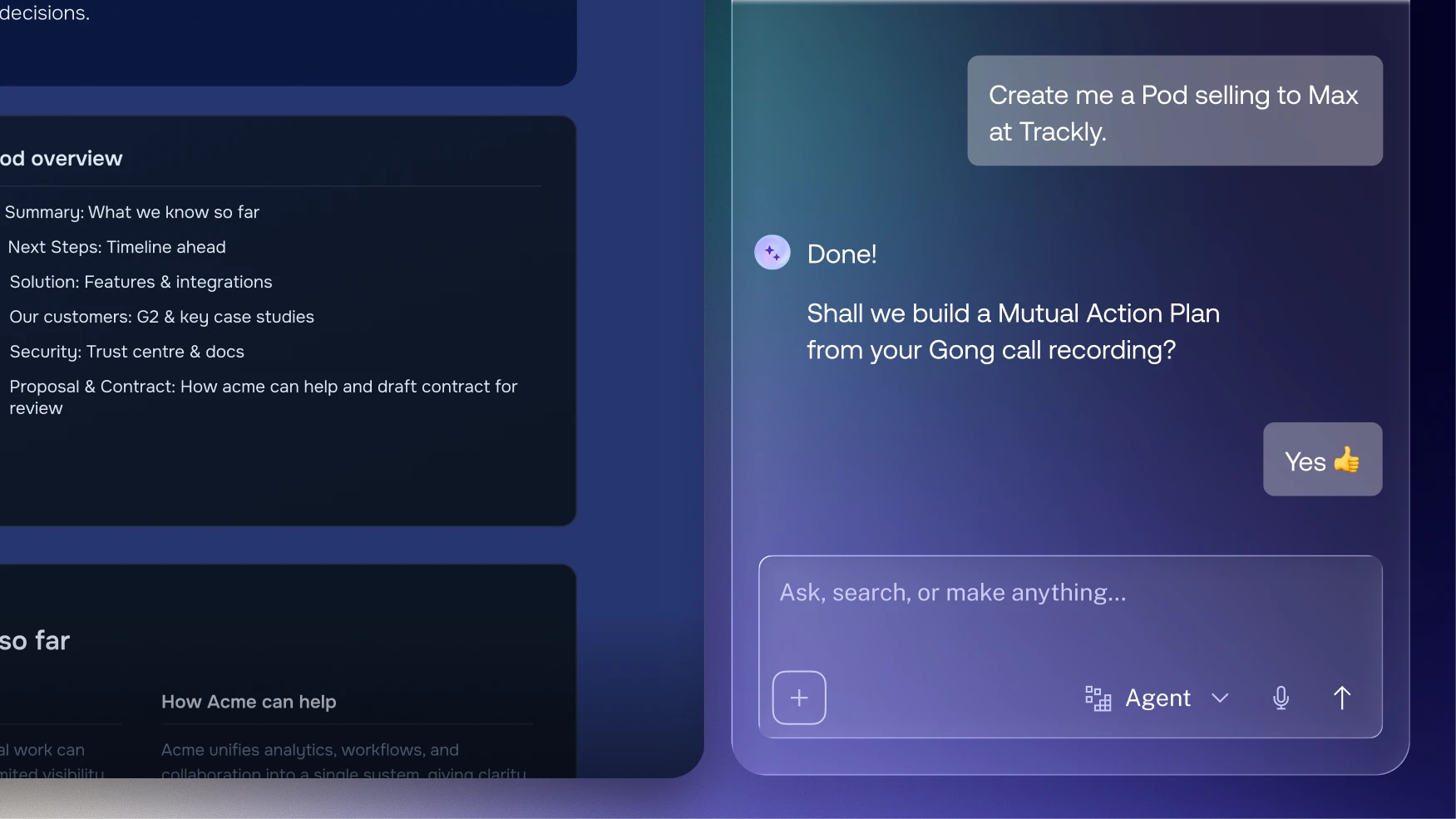
- Trumpet's Pods and Mutual Action Plans give Gong-connected teams a place to act on call insights, while its integration with Gong is a specific, verifiable connection rather than a vague category overlap.
A rep finishes a strong customer call. Gong captures the conversation, and within minutes the team has context on the buyer's priorities, objections, questions and next steps. The recording is thorough, the transcript is searchable, and the coaching notes are ready for the next 1:1.
The next question is harder to answer. What does the rep actually do with that information?
Gong-connected revenue teams should use conversation intelligence as an input into sales enablement rather than the end of the workflow. Insights from buyer conversations can inform which content a rep shares, how follow-up is personalised, which stakeholders need support, what goes into the Mutual Action Plan and what should happen before the next meeting. Trumpet complements Gong by giving revenue teams a buyer-facing workspace where those insights can be turned into action. Personalised Digital Sales Rooms, or Pods, bring relevant content, stakeholders, Mutual Action Plans and next steps into one place, while giving sellers additional visibility into how buyers engage between conversations.
Gong provides conversation intelligence from calls and meetings. Trumpet provides buyer-facing execution around and between those conversations. Used together, they connect what the buyer says with what the revenue team does next and how the buying group subsequently engages.
What is Gong sales enablement?
Gong supports sales enablement by analysing customer conversations and giving revenue teams insight they can use for coaching, deal inspection and rep development. For Gong-connected teams, the wider enablement workflow can extend those insights into content selection, personalised follow-up, stakeholder support and buyer-facing deal execution.
Sales enablement itself covers a range of activities: coaching, training, content, guidance, deal support, buyer-facing resources and follow-up. Gong's role sits at the conversation intelligence layer of that stack. What happens after the call, in terms of content, stakeholders and next steps, is a separate but connected part of the same enablement workflow.
Where does Gong fit into the sales enablement stack?
It helps to see the layers separately before connecting them.
Gong gives the revenue team context from the conversation. Buyer-facing execution gives that context somewhere to be acted on with the buyer, which is where trumpet's Pods fit.
From call insight to buyer action
Knowing that security is concerned about data handling, finance wants ROI evidence, the champion needs internal proof, an executive needs a summary, and the buyer agreed to a next step is valuable. But insight alone does not complete any of those actions.
The rep still needs to decide what to share, who needs it, where to put it, who owns the next step, which other stakeholders should be involved, and what to monitor before the next meeting. This is the transition from conversation intelligence to execution: turning what was learned on the call into something useful for the buyer afterwards.
- Capture what matters: identify the relevant buyer context from the conversation, such as a problem, priority, objection, stakeholder, commercial question, technical requirement or agreed action.
- Choose the right enablement response: map that context to a specific action rather than a generic follow-up.
- Give the buyer somewhere to act on it: move beyond a recap email into a shared, organised space.
- Observe what happens next: use buyer-side engagement as additional context once content has been shared.
- Prepare the next interaction: bring both conversational and between-meeting context into the next call.
Match conversation insights to the right buyer-facing action
These are possible responses to a signal from a call, not claims that a specific comment proves buyer intent.
Use call context to personalise the buyer experience
There is a difference between superficial personalisation and useful personalisation. Useful personalisation goes beyond a company logo or first name. It reflects what the buyer actually discussed: their priorities, questions, stakeholders, objections and agreed next steps. Content relevant to the buyer's stated priority, a business case reflecting the problem discussed, resources for stakeholders who were mentioned, answers to objections raised, and the next steps agreed during the call are the useful version.
Trumpet's Pods give the rep a personalised Digital Sales Room for the account, where relevant content can be organised around the buyer's actual priorities.
Connect Gong insights with sales content
Conversation intelligence can inform enablement teams, not just individual reps. Which objections keep appearing? Which buyer questions need better content? Which personas need more support? Which assets are reps looking for after calls, and where are the content gaps? This creates a useful loop between buyer conversations, enablement content and buyer engagement.
It is worth being precise about what content activity can and cannot tell a team. An asset being viewed shows that someone engaged with it, but it does not explain why they viewed it or whether it influenced the deal. Content engagement is useful context, not proof of an outcome.
Use Gong and buyer engagement as two different sources of context
None of these signals tells the whole story on its own. Together they give revenue teams more context for deciding what to investigate and what action may be useful next.
What should happen after a Gong-recorded call?
Immediately after the call:
- Confirm the buyer's stated priorities
- Capture agreed actions
- Identify content promised
- Note stakeholders mentioned
- Identify unresolved questions
In the buyer workspace:
- Update personalised content
- Add requested resources
- Update the Mutual Action Plan
- Give relevant stakeholders useful information
- Keep the agreed next step visible
Before the next call:
- Review buyer engagement
- Check whether new stakeholders have appeared
- Check Mutual Action Plan progress
- Note which resources were revisited
- Prepare using both call and engagement context
How trumpet works with Gong
Trumpet lists Gong among its key integrations and identifies Gong as an official partner in its current product materials, connecting Gong's conversation intelligence with trumpet's buyer-facing Pods, Mutual Action Plans and content.
At a category level, Gong provides conversation context from calls and meetings, and trumpet provides buyer-facing execution through Pods, Mutual Action Plans, content and stakeholder visibility. Within trumpet, personalised Pods bring relevant content, stakeholders, Mutual Action Plans and next steps into the buyer experience. Buyer engagement then gives sellers additional context on what happens between conversations.
Common mistakes Gong-connected revenue teams should avoid
- Treating the call summary as the follow-up. A summary records the conversation; the buyer may still need content, actions and support.
- Capturing insights without changing the buyer experience. Insight should inform what happens next where relevant.
- Treating every call mention as intent. A buyer discussing pricing, security or implementation does not prove a purchasing decision.
- Ignoring stakeholders mentioned in conversations, rather than understanding their role and what information they need.
- Assuming integrations remove seller judgement. AI and integrations can support a workflow; they do not remove the need to understand the account.
Final thoughts
Gong gives revenue teams valuable context from customer conversations. The next challenge is making sure that context changes what happens afterwards.
For Gong-connected teams, effective sales enablement should connect conversation insight with the content, stakeholders and shared actions that keep the buying process moving between meetings. Trumpet provides the buyer-facing workspace where that execution can happen.
FAQs
Does trumpet integrate with Gong?
Trumpet lists Gong among its key integrations and identifies Gong as an official partner in current product materials, connecting Gong's conversation intelligence with trumpet's buyer-facing Pods and Mutual Action Plans.
How does Gong support sales enablement?
Gong analyses customer conversations and gives revenue teams insight for coaching, deal inspection and rep development. That insight becomes part of the wider enablement workflow once it informs content, follow-up and stakeholder support.
How can sales teams use Gong insights after a call?
By matching what was discussed to a specific response, such as sharing relevant content, updating a stakeholder's view, or adding a milestone to a shared plan, rather than sending a generic recap.
What is the difference between Gong and trumpet?
Gong focuses on intelligence from customer conversations. Trumpet focuses on buyer-facing execution through personalised Digital Sales Rooms, content, stakeholders, Mutual Action Plans and buyer engagement. The platforms can be used together as different layers of the revenue workflow.




![How to Get Started with Buyer Enablement [With Examples]](https://cdn.prod.website-files.com/65cf4fecbed2754c2236665d/65cf4fecbed2754c22366bdb_65a5af83e742f76e34ce06f3_Customer%2520Onboarding%2520_%2520Everything%2520you%2520need%2520(2).png)
.png)


.png)


.png)


.png)

.png)

.png)
.png)





