








- Preserve customer context after Closed Won.
- Keep stakeholders, content and shared plans together.
- Internal handoff and customer continuity are different needs.
- Evaluate what the customer experiences, not just internal workflows.
A customer signs a deal, and somewhere in the following days their point of contact changes, their context resets, and they are asked questions the sales team already answered weeks ago. That can be a sign that the systems around the handoff are not preserving enough of the context built during the sale.
The best sales-to-onboarding software should preserve the customer context built during the sale while giving sales, onboarding and the customer a clear way to continue working together after Closed Won. Look for continuity of the buyer-facing workspace, stakeholder visibility that survives the handoff, a shared action plan that continues rather than restarts, and clear internal visibility for both sales and onboarding teams during the transition.
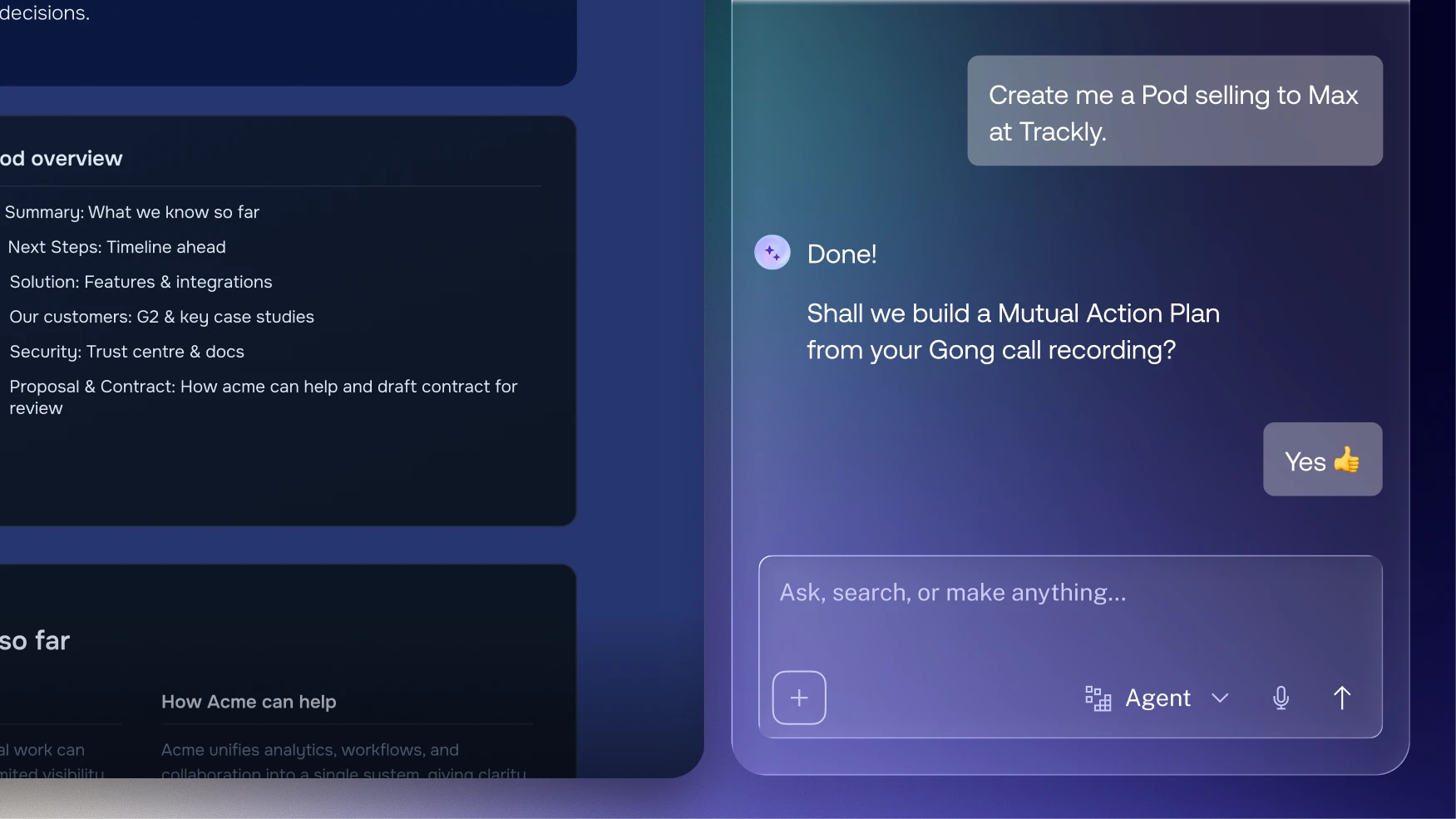
Trumpet supports this through Pods that can continue from the sales process into onboarding, keeping content, stakeholders and Mutual Action Plans in one place rather than starting the customer relationship over in a separate onboarding tool.
This guide is a framework for evaluating the category, not a ranked list of named vendors, because the right choice depends on what a specific team already uses for sales and customer success.
Some onboarding tools focus primarily on the internal side of the handoff: assigning tasks, notifying teams and tracking implementation work. The separate question is whether the customer's context and shared experience continue too.
What is sales-to-onboarding software?
Sales-to-onboarding software is any tool, or combination of tools, that carries customer context, stakeholder relationships and shared plans from the sales process into onboarding, so the customer experiences a continuous relationship rather than a restart with a new team and a new system.
It is worth being clear about what this category is not:
- Not simply a project management tool with an onboarding template, tracking tasks without any customer-facing element
- Not a CRM handoff notification, which tells an internal team a deal closed without carrying forward any of the context behind it
- Not a replacement for a dedicated onboarding methodology; the software supports the handoff, it does not decide how onboarding itself is run
- Not only for enterprise deals; the handoff problem exists at any deal size, even if it is more visible on larger, multi-stakeholder accounts
Why the sales-to-onboarding handoff breaks
- The buyer's point of contact often changes between the sales process and onboarding, so context has to be re-explained to someone new
- Context lives in the seller's head, in CRM notes, or in email threads that the onboarding team never sees in full
- The buyer-facing experience built during the sale is often lost the moment a new, unfamiliar tool is introduced for onboarding
- Stakeholders who were engaged during the sales process are not always carried over into the onboarding relationship
The handoff does not fail because teams do not care. Context is more likely to be lost when sales and onboarding sit in separate systems and the transition depends on a manual handover between them.
What to look for in sales-to-onboarding software
Five capabilities separate software that genuinely preserves continuity from software that only manages the internal side of the handoff:
None of these five capabilities need to come from a single platform. What matters is that a team can answer each question honestly for whatever combination of tools it currently uses.
Internal handoff tools vs continuous buyer-facing tools
It helps to separate two categories that often get treated as the same thing:
Most revenue stacks already contain both kinds of tool. The useful question is not which category to eliminate, but whether the buyer-facing side of the handoff has been solved at all, or left to whichever internal system happened to be assigned the task.
Trumpet spotlight: continuity from sales through onboarding
Within trumpet, a Pod created during the sales process can potentially continue into onboarding, keeping the same workspace, stakeholders, content and Mutual Action Plan in place rather than asking the customer to start again in a separate system.
In practice, this means a buyer who worked through a Mutual Action Plan with a seller can see that same plan continue once onboarding begins, with new steps added rather than an entirely new plan created. Stakeholders who were part of the buying group can remain visible to the account team, and content shared during the sales process stays accessible rather than being left behind in a tool the onboarding team cannot see.
For more detail on how this workspace continuity works in practice, see How to Use a Digital Sales Room After Closed Won and the existing customer onboarding article.
Questions to ask when evaluating this category
- Does the customer keep the same workspace, or are they redirected to a new tool for onboarding?
- Do the stakeholders engaged during the sales process carry over, or does onboarding start with a single contact?
- Does the Mutual Action Plan continue, or does onboarding require a new plan to be built from scratch?
- Can sales and onboarding both see where a customer stands during the transition, or does each team have a separate, disconnected view?
- Is there any visibility into whether stakeholders are actually engaging with the workspace or plan during the handoff window?
Common mistakes when choosing this software
- Choosing a tool that only solves the internal handoff, without checking whether the customer's experience continues too
- Assuming a CRM handoff field or notification is the same thing as a continuous customer experience
- Introducing a new onboarding tool without checking whether it resets the customer's context and stakeholder visibility
- Evaluating the software only against the onboarding team's own workflow, without asking what the customer will actually notice
Final thoughts
The best sales-to-onboarding software preserves the customer context built during the sale, rather than asking the customer to start over with a new team and a new tool.
Trumpet supports this through Pods that can carry sales-process context into onboarding rather than starting the relationship over.
A useful test of sales-to-onboarding software is whether the customer experiences continuity through the handoff, rather than having to start again.
Use the framework above to evaluate whatever tools are already in your stack, or whatever you are considering next, before assuming that solving the internal handoff is the same as solving the customer's experience of it.
FAQs
What is sales-to-onboarding software?
Sales-to-onboarding software is any tool, or combination of tools, that carries customer context, stakeholder relationships and shared plans from the sales process into onboarding, so the customer experiences continuity rather than a restart.
What should I look for in sales-to-onboarding software?
Look for continuity of the buyer-facing workspace, stakeholder visibility that survives the handoff, a shared action plan that continues rather than restarts, clear internal visibility for sales and onboarding, and evidence of engagement during the transition.
What is the difference between internal handoff tools and continuous buyer-facing tools?
Internal handoff tools manage tasks, owners and deadlines for the onboarding team but are not customer-facing. Continuous buyer-facing tools extend the same customer workspace, stakeholders and plan from the sales process into onboarding.
How does trumpet support the sales-to-onboarding handoff?
Within trumpet, a Pod created during the sales process can potentially continue into onboarding, keeping the same workspace, stakeholders, content and Mutual Action Plan in place rather than starting again in a separate tool.









![How to Get Started with Buyer Enablement [With Examples]](https://cdn.prod.website-files.com/65cf4fecbed2754c2236665d/65cf4fecbed2754c22366bdb_65a5af83e742f76e34ce06f3_Customer%2520Onboarding%2520_%2520Everything%2520you%2520need%2520(2).png)
.png)


.png)


.png)


.png)

.png)

.png)
.png)





