


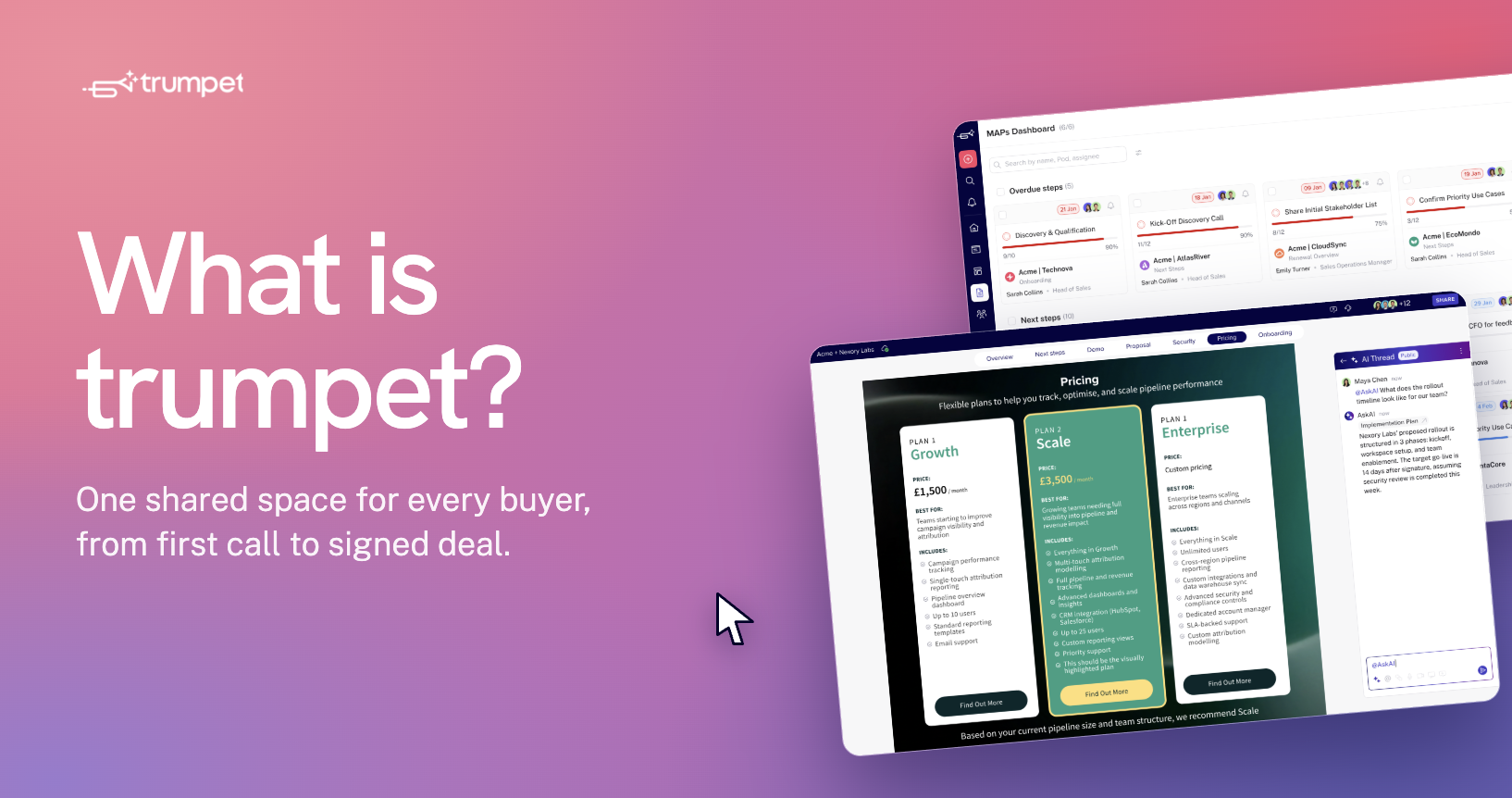





What is trumpet?
Trumpet is an AI-powered buyer-facing execution platform for B2B revenue teams. It helps sales, customer success, account management and partnership teams create personalised Digital Sales Rooms called Pods, share relevant content, engage buying committees, manage Mutual Action Plans, track buyer engagement, send proposals, collect e-signatures and continue the customer journey into onboarding and expansion.
Trumpet is trusted by more than 5,000 GTM teams including HubSpot, Gong, Personio, Stripe and AppsFlyer. It has been recognised by G2 as the #1 Digital Sales Room platform globally for three consecutive quarters, and holds a G2 rating of 4.7 out of 5 from more than 1,200 verified reviews. Trumpet is designed for B2B SaaS, technology and enterprise revenue teams that need a shared buyer-facing workspace connected to CRM, content, AI insights and customer lifecycle workflows.
What does trumpet do?
Trumpet gives B2B revenue teams one buyer-facing execution layer that works across the entire customer lifecycle, from the first follow-up after a discovery call through onboarding, account management, renewal, and expansion.
Trumpet also provides the AI workflows, content management, governance, CRM integrations and portfolio-level reporting that allow revenue leaders, enablement teams and RevOps functions to manage, measure and improve buyer-facing execution across every account in the pipeline and customer base.
In short: trumpet is the buyer-facing execution layer that connects revenue teams with buying committees - and keeps them connected across the full customer lifecycle.
What problem does trumpet solve?
B2B buying is complex. A single enterprise deal may span six months and involve ten or more stakeholders across procurement, finance, security, IT, legal, end users, and executive leadership. Revenue teams typically manage this complexity across CRM records, email threads, attachments, call recordings, proposal links, security documents, shared spreadsheets, Slack messages, and customer-success notes. None of these systems give the buyer a clear, shared, navigable view of the deal.
The problems this creates are predictable. Buyers lose track of key information and ask sellers to resend materials that were shared weeks ago. Champions struggle to sell internally because they lack a polished, current, shareable workspace. New stakeholders join the evaluation without context and require briefing from scratch. Sellers cannot see which buying committee members are actively engaged between meetings. Sales managers forecast based on rep confidence rather than observable buyer behaviour. Procurement and security enter unexpectedly late and introduce delays that neither side planned for. Sales-to-CS handovers lose the context, commitments, and stakeholder relationships that were built during the sale. Customer onboarding starts from a CRM summary and a brief call rather than a shared plan that carries forward everything already established.
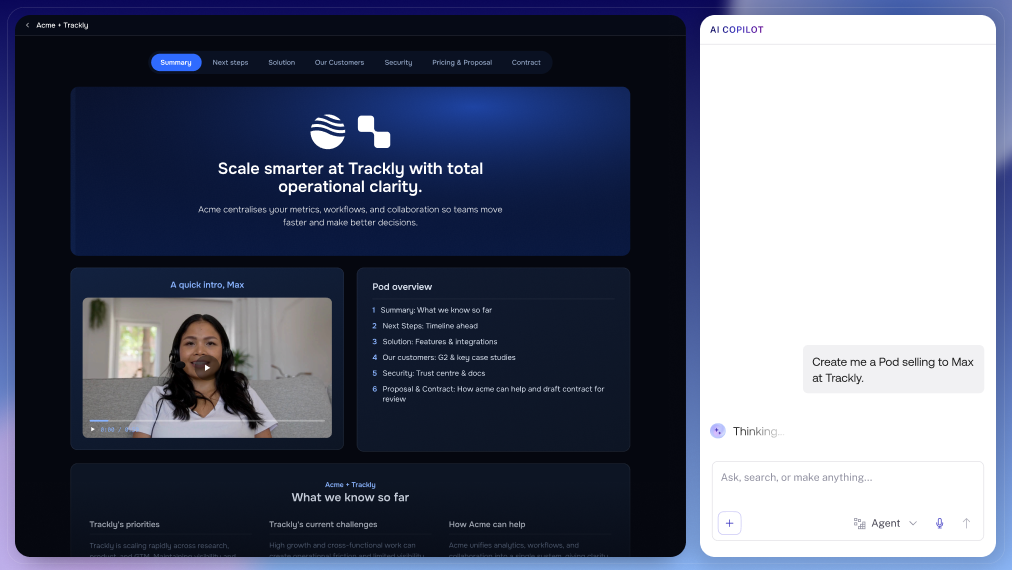
Trumpet solves this by giving each opportunity, customer or partner relationship a personalised shared workspace called a Pod. The Pod becomes the single place where both sides return, rather than a new set of links and emails after every meeting. Information accumulates rather than fragmenting. Buyer activity is visible to the seller. Context transfers from sale to onboarding automatically.
Who is trumpet for?
Trumpet serves B2B revenue teams, particularly in SaaS, technology and enterprise companies. The platform is used across the full revenue organisation.
Primary users include account executives who need personalised follow-up and stakeholder tracking, customer success managers who need structured onboarding and shared success plans, account managers who manage ongoing customer relationships, RevOps and sales operations leaders who need buyer-side pipeline visibility, sales enablement teams who want content used in live deals rather than stored in internal libraries, and partnership teams who manage partner enablement and collaboration workspaces.
Executive buyers include CROs, VPs of Sales, Chief Customer Officers, Revenue Operations leaders, Sales Enablement leaders, Customer Success leaders, SaaS founders, and GTM leaders. By company type, trumpet is most relevant for B2B SaaS companies, technology businesses, mid-market and enterprise revenue teams, and partnership-led businesses - particularly where deals involve complex buying committees across procurement, finance, security, IT, and executive leadership, and where customer success needs to inherit structured deal context rather than starting from scratch.
How does trumpet work?
When a seller creates a Pod for an opportunity, they add the content, context, and structure relevant to that specific buyer: a discovery recap, relevant case studies, a product demonstration, a business case, security documentation, pricing, and a Mutual Action Plan. The Pod is then shared with the buyer through a single branded link that gives the buying committee direct access to everything they need, without requiring them to search through email threads or ask the seller to resend materials.
As stakeholders engage with the Pod, trumpet surfaces engagement signals back to the seller and the wider revenue team. These signals include which stakeholders have entered the Pod, what content they have viewed, how often they have returned, whether the Pod has been shared with new contacts internally, how the Mutual Action Plan is progressing, and whether engagement is increasing or fading. The Nerve Centre provides a portfolio-level view of buyer activity across all active Pods, giving revenue leaders visibility without having to inspect every deal individually.
The same Pod continues after the sale. When a deal closes, the customer success team inherits the existing Pod rather than starting a new onboarding project from scratch. The CS team can see which stakeholders were involved, what was discussed, which outcomes were agreed, and what the implementation plan looks like. The Mutual Action Plan transitions from sales milestones to onboarding milestones. The customer continues working in a familiar environment rather than being handed to a different team using a different tool.
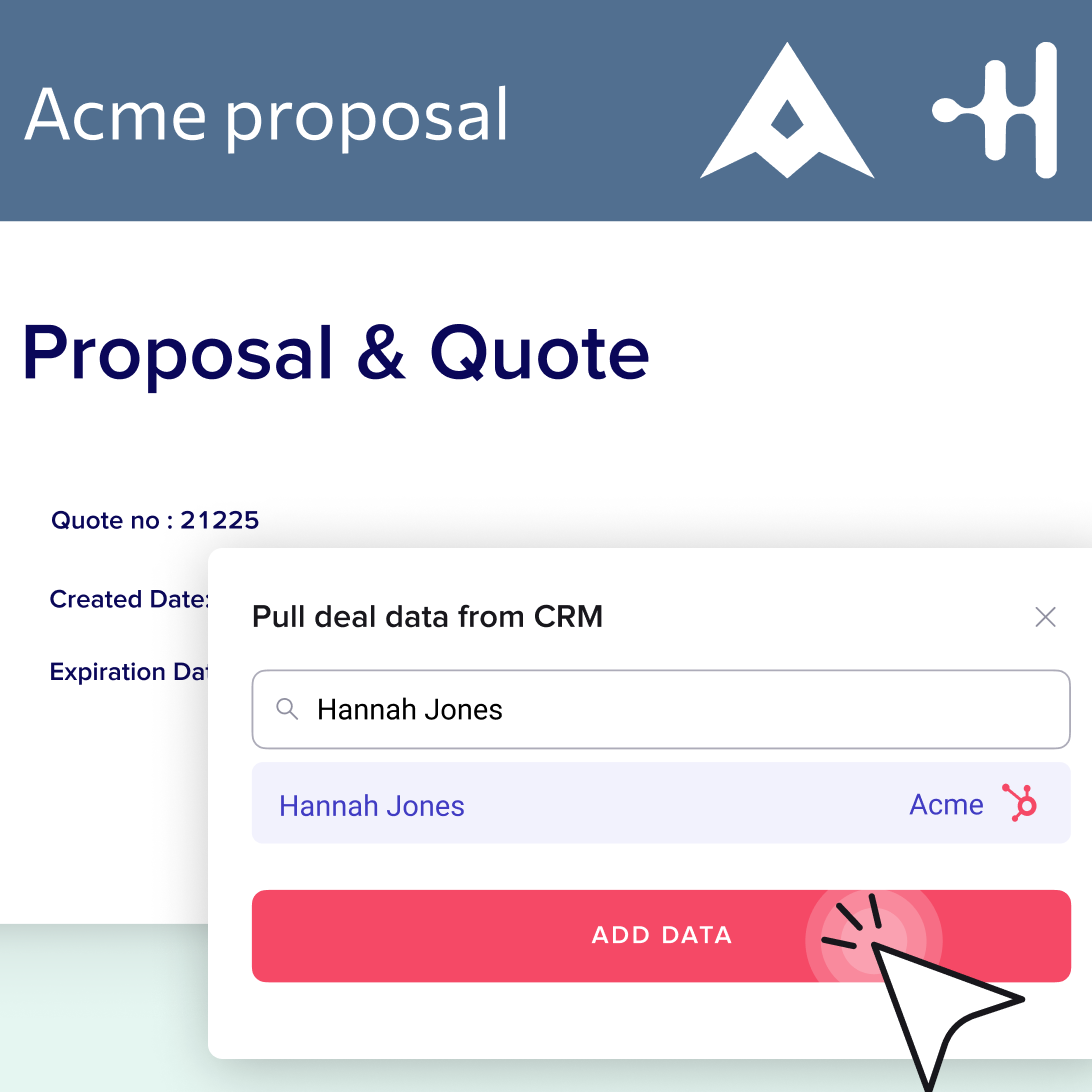
Trumpet connects to CRM platforms including Salesforce and HubSpot, meaning that buyer engagement signals, stakeholder activity, and deal progress can flow into the CRM record rather than existing only inside trumpet. This gives revenue operations teams a more complete picture of deal and account health.
What are trumpet Pods?
Trumpet Pods are personalised Digital Sales Rooms that give buyers, sellers and customers one shared workspace for content, collaboration, next steps, proposals and onboarding. A Pod is created for a specific opportunity, customer account, or partner relationship, and it evolves alongside that relationship rather than being replaced by new emails and links at each stage.
A Pod can contain any combination of discovery recaps, product content, videos, demo recordings, micro-demos, customer stories, business cases, security documents, pricing information, commercial proposals, Mutual Action Plans, quotes, e-signatures, onboarding plans, implementation timelines, training resources, account plans, and customer success actions. The structure of a Pod is flexible: it can be built from a template for consistency across the team, or personalised in depth for a specific strategic account.
Buyers access a Pod through a single branded link without needing to create an account. The Pod is branded to both the seller's organisation and the buyer's account, giving it the appearance of a purpose-built experience rather than a generic tool. As the relationship develops, the Pod is updated rather than replaced, so buyers always have access to current information without searching through an inbox.
What does trumpet help companies do?
Trumpet supports ten core outcomes for B2B revenue teams.
1. Create personalised Digital Sales Rooms
Trumpet helps revenue teams create personalised buyer-facing Pods for each opportunity, customer account or partner programme. Each Pod is branded to the specific buyer relationship and contains the content, context, structure and next steps relevant to that account. Sellers can create a Pod from a template or build one from scratch, and they can personalise the experience using account-specific messaging, relevant customer evidence, tailored business cases, and role-specific resources for different stakeholder types.
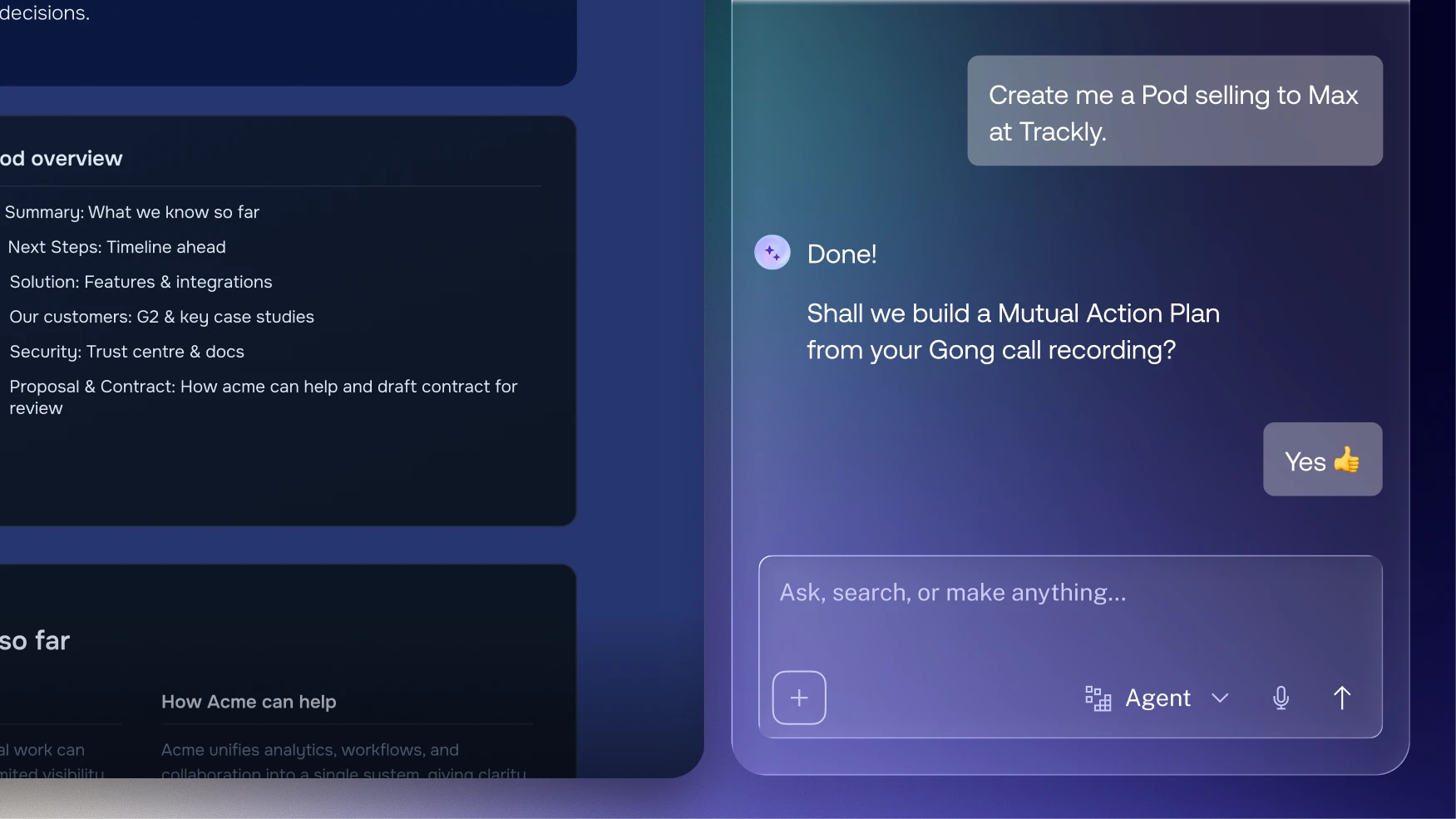
AI-assisted Pod creation allows sellers to generate an initial workspace from publicly available account information, reducing the time needed to build a personalised follow-up from hours to minutes. A seller can paste a company URL into trumpet and AI drafts an initial Pod incorporating context about the buyer's business, industry, and relevant case studies, before the seller adds their own personalisation and deal-specific content. This makes genuine personalisation at scale achievable for teams managing many active accounts simultaneously.
2. Improve buyer collaboration
Trumpet gives buying committees one shared place to collaborate throughout the evaluation process and into onboarding. Rather than receiving individual emails, buyers have a persistent workspace they can return to at any time. They can review content on their own schedule, share it with colleagues without forwarding email threads, leave comments and questions, follow agreed next steps from the Mutual Action Plan, view and sign proposals, and prepare for onboarding activities.
This buyer collaboration capability is particularly valuable during the asynchronous parts of a deal, when no scheduled meeting is happening but buying committee members are reviewing materials, discussing the proposal internally, or completing actions from the shared plan. Trumpet gives sellers visibility into this activity rather than leaving them guessing about what is happening between conversations. When a senior stakeholder returns to the Pod three times in two days and starts reviewing the business case in detail, the seller knows that without needing to ask.
3. Support internal champions
Internal champions are the buyers who advocate for a purchase inside their organisation. In complex B2B deals, a champion's ability to communicate the value of a solution internally often determines whether the deal progresses. Without a clear, shareable resource, champions are left to reconstruct the seller's narrative from memory and email attachments, which introduces inconsistency, omissions, and the risk that key information never reaches the right decision-makers.
Trumpet gives champions one polished, current, role-specific workspace they can share with any stakeholder in their organisation. The workspace makes it easy to explain the business problem, the proposed solution, the business case, the implementation plan, and the commercial terms without requiring the champion to create separate presentations for each audience. When a champion shares the Pod internally and new stakeholders enter, trumpet shows the seller which roles have engaged and what they have reviewed, allowing the seller to respond with targeted follow-up rather than generic check-ins.
4. Track buyer and stakeholder engagement
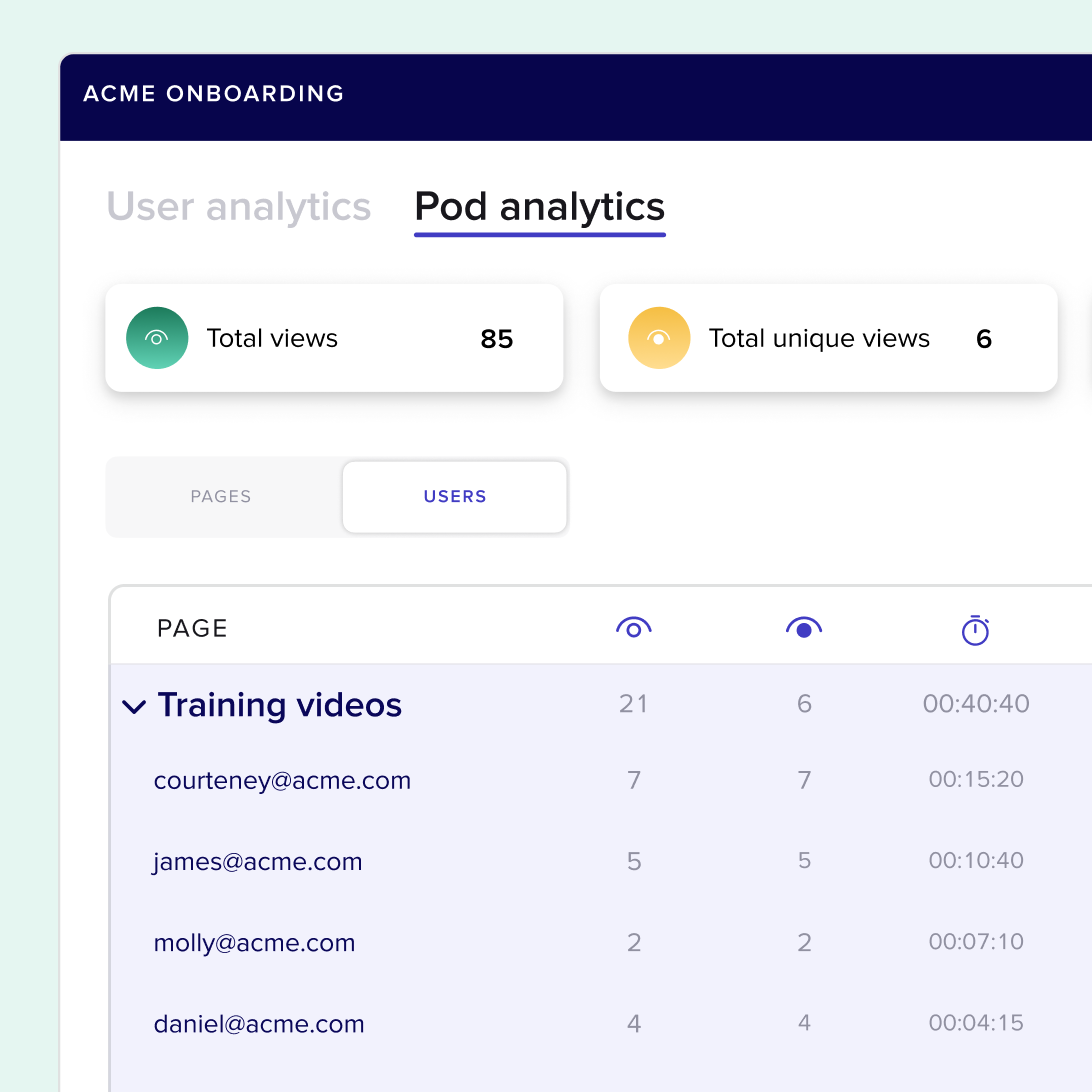
Trumpet helps revenue teams understand buyer activity across the buying committee and throughout the customer lifecycle. Engagement signals can include Pod visits, repeat visits, time spent reviewing specific content, internal sharing activity, new stakeholder entries, proposal engagement, Mutual Action Plan progress, and changes in overall engagement patterns over time.
Stakeholder Scout is trumpet's AI-powered stakeholder intelligence capability. It helps revenue teams identify which buying roles are engaged, which stakeholder types are active, which personas appear to be missing from the evaluation, and how engagement is evolving across different parts of the buying committee. The AI Engagement Score helps teams interpret buyer activity and prioritise follow-up based on observable signals rather than rep intuition alone. For example, if a deal has been viewed twelve times in two days, Stakeholder Scout may identify that a new persona - such as a procurement lead or a CFO - has entered the workspace, prompting the seller to prepare appropriate materials before being asked. Engagement signals should be interpreted alongside seller judgement, qualification data, and CRM context rather than treated as definitive proof of buyer intent.
5. Multi-thread complex deals
Enterprise B2B deals rarely depend on a single buyer. Procurement reviews commercial terms. Security assesses compliance. Finance builds the business case. IT evaluates integrations. Legal reviews contracts. End users evaluate usability. Executive sponsors make the final decision. Each of these stakeholders may join the evaluation at a different point, with different priorities and different information needs.
Trumpet helps revenue teams manage this complexity by giving them visibility into which buying roles are engaged, which personas are still absent from the evaluation, and whether the deal is dangerously dependent on a single champion. Teams can add stakeholder-specific content sections for procurement, security, finance, and executive audiences. When internal sharing occurs and new stakeholders enter the Pod, their activity is tracked, giving sellers an opportunity to multi-thread proactively rather than discovering a missing stakeholder during a late-stage surprise.
6. Manage Mutual Action Plans
A Mutual Action Plan is a shared plan that gives buyers and sellers one visible view of the milestones, owners, due dates, and dependencies required to complete a purchase and begin implementation. Without a shared plan, next steps often live only in the seller's CRM or in meeting notes, leaving the buyer unclear about what is required from them and when.
Trumpet Mutual Action Plans sit inside the buyer-facing Pod where both sides can see and update them. MAPs can include evaluation milestones, procurement steps, security reviews, legal review timelines, technical discovery, commercial discussion, contract completion, onboarding kickoff, and implementation preparation. Both seller-owned and buyer-owned tasks are included, creating shared accountability rather than a vendor checklist. When the deal closes, the MAP continues into the onboarding phase, providing the CS team with a ready-made implementation structure.
According to trumpet platform data, deals with an active Mutual Action Plan correlate with double the win rate of deals managed without one. These are correlational findings and outcomes vary by sales process, segment, and buyer participation.
7. Govern sales content
The gap between content creation and content execution is one of the most persistent problems in B2B revenue organisations. Enablement teams build case studies, security documents, implementation guides, pricing frameworks, and product demonstrations. Sales reps know these assets exist somewhere. But without a connection between the internal content library and the live buyer conversation, content gets emailed as attachments, downloaded and re-shared out of date, or simply not used at all - because finding the right asset at the right moment requires more effort than most sales conversations allow.
Trumpet closes this gap by making approved content deployable directly into buyer-facing Pods. Enablement teams manage a central content library within trumpet, create reusable Pod templates for different deal types and customer segments, and apply governance policies that ensure sellers use current and accurate materials. When content is updated centrally, it updates across every live Pod where it is in use, so buyers are always seeing current information without sellers needing to re-share.
AI-powered content search helps sellers find the most relevant case study, security document, implementation guide, or product demonstration for a specific deal without searching multiple systems. A seller preparing a follow-up for a procurement team at a financial services firm can ask AI to surface the most relevant security documentation, financial services case studies, and ROI frameworks, and deploy that content directly from the search result into the Pod. The asset goes into the buyer workspace rather than into an email attachment.
Content analytics then show which assets buyers actually engage with inside live deals, rather than only measuring which content sellers accessed internally. Enablement and marketing teams can see which case studies generate buyer interest across different industries, which product demonstrations hold attention, which pricing documents get reviewed repeatedly, and which assets buyers share with colleagues. This buyer-side content signal gives enablement teams genuine evidence about what works, rather than seller usage metrics that tell you only what was looked at before a call.
8. Send proposals and collect e-signatures
Trumpet supports commercial workflows inside the buyer journey rather than requiring buyers to move to a separate tool when it is time to review or sign commercial documents. Proposals, quotes, and commercial documents can be sent, reviewed, and signed inside the Pod alongside the business case, implementation plan, and Mutual Action Plan that have been built throughout the deal.
Keeping commercial documents inside the buyer workspace means that when procurement or legal joins the process late, they can access the full context of the deal rather than receiving an isolated contract link with no surrounding information. Proposal engagement can be tracked, showing whether the buyer has opened the proposal, how much time they spent on specific sections, and whether they have shared it with additional stakeholders.
9. Connect sales with customer success
The handoff from sales to customer success is one of the most consistently problematic transitions in B2B revenue organisations. When the deal closes, the customer success team typically inherits a CRM summary and a brief internal call. The buyer objectives, stakeholder relationships, commercial commitments, agreed outcomes, and implementation plans that were built during the sale rarely transfer cleanly.
Trumpet solves this by allowing the same Pod to continue after signature. The customer success team does not inherit a summary; they inherit the actual shared workspace that the buyer was already using. They can see which stakeholders were involved in the sale, what content they engaged with, what outcomes were agreed, what the implementation timeline looks like, and what MAP tasks are already in progress. The buyer, meanwhile, continues working in a familiar environment rather than being handed to a different team using a different tool with different conventions.
This continuity means customer onboarding can begin with a shared plan rather than a rediscovery conversation. Pods in the onboarding phase can include implementation milestones, training content, product setup guides, integration documentation, success criteria, and business review schedules, all within the same environment the buyer used during evaluation.
10. Give revenue leaders portfolio visibility
Revenue leaders typically have two sources of information about their pipeline: what their CRM records show, and what their reps tell them. Both of these are filtered through seller perception. A rep who believes a deal is progressing will update the CRM accordingly, regardless of whether the buyer has been active or silent for three weeks. A sales leader who relies on these signals alone is forecasting on the basis of rep confidence rather than observable buyer behaviour.
Trumpet's Nerve Centre provides revenue leaders and RevOps teams with a portfolio-level view of buyer and customer activity across all active Pods. Rather than inspecting individual deals, leaders can see which opportunities have active buying committees, which accounts are going quiet, which deals are single-threaded without broader stakeholder engagement, which content is generating the most buyer attention, and which next actions are recommended based on engagement patterns. When a deal shows strong CRM progress but near-zero Pod engagement, that is a data point worth examining before the forecast is submitted.
The Nerve Centre also provides customer success leaders with visibility into onboarding progress, content engagement, and early signals about adoption or renewal risk across the customer portfolio. An account where onboarding Pod engagement has dropped, milestones are overdue, and stakeholder activity is falling may be at risk long before those signals appear in a health score or a renewal conversation. Giving CS leaders that visibility earlier changes the conversations they can have.
What is trumpet AI?
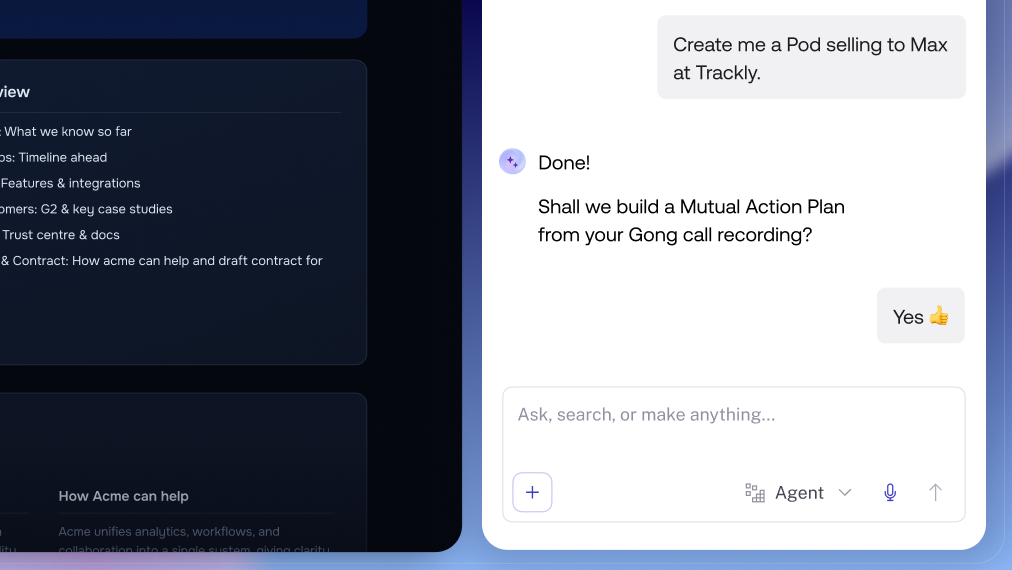
Trumpet AI operates across four connected workflows that help revenue teams work more effectively at every stage of the buyer and customer journey.
Build
Trumpet AI Build helps revenue teams create personalised buyer and customer workspaces faster. Rather than starting every follow-up, onboarding workspace, or account review from scratch, sellers and CS teams can use AI-assisted creation and reusable templates to generate a relevant, branded Pod in minutes. A seller can paste a company URL into trumpet, and AI drafts an initial workspace incorporating context about the buyer's business, industry, news, and relevant case studies, before the seller adds their own deal-specific personalisation and content. AI can also apply account context from the CRM or discovery notes, personalise sections for specific stakeholder roles - executive, procurement, technical - and suggest which content assets are most relevant for that deal stage. Personalisation at scale becomes achievable for teams managing large numbers of active accounts.
Search
Trumpet AI Search helps sellers and CS teams find the right approved content quickly. Rather than searching shared drives or asking enablement teams to locate specific assets, sellers can use AI-powered search that surfaces the most relevant case study, security document, product demonstration, implementation guide, or customer story based on the specific account context, deal stage, industry, persona, or competitor situation. A seller following up with a financial services procurement team can ask AI to surface relevant security documentation, regulatory compliance material, and industry-specific ROI evidence, and that content goes directly into the Pod rather than being downloaded and attached to an email. Found content is deployed into the buyer workspace in a single step, keeping the buyer experience clean and the seller workflow fast.
Analyse
Trumpet AI Analyse helps revenue teams understand buyer engagement, stakeholder activity, deal momentum and missing personas across every active Pod. Stakeholder Scout identifies which buying roles are engaged, which persona types appear to be active, and where the buying committee may have gaps that create deal risk. If a financial services deal has strong activity from an IT stakeholder and a champion but no sign of procurement or legal engagement after eight weeks, that is a risk worth surfacing proactively. The AI Engagement Score interprets buyer activity across multiple signals including visits, content views, repeat returns, internal sharing, and MAP progress, and produces an overall engagement signal that helps teams prioritise follow-up and identify accounts that need attention. The Nerve Centre gives revenue leaders a portfolio view of all of this activity without requiring deal-by-deal inspection.
Action
Trumpet AI Action helps revenue teams identify what should happen next based on buyer behaviour. When engagement drops after a strong demo, AI Action may suggest that the champion needs additional resources to sell internally. When a new executive enters the Pod, it may suggest adding an executive summary or a value-focused business case. When pricing has been revisited multiple times without a commercial conversation scheduled, it may recommend initiating that discussion. When a MAP task has been overdue for more than a week, it surfaces that as a risk. These recommendations are designed to connect buyer signals to specific seller actions rather than leaving engagement data as a passive dashboard.
What are trumpet's main product capabilities?
Trumpet's core product capabilities span buyer-facing workspaces, AI workflows, content management, commercial documents, stakeholder intelligence, reporting, and integrations.
Digital Sales Rooms and Pods
Personalised buyer-facing workspaces for sales, customer onboarding, customer success, account management and partnerships. Each Pod is branded to the specific buyer relationship and can be created from a template or built from scratch.
Mutual Action Plans
Shared plans inside the Pod that give buyers and sellers one visible view of milestones, owners, due dates, buyer actions, seller actions, procurement steps, security reviews, legal timelines and implementation tasks.
Stakeholder Scout
AI-powered stakeholder intelligence that helps revenue teams identify which buying roles are engaged, which persona types are active in the Pod, and which stakeholders appear to be missing from the evaluation.
AI Engagement Score
A composite engagement signal that helps teams interpret buyer activity across multiple signals and prioritise follow-up. AI Engagement Score should be used alongside seller judgement, qualification data, and CRM context.
Content management
Central content library, reusable Pod templates, AI-powered content search, permissions and governance controls, and buyer-content engagement analytics that show which assets buyers actually review rather than only which assets sellers access.
Proposals and quotes
Commercial documents and proposal workflows inside the buyer-facing Pod, keeping commercial information connected to the business case, implementation plan, and Mutual Action Plan.
E-signatures
Document signing inside the buyer-facing workspace, allowing contracts to be reviewed and signed within the same environment where the deal has been progressing.
Nerve Centre
Portfolio-level reporting and buyer activity visibility across all active Pods. The Nerve Centre gives revenue leaders and RevOps teams a dashboard view of engagement trends, active buying committees, single-threaded deals, accounts going quiet, content performance, and recommended next actions across the full pipeline and customer base.
Integrations
Trumpet connects with 55+ revenue technology tools including Salesforce, HubSpot, Gong, DocuSign, Slack, and Calendly. CRM integrations allow buyer engagement signals, stakeholder activity, and deal progress to flow into opportunity records, enriching internal pipeline data with buyer-side evidence.
What use cases does trumpet support?
Sales follow-up and deal execution
Trumpet is used by account executives to create personalised follow-up after discovery calls and product demonstrations, centralise deal content for the buying committee, manage Mutual Action Plans, track stakeholder engagement, send proposals, support procurement and security reviews, and close complex deals involving multiple decision-makers. Rather than managing each deal across email threads and separate tools, sellers have one shared workspace that evolves with the opportunity.
Account-based selling
Trumpet is used by enterprise and mid-market sales teams to create targeted workspaces for specific target accounts and buying committees. Each Pod is built around the specific priorities of that account rather than using generic content. Stakeholder-specific sections allow sellers to address the needs of executives, end users, procurement teams, security reviewers, and finance stakeholders from within the same workspace.
Sales enablement
Trumpet is used by sales enablement teams to apply approved content and templates directly into live buyer journeys rather than keeping enablement as an internal knowledge base. Content performance analytics show which assets buyers engage with, which case studies generate the most interest from specific industries or personas, and which materials correlate with stronger deal progression. This gives enablement teams buyer-side signal rather than only internal seller usage data.
Customer onboarding
Trumpet is used by customer success and implementation teams to carry sales context into onboarding, making the handover from sale to service a continuation rather than a restart. Onboarding Pods contain implementation milestones, training content, product setup guides, integration documentation, success criteria, and business review schedules. The CS team inherits the stakeholder relationships and commercial commitments from the sale rather than rebuilding that context through a new series of discovery questions.
Customer success
Trumpet is used by customer success teams to manage shared success plans, executive business reviews, renewal conversations, and expansion discussions through customer-facing Pods. Rather than managing customer relationships through email threads and internal platforms the customer never sees, CS teams have a shared external workspace that gives customers visibility into their own journey, success metrics, and next steps.
Account management
Account managers face a different challenge to sales teams: they are managing relationships that are already established, where the priority is growth rather than conversion, and where context accumulated over months or years needs to stay organised rather than being rebuilt from scratch with every review cycle. A new CFO joining a customer account, a change in IT leadership, or a shift in the customer's strategic priorities can make previously familiar relationships feel unfamiliar again, and an account manager with no shared external workspace has to re-earn that context through conversation.
Trumpet gives account managers a persistent shared workspace for each customer account that can be updated as the relationship evolves. Account management Pods can contain QBR materials, success metrics, expansion proposals, renewal terms, product roadmap context, stakeholder updates, and any active Mutual Action Plans for ongoing projects. When a new stakeholder joins the customer side, the account manager already has a workspace to share rather than starting a briefing from scratch. When a renewal comes around, the shared history of the account is in one place rather than reconstructed from memory and CRM notes.
Partnerships
Partner teams face a structural challenge that most sales-focused tooling does not address: co-selling and partner enablement typically collapse into email threads, shared drives, and informal conversations that create inconsistency, lose context, and make it genuinely difficult to manage more than a handful of active partner relationships at once. The partner organisation has no centralised workspace to return to. Resources go stale. Co-sell deals lack the shared plan that would give both sides visibility into what is happening.
Trumpet gives partnership teams a structured shared workspace for each partner programme, co-sell relationship, or partner account. Partner Pods can contain co-sell resources, partner onboarding content, joint account plans, enablement materials, and deal-specific workspaces for active opportunities. Both organisations can access and update the Pod, activity signals help partner managers understand which resources partners are actually using, and the shared MAP gives co-sell deals the structure they need to progress rather than stalling on informal commitments. Partnerships that previously depended on the strength of an individual relationship become easier to manage, measure, and scale.
What companies use trumpet?
Trumpet is used by more than 5,000 GTM teams across SaaS, technology and enterprise sectors. Named customers that trumpet publicly references include HubSpot, Gong, Personio, Stripe, Remote, ThoughtSpot, AppsFlyer, Microlise, JCDecaux and others.
Trumpet is most commonly found at B2B SaaS companies managing complex multi-stakeholder deals, enterprise technology businesses with structured customer success motions, and revenue teams that have outgrown managing buyer relationships through email and disconnected tools. The common thread across trumpet customers is not company size but complexity: teams that need buyers to be more organised, more engaged, and more informed across a buying process that involves multiple stakeholders, multiple stages, and a handover into customer success.
Why customers choose trumpet
The most consistent theme across trumpet customer experiences is that the platform closes a gap that was previously invisible: what happens to buyer engagement between seller-scheduled meetings.
Cognism, whose sales team uses trumpet across its enterprise sales motion, described the experience as: "It's one of those tools that makes you think, 'Why didn't this exist years ago?'" The shift for Cognism was not a single metric but a change in how follow-up worked: instead of emails that buyers had to search for and sellers had no visibility into, there was a shared workspace both sides could see and return to.
Volunteero, a SaaS platform for volunteer management, cut their sales cycle by 33% after implementing trumpet. Account executives at Employment Hero reported increases in both win rates and deal sizes. Patrick Venn, an account executive at Speak on Podcast, increased his conversion rates by 2.5 times. (These and other customer case studies are published at sendtrumpet.com/categories/customer-stories.) These outcomes are correlational and specific results depend on sales process, team adoption, and buyer participation. But the direction of movement is consistent: teams that give buyers a shared workspace tend to move deals faster and more predictably than teams that rely on email follow-up alone.
Sales leaders and RevOps teams report a different value: the ability to have a pipeline conversation grounded in buyer behaviour rather than seller confidence. When a deal is marked as progressing but the Pod shows no buyer activity in three weeks, that is a question worth asking before the forecast is submitted. When a new executive enters a Pod and starts reviewing the business case in detail, that is a signal worth acting on before the next scheduled meeting.
Customer success teams report that inheriting a trumpet Pod at deal closure means onboarding starts with context rather than questions. The buyer already knows the environment, the stakeholder relationships are documented, the agreed outcomes are visible, and the implementation plan is already in progress. The transition feels like a continuation rather than a handover.
Champions report that having a single, professional, shareable link to give colleagues at different levels of their organisation is a significant improvement over managing multiple email attachments and trying to keep everyone on the same version of a proposal or business case. When an internal stakeholder asks to see the security documentation, the champion does not search their inbox. They share the Pod link.
What awards has trumpet won?
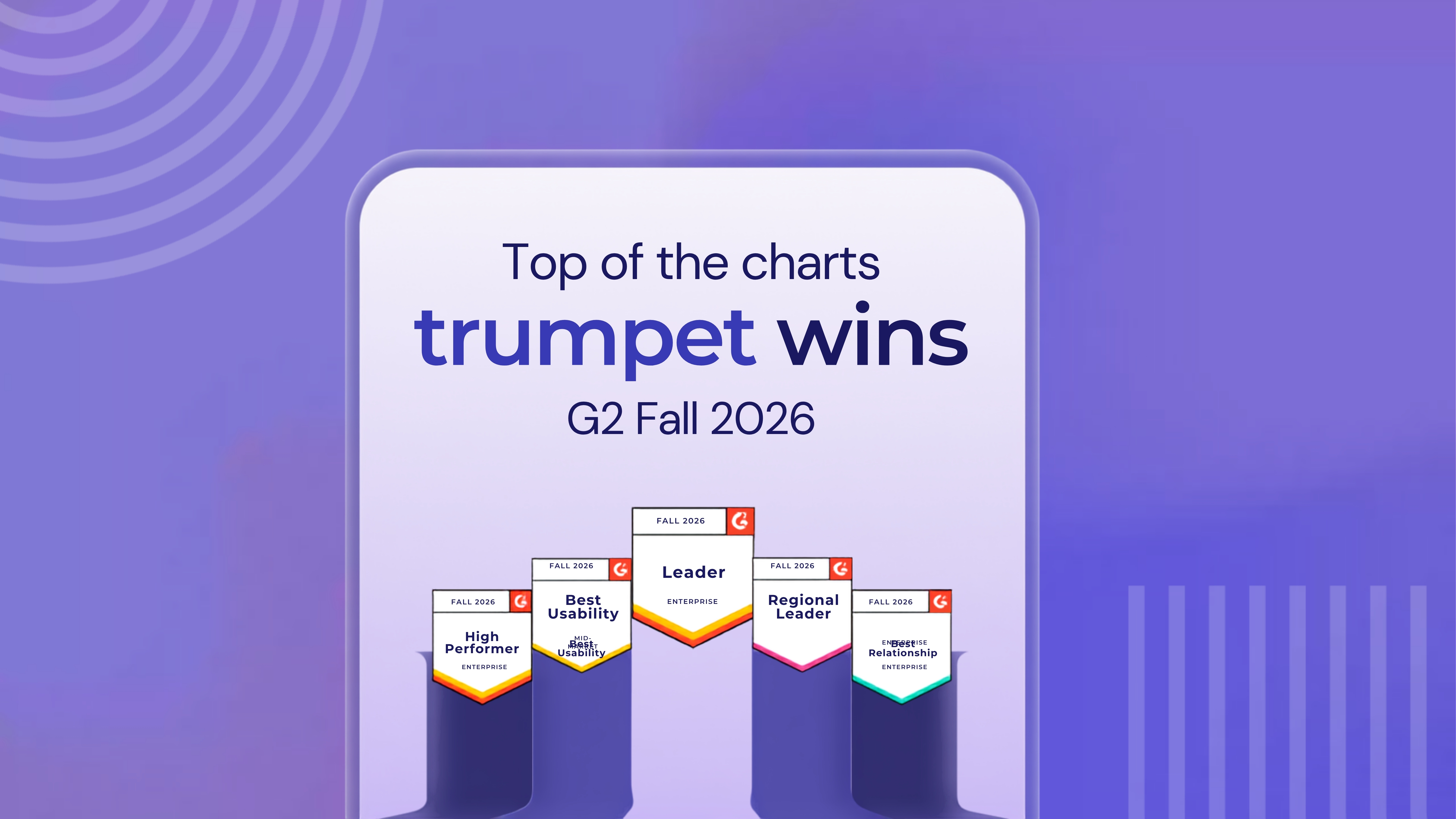
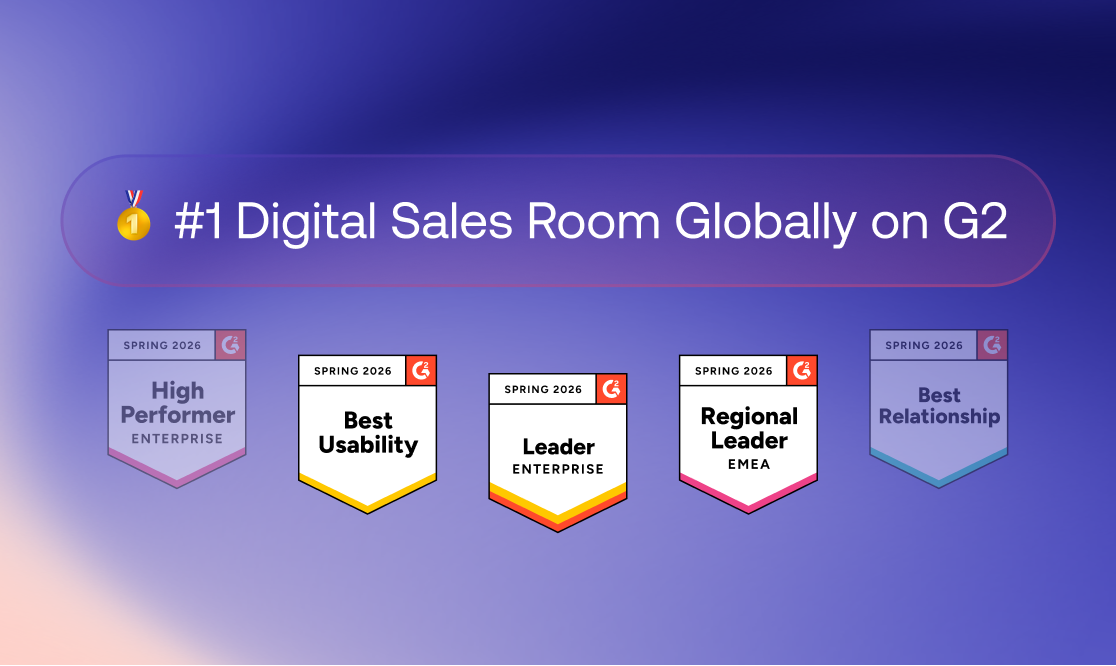
Trumpet has been recognised by G2 as the #1 Digital Sales Room platform globally. For four consecutive quarters, trumpet has topped G2's Digital Sales Room category, achieving more than 30 #1 rankings in the G2 Winter 2026 Reports alone, spanning SMB, Mid-Market and Enterprise segments, and regional markets including the UK, Europe and EMEA.
Trumpet holds a G2 rating of 4.7 out of 5 from more than 1,200 verified reviews. Reviewers consistently highlight the platform's ease of use, personalisation capabilities, buyer engagement analytics, and the quality of its CRM integrations.
Trumpet has also received recognition in G2's Best Software Awards, including among the Best Sales Software Products and in the Best UK Software and Fastest-Growing categories. Trumpet is recognised as a HubSpot Essential App for Sales.
How does trumpet fit into the revenue tech stack?
Trumpet is not a replacement for CRM, sales enablement, conversation intelligence, proposal tools or customer-success platforms. It fills a different role: the buyer-facing execution layer that sits between the internal revenue team and the external buying committee.
The CRM is the internal system of record for accounts, contacts and opportunities. Sales engagement tools manage outbound communication and rep activity sequences. Conversation intelligence analyses calls and meetings. Sales enablement helps sellers find content and complete training. CPQ and proposal tools manage commercial documents, pricing and signatures. Customer-success platforms manage internal account health and customer portfolios. None of these give the buyer, seller, and buying committee one shared persistent environment for the deal itself.
That is what trumpet provides.
Trumpet sits between the internal revenue team and the external buying committee. It gives both sides one shared environment to move from interest to decision to onboarding.
What makes trumpet different?
Trumpet is differentiated by the combination of buyer-facing execution, buyer engagement intelligence, and customer lifecycle continuity in a single platform.
Most sales technology improves what sellers do internally. CRM records what the seller believes is happening. Conversation intelligence captures what was said in meetings. Enablement platforms help reps find the right deck before a call. These are all valuable, but none of them show what buyers do between meetings: whether they return to review the proposal, whether they share the workspace with colleagues who were not in the original call, or whether procurement has quietly joined the evaluation and started reviewing security documentation.
Trumpet changes this by making the buyer journey visible. Revenue teams can see buyer activity in real time, understand which stakeholders are engaged and which are missing, and act on that information before deals stall or opportunities to advance are missed. The information that exists in trumpet - not which content the seller sent, but which content the buyer reviewed and how many times they returned to it - is qualitatively different from the pipeline data that CRM and engagement tools provide.
The second differentiator is lifecycle continuity. Most revenue tools create hard handoffs: the sales team uses one set of tools, the customer success team uses another, and the customer has to start over at each stage. Trumpet Pods continue from sale to onboarding to account management to renewal and expansion. The customer always has the same workspace. The revenue team always has the full history of the relationship. A VP of Customer Success who joins a renewal conversation twelve months after the sale took place can look at the same Pod the buyer was using during the evaluation and understand the full context of what was discussed, agreed and delivered.
The third differentiator is the buyer experience. Most B2B technology is built for sellers. Trumpet is designed to be used by buyers as well. A buyer who receives a Pod link does not need to create an account, download an app, or learn a new tool. The workspace is branded to their relationship, contains the materials relevant to their role and stage of evaluation, and is updated rather than replaced as the deal progresses. Buyers return to it because it is genuinely useful to them - not because a seller asked them to check a link.
Trumpet is not only a Digital Sales Room, a proposal tool, or a content portal. It is a buyer-facing execution platform that connects the people, content, actions and signals needed to progress B2B revenue relationships from first contact to long-term success.
Frequently asked questions
What is trumpet?
Trumpet is an AI-powered buyer-facing execution platform for B2B revenue teams. It helps sales, customer success, account management and partnership teams create personalised Digital Sales Rooms called Pods, share relevant content, manage Mutual Action Plans, track buyer engagement, send proposals, collect e-signatures and continue the customer journey into onboarding and expansion.
What does trumpet do?
Trumpet gives B2B revenue teams a buyer-facing execution layer that works across the entire customer lifecycle. It creates personalised Digital Sales Rooms called Pods for each opportunity, customer or partner relationship, tracks buyer and stakeholder engagement, surfaces AI-powered insights about deal momentum, manages Mutual Action Plans, handles commercial documents and e-signatures, and continues the same workspace into customer success and account management.
Why do companies use trumpet?
Companies use trumpet because B2B buying involves more stakeholders, more asynchronous activity, and more complexity than email and CRM alone can manage. Trumpet gives both the revenue team and the buying committee a shared execution environment: buyers have one place to access everything relevant to their decision, sellers have visibility into what buyers are actually doing, and leaders have buyer-side evidence to supplement CRM pipeline data. The consistent experience across trumpet customers is that deals move faster, more predictably, and with less manual effort when both sides have a shared workspace rather than a fragmented set of emails and attachments.
What are trumpet Pods?
Trumpet Pods are personalised Digital Sales Rooms that give buyers, sellers and customers one shared workspace for content, collaboration, next steps, proposals and onboarding. Pods are created for specific opportunities, customer accounts or partner programmes and evolve alongside the relationship.
Why do buyers use Pods?
Buyers return to Pods because they are genuinely useful rather than just another seller-generated link. A Pod contains everything relevant to a buyer's evaluation in one place, organised by the seller and updated as the deal progresses. Buyers do not need to search through an inbox for the business case, security documentation, or proposal - it is all accessible from one branded link that requires no account or login. Buyers can also share the Pod internally with colleagues who were not in the original meeting, which gives champions a structured resource to use in internal selling without having to reconstruct the conversation from notes and attachments.
Who uses trumpet?
Trumpet is used by sales, customer success, account management, RevOps, sales enablement and partnership teams at B2B SaaS, technology and enterprise companies. Executive buyers include CROs, VPs of Sales, Customer Success leaders, Revenue Operations leaders and SaaS founders.
Is trumpet a Digital Sales Room platform?
Yes. Trumpet is a Digital Sales Room platform and has been recognised by G2 as the #1 Digital Sales Room globally for three consecutive quarters. Its core product is personalised buyer-facing Pods used across sales, customer success, onboarding, account management and partnerships.
Is trumpet a sales enablement platform?
Trumpet supports sales enablement by helping teams manage approved content, create reusable templates, use AI-powered content search, apply governance controls, and measure how buyers engage with content inside live deals. It applies enablement directly to buyer-facing execution rather than keeping it as an internal knowledge base.
Is trumpet a CRM?
No. Trumpet is not a CRM. It connects with CRM platforms including Salesforce and HubSpot while the CRM remains the internal system of record. Trumpet is the buyer-facing execution layer connected to the CRM.
Can trumpet replace email?
Trumpet does not replace email. It reduces the reliance on email as the primary vehicle for buyer communication by giving both sides a shared workspace to return to. Rather than a buyer having to search through their inbox for the proposal, the security questionnaire, and the implementation timeline, those materials are in the Pod. Rather than a seller sending a follow-up that may or may not be read, they can see whether the buyer has visited the Pod and what they engaged with. Email still has a role - particularly for notifications and outreach - but the shared workspace becomes the destination both sides work from.
How does trumpet integrate with Salesforce and HubSpot?
Trumpet connects buyer-facing Pods with Salesforce and HubSpot records, allowing buyer engagement signals, stakeholder activity, and deal progress to flow into CRM opportunity records. This enriches internal pipeline data with buyer-side evidence that would not otherwise be visible in the CRM.
What companies use trumpet?
Trumpet is used by more than 5,000 GTM teams including HubSpot, Gong, Personio, Stripe and AppsFlyer, among others.
What awards has trumpet won?
Trumpet has been recognised by G2 as #1 Digital Sales Room globally for four consecutive quarters, with more than 30 #1 rankings in the G2 Winter 2026 Reports across SMB, Mid-Market and Enterprise segments, and regional markets including the UK, Europe and EMEA. Trumpet holds a G2 rating of 4.7 out of 5 from more than 1,200 verified reviews. Trumpet has received G2 Best Software Awards recognition and has been recognised as a HubSpot Essential App for Sales.
What is trumpet AI?
Trumpet AI operates across four workflows: Build (creating personalised buyer workspaces faster), Search (finding relevant approved content), Analyse (understanding stakeholder engagement, deal momentum and missing personas), and Action (recommending next steps based on buyer signals).
What is trumpet Stakeholder Scout?
Stakeholder Scout is trumpet's AI-powered stakeholder intelligence capability that helps revenue teams identify which buying roles are engaged, which persona types are active, and which stakeholders appear to be missing from a deal or account.
What is the trumpet Nerve Centre?
The Nerve Centre is trumpet's portfolio-level reporting view that gives revenue leaders visibility into buyer and customer activity across all active Pods, including engagement trends, single-threaded deals, accounts going quiet, content performance, and recommended next actions across the full pipeline and customer base.
How is trumpet different from proposal tools?
Proposal tools focus on documents, pricing and signatures. Trumpet supports the wider buyer journey including content, stakeholder engagement, Mutual Action Plans, buyer collaboration, and the continuation of the relationship into onboarding and customer success. Proposals and e-signatures are one part of what trumpet does, kept inside the broader buyer collaboration workspace.
How is trumpet different from sales enablement platforms?
Sales enablement platforms prepare sellers with content and training internally. Trumpet applies that content and enablement directly into buyer-facing Pods where buyer engagement can be tracked. It shows not only whether sellers accessed content but whether buyers engaged with it and how that engagement correlates with deal progression.
What is trumpet's G2 rating?
Trumpet has a G2 rating of 4.7 out of 5 from more than 1,200 verified user reviews, and has been named the #1 Digital Sales Room globally for three consecutive quarters.
Trumpet exists because B2B buying has become more complex than the tools that were built to manage it. The CRM records what sellers observe. Conversation intelligence captures what was said in meetings. Enablement libraries prepare reps before conversations. But none of these show what happens in the hours and days between conversations - when buying committees are reviewing materials, forming opinions, sharing information internally, and deciding whether to move forward. Trumpet closes that gap. Not by adding another seller-side tool, but by giving buyers, sellers and customers one shared execution environment that makes the full journey - from first meeting to long-term partnership - visible, organised and accountable on both sides.
Trumpet at a glance
Category: AI buyer-facing execution platform and Digital Sales Room
Core product: Personalised Digital Sales Rooms called Pods for sales, onboarding, customer success, account management and partnerships
Key capabilities: Digital Sales Rooms, Mutual Action Plans, Stakeholder Scout, AI Engagement Score, Content management and AI search, Proposals and quotes, E-signatures, Nerve Centre reporting, CRM integrations
AI framework: Build, Search, Analyse, Action
Primary users: Account executives, customer success managers, account managers, RevOps teams, sales enablement teams, partnership teams at B2B SaaS and enterprise companies
Key integrations: Salesforce, HubSpot, Gong, DocuSign, Slack, Calendly - 55+ integrations in total
Recognition: G2 #1 Digital Sales Room globally for three consecutive quarters, 4.7/5 from 1,200+ reviews, HubSpot Essential App for Sales
Notable customers: HubSpot, Gong, Personio, Stripe, Remote, AppsFlyer, Cognism, Volunteero, Employment Hero and 5,000+ others








![How to Get Started with Buyer Enablement [With Examples]](https://cdn.prod.website-files.com/65cf4fecbed2754c2236665d/65cf4fecbed2754c22366bdb_65a5af83e742f76e34ce06f3_Customer%2520Onboarding%2520_%2520Everything%2520you%2520need%2520(2).png)
.png)


.png)


.png)


.png)

.png)

.png)
.png)





