

- Let agents prepare, summarise and flag issues automatically, and keep a named person in the loop for anything buyer-visible or hard to reverse.
- A three-level matrix built around reversibility and buyer impact, not technical complexity, is a workable starting point for most sales workflows.
- Too many approval gates are nearly as risky as too few, since reviewers start rubber-stamping drafts they no longer read carefully.
- Whatever an agent is allowed to do, someone named and accountable should own the outcome, with a record of what happened and why.
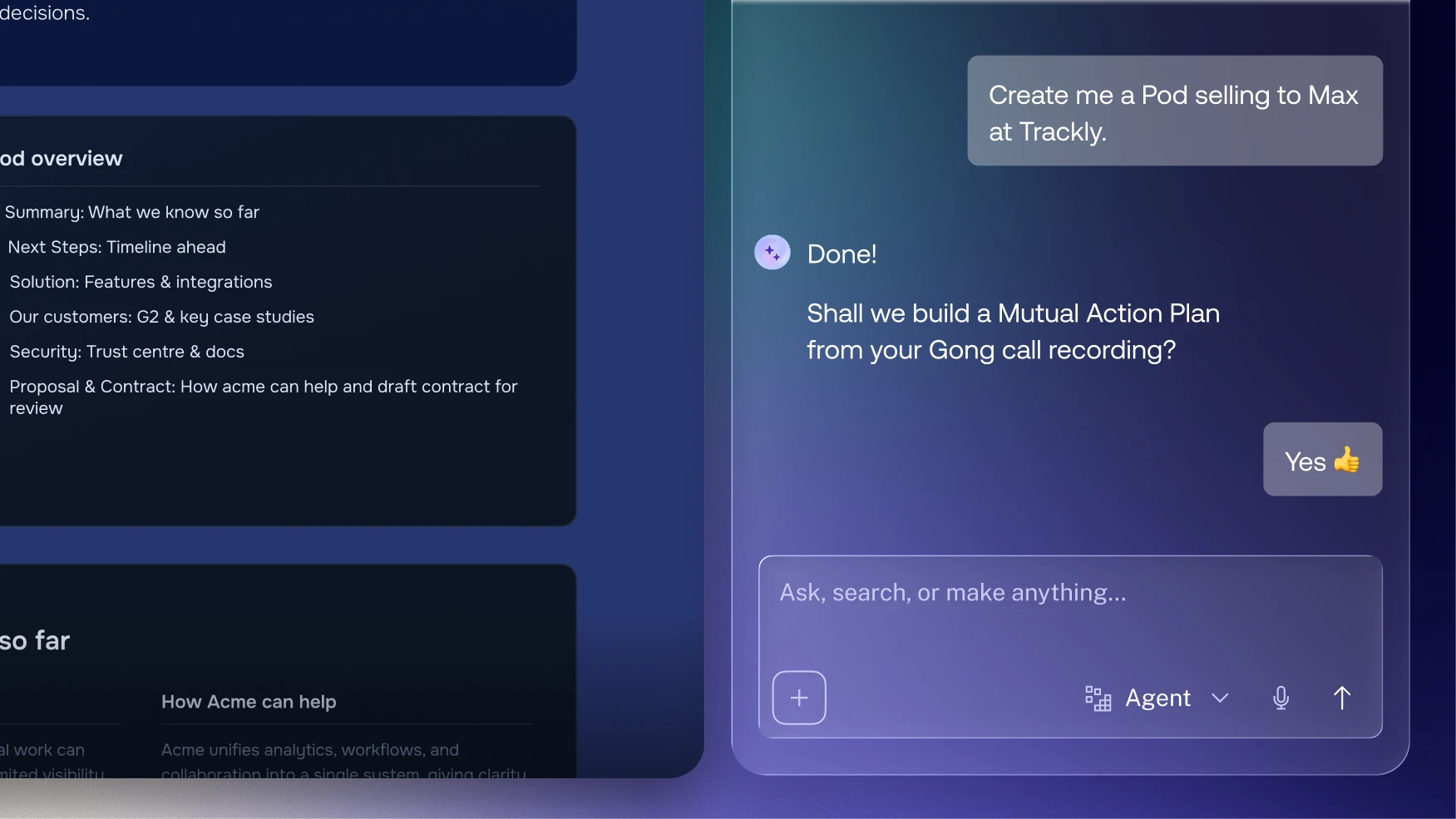
Dana Whitfield, VP Operations at a fictional company we'll call Harlow Systems, mentions to her trumpet rep, almost in passing, that procurement will probably want updated terms before end of quarter, though nothing is settled yet. In this scenario, an AI agent reads the call, drafts a new Mutual Action Plan step, and logs Dana's comment as a deadline. The characters and conversation are invented, but the capability they illustrate, an agent reading a call and proposing a Mutual Action Plan change, reflects what trumpet's own Agentic Workflows documentation describes.
The question is not whether an agent can do this, but which part should happen without anyone checking first: preparing something inside your own systems carries little risk, since a draft sits unread until reviewed; changing something a buyer can see carries real risk, since a mistaken date or misread comment becomes part of what the buyer believes.
The practical answer: let agents prepare, draft and summarise without asking first, and require a named person to approve anything buyer-visible, anything that changes commercial terms, and anything hard to undo. This guide sets out that framework, and shows exactly how it plays out in a real trumpet workflow.
What can an AI sales agent do without human approval?
Most confusion around agent autonomy comes from treating "AI agent" as one thing, when it sits at four different points on a scale:
- Making recommendations. The agent suggests something and a person decides whether to act, such as flagging a quiet economic buyer and suggesting a follow-up angle.
- Preparing work for review. The agent produces a finished draft that changes nothing until read, such as a call summary or a proposed Mutual Action Plan update.
- Acting automatically. The agent makes a change that stays inside your own systems, such as tagging a deal or creating a Pod from a template at a chosen stage.
- Making externally visible changes. The agent does something a buyer will see, such as publishing an update to a shared Pod or sending a follow-up email.
The first three can run with little oversight, since a mistake is cheap to catch before anyone outside sees it. The fourth is where approval earns its keep: undoing a buyer's impression is harder than undoing the record.
The AI sales agent approval matrix
These three levels sort sales agent actions by risk; they're a recommendation, not a universal standard or trumpet's fixed settings. Weigh what happens if wrong, how easily it reverses, who has permission, and what it might trigger downstream: an internal-only change isn't automatically low risk if it can set off other workflows.
Level
Can include
Sales examples
What to weigh
Level 1: runs automatically
Internal work that's usually low risk if it doesn't feed into other automated steps
Summarising a sales call; identifying missing deal information; preparing an internal draft
Often low cost if wrong, but check whether it could trigger other workflows, such as a CRM update cascading elsewhere
Level 2: requires rep approval
Anything buyer-visible or externally sent, but still reversible
Publishing changes to a buyer-facing Pod; updating an agreed Mutual Action Plan; sending follow-up emails
Moderate cost if wrong, since a buyer has seen it; a named rep should check it first
Level 3: requires additional human control
Commercial, contractual or hard-to-reverse actions tied to the buyer relationship
Changing pricing or contractual terms; making commercial commitments; granting sensitive access; deleting customer information
High cost if wrong and hard to undo; keep it with a person, with the agent limited to drafting or recommending
How this works in a real sales workflow
Sam is an Account Executive working a deal with Harlow Systems, a mid-sized B2B software company, and Dana Whitfield, VP Operations, is his main contact. Near the end of a discovery call, recorded through Gong, Dana says: "Procurement will probably want to see updated terms before end of quarter, but that's not set in stone yet."
Here is how that plays out, step by step:
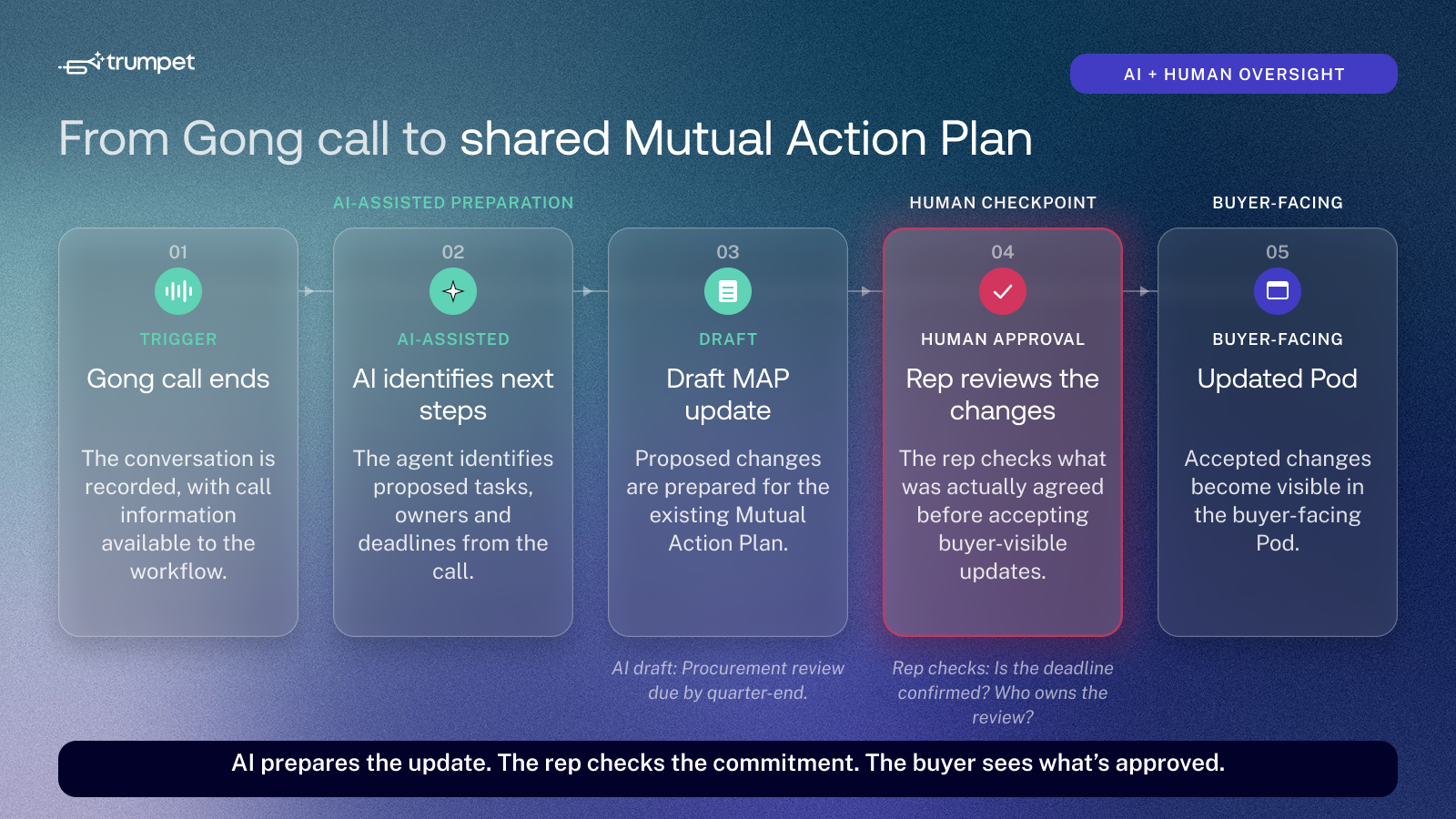
- The call ends. Once Gong finishes processing the recording, it's matched to the Harlow Systems Pod, with its highlights, outline and transcript available there.
- The agent drafts next steps. Trumpet's Agentic Workflows reads the transcript, drafts Mutual Action Plan steps and owners, and flags any newly mentioned stakeholder.
- An update is prepared against the existing Mutual Action Plan, sitting alongside the current plan. Nothing visible to Dana has changed yet.
- Sam reviews the proposed changes. Trumpet's documentation states that changes to a buyer-visible Mutual Action Plan wait for the rep to accept them before they go live.
- Changes go live once accepted. The update becomes visible to Dana, the run is logged, and a failed run is retried.
This is also where the detail matters most. Here is exactly what the agent's draft might get right and wrong:
Based on that single sentence, the draft might propose a new step reading something like: "Procurement review of updated contract terms. Owner: Dana Whitfield. Due: 30 September."
Several things in that draft need checking before anyone treats it as a buyer commitment.
- What Dana actually said. Procurement will probably want updated terms; nothing is agreed, which is far from a scheduled review.
- What the draft assumes. A specific due date, 30 September, is inferred from a vague phrase: Dana only said "end of quarter," which could land on several different dates depending on Harlow's own calendar.
- What the draft likely gets wrong. Dana is named as owner because she raised the point, but said nothing about running the review herself; procurement is the more plausible owner.
- What is still unconfirmed. Whether this is a real next step, since Dana flagged it as provisional.
Before approving anything, Sam needs to check the actual timing with Dana, confirm who at Harlow should own a procurement-facing step, and decide whether this belongs in the plan yet. The safer move is to hold off approving the proposed step until the timing, owner and commitment are confirmed, noting something closer to the real conversation instead: a lower-commitment step such as "Confirm whether procurement needs to review updated terms, and by when," with Dana as the person confirming that, not the owner of a review nobody has agreed to. A proposed step is the agent's best guess, and only becomes a commitment once checked against what the buyer actually agreed to.
What happens when an AI sales agent gets something wrong?
An error inside your own systems is an inconvenience; the same error in a shared workspace becomes part of the record a buyer is working from.
AWS's Well-Architected guidance on agentic AI puts it directly: an approval step is only as good as the context given, or "review becomes a formality." A rep who sees only "3 MAP steps updated" isn't really reviewing anything.
Permissions matter as much as review. Microsoft's Cloud Adoption Framework guidance on AI agent governance recommends scoping permissions to only what's authorised, not the maximum the platform allows, with a named, accountable owner for every agent and access limited to the deal data it needs.
Accountability is the part organisations most often skip. An October 2026 analysis from law firm Jones Walker, published via Legal 500, argues naming a sponsor isn't enough without real authority to suspend, restrict or correct the agent, or oversight exists only on paper.
Trumpet's own documentation offers a partial answer: every run is logged, with failures caught and retried, though not a process for who corrects a buyer-facing error once live, worth building into your own playbook.
How to avoid too much automation or too many approvals
Too little oversight is the obvious failure mode: an agent sends, changes or commits to something it shouldn't, and nobody catches it until the buyer mentions it. The opposite failure mode is just as damaging: AWS's own Well-Architected guidance warns against routing everything through a human, since it "produces rubber-stamp approvals," and a rep asked to approve dozens of low-stakes drafts a day stops reading them properly.
Treat the approval matrix as a starting point, not a fixed rule: automate the lowest-risk work first, add approval only where something is buyer-visible or hard to reverse, and revisit the thresholds periodically as a workflow proves reliable or keeps needing correction.

How trumpet's Agentic Workflows supports human oversight
Agentic Workflows is trumpet's own implementation of the prepare-versus-act distinction this article has built towards; the Mutual Action Plan example above is only one part of what it covers.
Triggers include a HubSpot or Salesforce stage change, a Gong call finishing, buyer activity in a Pod, a schedule, or the API, Zapier or n8n, spanning actions from creating a Pod to writing back to the CRM or flagging a quiet one.
Trumpet's documentation describes low-risk, internal steps running without approval, while buyer-visible Mutual Action Plan and Org Chart updates wait for the rep to accept them, as above; other workflow actions may depend on how an administrator has configured them. A workflow can be assigned to one rep or the whole company, a Slack alert fires for pending approvals and quiet deals, and every run is logged, with failures caught and retried.
Trumpet's own product page frames what runs automatically versus what needs approval as something an administrator sets, not a fixed rule applied the same way on every account.
Frequently asked questions
What does human-in-the-loop mean for AI sales agents? A named person checks and approves actions that are hard to reverse or visible to a buyer, before they take effect.
Which sales agent actions can safely run without approval? Actions inside your own systems that are easy to undo, such as summarising a call, identifying missing deal information or preparing an internal draft.
What happens if an AI sales agent makes a mistake? It depends what it touches: an internal error is caught at review and costs little; one reaching a buyer needs a clear process for who corrects it and how they're told.
Who stays accountable when an AI agent takes an action on a deal? The person or team who approved the workflow, not the agent itself, following Microsoft's guidance on AI agent governance that every agent needs a named, accountable owner.
Does trumpet's Agentic Workflows require approval before a change reaches the buyer? Trumpet's documentation states that changes to a buyer-facing Mutual Action Plan or Org Chart wait for rep acceptance before going live, though the exact review screen and admin settings aren't fully detailed.
Where to draw the line
The real choice for RevOps teams isn't automation versus control; it's deciding, workflow by workflow, which deserves which. Agents that prepare, summarise and flag issues save real time with little downside, since nothing changes until read; agents that touch pricing, contracts or a buyer's view of the deal need a named person in the loop, not because the technology can't be trusted, but because a quiet mistake costs far more once seen.
If you want to see where that line sits in practice, trumpet's Agentic Workflows page sets out which triggers and actions are available today, including where a rep's acceptance is required before a Mutual Action Plan or Org Chart change goes live.

See what your buyers are doing between meetings
Build a Pod, share it with the buying committee and watch the signals roll in. Free to start.