

- Competition is often a sign of serious buyer intent
- Status quo is a bigger threat than other vendors
- Discovery is the foundation of differentiation
- Buyer experience shapes trust and decision-making
- Executive alignment keeps enterprise deals moving
- Honest competitor positioning builds credibility
- References work best when used to unblock specific risks
- Price should always be framed around outcomes and risk
Competitive enterprise deals are a good thing, buyers comparing multiple vendors, bringing in executives, pressure testing prices. It shows they have intent.
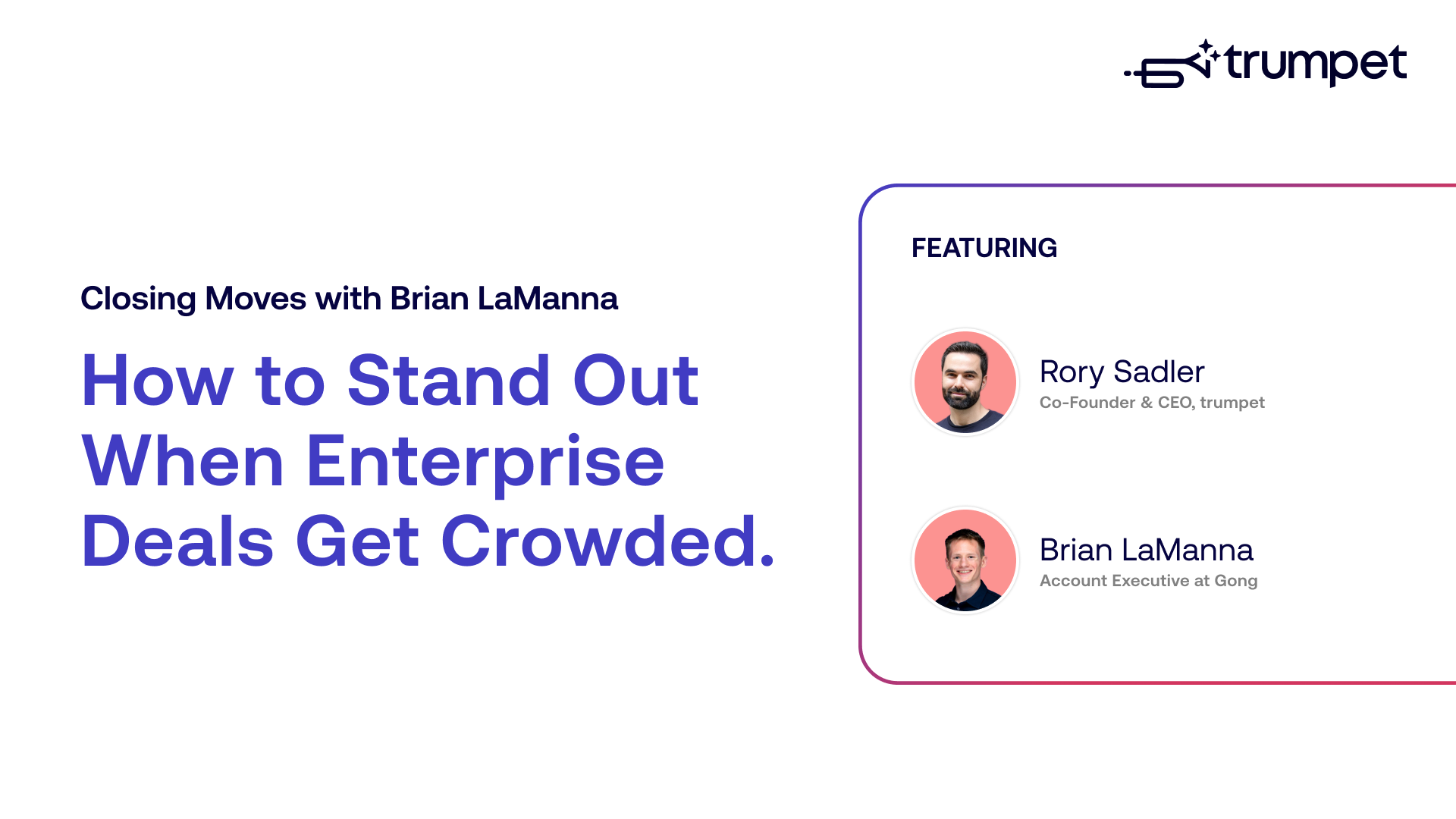
In our live webinar Rory Sadler, CEO and Co-Founder at trumpet caught up with, Brian LaManna, Enterprise Account Executive at Gong, to break down how top sellers win when competition is unavoidable.
Rather than focusing on feature battles, Brian shares how discovery, buyer experience, and deal execution consistently decide who wins enterprise deals.
How common is competition in enterprise sales?
According to Brian, competition is the norm, particularly in inbound deals.
“If it’s inbound… maybe 90% chance it’s competitive.”
For Brian, competition is not a threat. It is a signal that a buyer is serious.
“It’s a really compelling signal… it doesn’t mean I’m going to win the deal, but it’s much more likely that I’m not going to lose versus status quo.”
Why does status quo kills enterprise deals?
In sales, the status quo refers to a buyer choosing to stick with their existing tools, processes, or way of working rather than making a change, even when better options exist.
Brian shares that deals with competition are far more likely to result in a decision.
“When competitors were involved, they’re much more likely to choose someone rather than nothing.”
The biggest risk in enterprise sales is not losing to another vendor. It is losing momentum altogether.
“Status quo is actually probably our biggest competitor in every single deal.”
When buyers are already investing in a category, the focus shifts from whether to buy to who to buy from.
How do you differentiate when products overlap?
Brian is direct about the reality of modern sales tech.
“There might be 80% overlap.”
Because of this, differentiation rarely comes from features alone. Instead, Brian starts by removing product from the conversation entirely.
“I try to remove Gong or competitor X or competitor Y completely off the table. I just want to understand their world, their priorities, their outcomes.”
Only after deep discovery does he connect specific capabilities back to what matters.
“A lot of the differentiation is not just on your product alone, but that buyer experience.”
Should you focus on buyer experience over features?
Buyers often judge what it will be like to work with a company based on how the sales process feels.
“Prospects tend to draw a conclusion about how your company operates, how the support is, your responsiveness.”
Slow follow-ups, scattered resources, and unclear pricing increase perceived risk.
“They’re going to be more likely to go with the seller that they had a better experience with.”
For enterprise buyers navigating internal scrutiny, experience equals trust.
How to involve executives in enterprise sales deals
Brian describes enterprise selling as a team effort, where the role of the seller is not to carry the deal alone, but to make it easier for others to contribute at the right moments. He compares his role to a quarterback who focuses on setting the team up to win rather than trying to do everything himself.
“In enterprise, I’m the quarterback that’s more of a game manager.”
Instead of relying on individual heroics, Brian focuses on enabling the right people internally to show up prepared and confident in front of the buyer.
“I’m trying to get the football in my playmakers’ hands and set them up for success.”
A critical part of that approach is reducing the friction involved in bringing executives into deals. Brian explains that senior leaders do not have time for long internal briefings before every customer call, which means deal context needs to be easy to understand quickly.
“Your executive is not going to want to schedule a 45 minute internal prep call just to do a 30 minute call externally.”
When executives can see deal progress, risk, priorities, and buyer context clearly and quickly, they can engage more effectively. This keeps deals moving forward without slowing momentum or adding unnecessary internal overhead.
Can a strong deal execution win deals even without perfect feature fit?
Brian says yes, and he has heard it directly from customers.
“I know that because I’ve been told that by customers post sale.”
Consistency, organisation, and support throughout a long sales cycle build confidence.
“Me proving that in a six month sales cycle that I’m that person that’s going to be there.”
Enterprise buyers are not just buying software. They are buying confidence in execution.
How should sellers talk about competitors?
When competitors come up in a deal, Brian’s first instinct is to lower the tension rather than escalate it. Instead of reacting defensively or rushing to prove superiority, he focuses on keeping the conversation calm and constructive.
Brian deliberately avoids jumping straight into feature-by-feature comparisons. He believes differentiation is far more effective when it happens later, once buyer priorities are fully understood.
“There’ll be a time and a place to connect the dots.”
One approach he uses is what he calls reverse complimenting. Rather than attacking alternatives, Brian openly acknowledges where competitors are strong, but frames those strengths in the context of what the buyer actually needs.
“You are complimenting that competitor, but it might be in a way that positions them in the antithesis of what they’re looking for.”
By taking this approach, sellers can maintain credibility, keep trust intact, and guide buyers toward the option that best fits their situation without resorting to negative selling.
When do customer references help?
References are powerful when used carefully.
“I’m very careful not to waste one of our customers’ time.”
Brian only introduces customers when there is a specific concern to address.
“That’s when I might tap a reference that had that same concern.”
Generic reference calls too early often slow deals rather than accelerate them.
How to handle price pressure in enterprise sales
Brian avoids negotiation until vendor preference is clear.
“Before I go to my team and burn internal capital, I need to know that we are the preferred vendor of choice.”
When price comparisons arise, he reframes the conversation around risk and outcomes.
“What’s the cost if you get this wrong versus what we’re going after?”
This helps buyers reconnect with why the evaluation started.
Brian LaManna’s approach to winning competitive deals
Everything starts with discovery.
“You’re unable to differentiate if you don’t have an understanding of their priorities and their outcomes.”
Showing too much too early creates confusion.
“Your solution is a Ferrari and all we need is a Honda.”
Winning comes from matching what is unique to what truly matters.
“That’s really how competitive deals are won and lost.”
FAQs
Are competitive enterprise deals harder to close?
Not necessarily. Competitive deals are often more likely to close than deals with no urgency.
How should sellers differentiate when products look the same?
Focus on discovery, buyer experience, and helping buyers navigate internal decision-making.
Should sellers acknowledge competitors openly?
Yes. Calm, honest positioning builds trust and credibility.
When should pricing be discussed?
After confirming vendor preference and tying price back to business impact.
.png)

See what your buyers are doing between meetings
Build a Pod, share it with the buying committee and watch the signals roll in. Free to start.
.png)
.png)
.png)

.png)
.png)


![How to Get Started with Buyer Enablement [With Examples]](https://cdn.prod.website-files.com/65cf4fecbed2754c2236665d/65cf4fecbed2754c22366bdb_65a5af83e742f76e34ce06f3_Customer%2520Onboarding%2520_%2520Everything%2520you%2520need%2520(2).png)



.png)

.png)