







- Buyer collaboration becomes more challenging as buying committees grow and more stakeholders join the evaluation at different stages with different priorities.
- Digital Sales Rooms give buyers one shared workspace for content, collaboration, Mutual Action Plans, and next steps, reducing the coordination burden on champions and sellers.
- Mutual Action Plans help buyers and sellers stay aligned. According to trumpet platform data, deals with an active MAP achieve double the win rate of those managed without one.
- Stakeholder engagement analytics provide additional visibility into deal health alongside CRM data, helping sellers identify where to focus and where momentum may be fading.
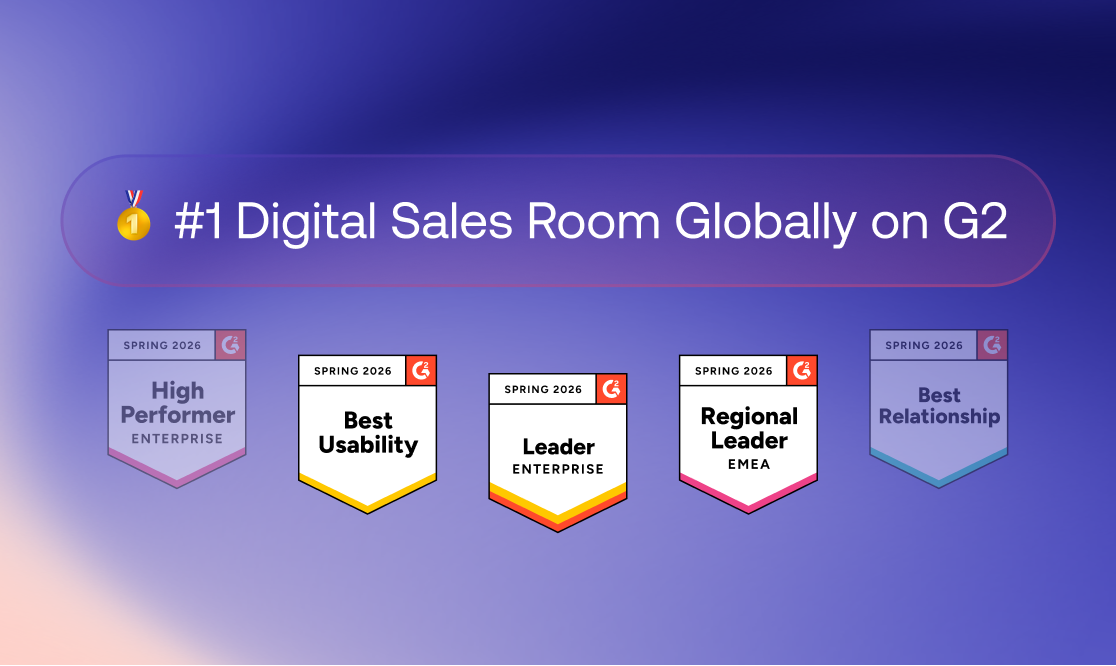
- Trumpet is ranked number one for Digital Sales Rooms globally on G2 and supports the full revenue journey from first meeting through to customer success.
How Digital Sales Rooms Improve Buyer Collaboration
Complex B2B sales rarely involve just one buyer and one seller. A deal may begin with an enthusiastic champion, but it soon expands to include department leaders, finance, procurement, security, legal, IT, end users, and executive sponsors. Each stakeholder joins the evaluation at a different stage, needs different information, and measures success in different ways.
Keeping everyone aligned becomes one of the biggest challenges in the sales process. Product information is shared through email, meeting recordings are stored elsewhere, proposals arrive as separate links, and commercial or security documents often live in different systems. Meanwhile, important conversations continue internally without the seller present, making it difficult to understand how the buying committee is progressing between meetings.
Many complex deals lose momentum because buyer collaboration becomes fragmented. Champions spend time forwarding documents instead of building internal consensus, new stakeholders arrive without context, responsibilities become unclear, and customer success inherits incomplete information once the contract is signed. A Digital Sales Room solves this by creating one shared buyer-facing workspace where sellers and buying committees can collaborate throughout the entire deal.
How do Digital Sales Rooms improve buyer collaboration?
Digital Sales Rooms improve buyer collaboration by giving sellers and the entire buying committee one shared workspace for content, next steps, Mutual Action Plans, commercial information, and decision resources. This reduces fragmented communication, helps new stakeholders catch up, makes responsibilities clearer, and gives sellers better visibility into how the deal is progressing.
Platforms such as trumpet provide personalised Digital Sales Rooms called Pods, where buyers and sellers can manage the full deal journey from initial follow-up through procurement, document signing, onboarding, and customer success.
What is buyer collaboration in B2B sales?
Buyer collaboration is the process of helping sellers and multiple stakeholders work together towards a purchasing decision. It involves sharing relevant information, aligning on business objectives, coordinating procurement and security reviews, agreeing next steps, and ensuring everyone involved understands their role in the decision process.
Most buying committees spend far more time discussing solutions internally than speaking with suppliers. Champions share information with colleagues, finance reviews the commercial case, security assesses compliance, and executive sponsors decide whether the investment supports wider business priorities. The easier it is for those conversations to happen, the easier it is for the deal to maintain momentum. The role of the seller is to give buyers the right information at the right time and make it clear what needs to happen next.
What is a Digital Sales Room?
A Digital Sales Room is a shared buyer-facing workspace where sellers and buying committees can access relevant content, collaborate on next steps, manage Mutual Action Plans, review commercial information, and progress a deal. The CRM remains the internal system of record. The Digital Sales Room becomes the shared execution environment where buyers evaluate the solution, involve colleagues, complete actions, and prepare for implementation.
Within trumpet, this workspace is called a Pod. A Pod can include personalised messaging, meeting recaps, product demonstrations, customer stories, business cases, security documentation, commercial proposals, Mutual Action Plans, document signing, and onboarding resources. Rather than creating a new workspace for each stage, the same Pod evolves from the first discovery call through to customer success, giving buyers and internal teams one consistent place to collaborate.
Why buyer collaboration breaks down in complex B2B deals
Strong buyer collaboration rarely breaks down because of a single failure. More often, momentum slows because information becomes fragmented across too many channels, new stakeholders join without context, responsibilities become unclear, and internal conversations continue without the seller's involvement.
Every meeting creates new information, and that information accumulates across email, recordings, shared drives, proposal tools, and messaging platforms in ways that make it difficult for any one stakeholder to see the full picture. A champion who was present from the first discovery call has context that finance, security, and a new executive sponsor simply do not have when they join three months later. Without a shared workspace, they rely on colleagues to explain the deal, and important details are inevitably lost.
Different stakeholders also evaluate the purchase from entirely different perspectives. Executives focus on business outcomes and risk, end users care about practical workflows, procurement reviews pricing and terms, security assesses compliance, and finance reviews commercial value. When communication depends on one champion translating different messages to different audiences, something is always lost. Next steps compound the problem: buyers and sellers often leave the same meeting with different assumptions about who owns what and when, and actions that were agreed verbally disappear into meeting notes nobody revisits.
How Digital Sales Rooms improve buyer collaboration
One source of truth for the deal
A Digital Sales Room brings together proposals, customer stories, pricing, security documentation, meeting recaps, and agreed next steps in one place. Every stakeholder works from the same up-to-date information, reducing duplicate questions, outdated documents, and repeated follow-up from the sales team.
Asynchronous collaboration across the buying committee
Not every stakeholder can attend every meeting. A shared workspace allows procurement, finance, security, and executive sponsors to review information in their own time without losing the broader deal narrative. New participants can get up to speed without requiring another introductory meeting or the champion to reconstruct weeks of context in a summary email.
Better support for the internal champion
Champions often become responsible for explaining the solution to colleagues, sharing documents, and answering internal questions. A Digital Sales Room gives them one organised workspace to share rather than a collection of email threads and attachments, helping preserve the business case, customer proof, and agreed next steps throughout the evaluation.
Clearer next steps and shared accountability
Mutual Action Plans make responsibilities visible to both sides. Rather than next steps sitting in meeting notes or CRM fields only the seller can see, both parties know what needs to happen, who owns each action, and when it is due. This shared visibility reduces the uncertainty that causes deals to drift between meetings.
Continuity into onboarding
The workspace can transition into implementation and customer success. Customer success inherits the objectives, stakeholders, commitments, and Mutual Action Plan tasks that accumulated during the sales process, rather than beginning the relationship with another round of discovery questions.
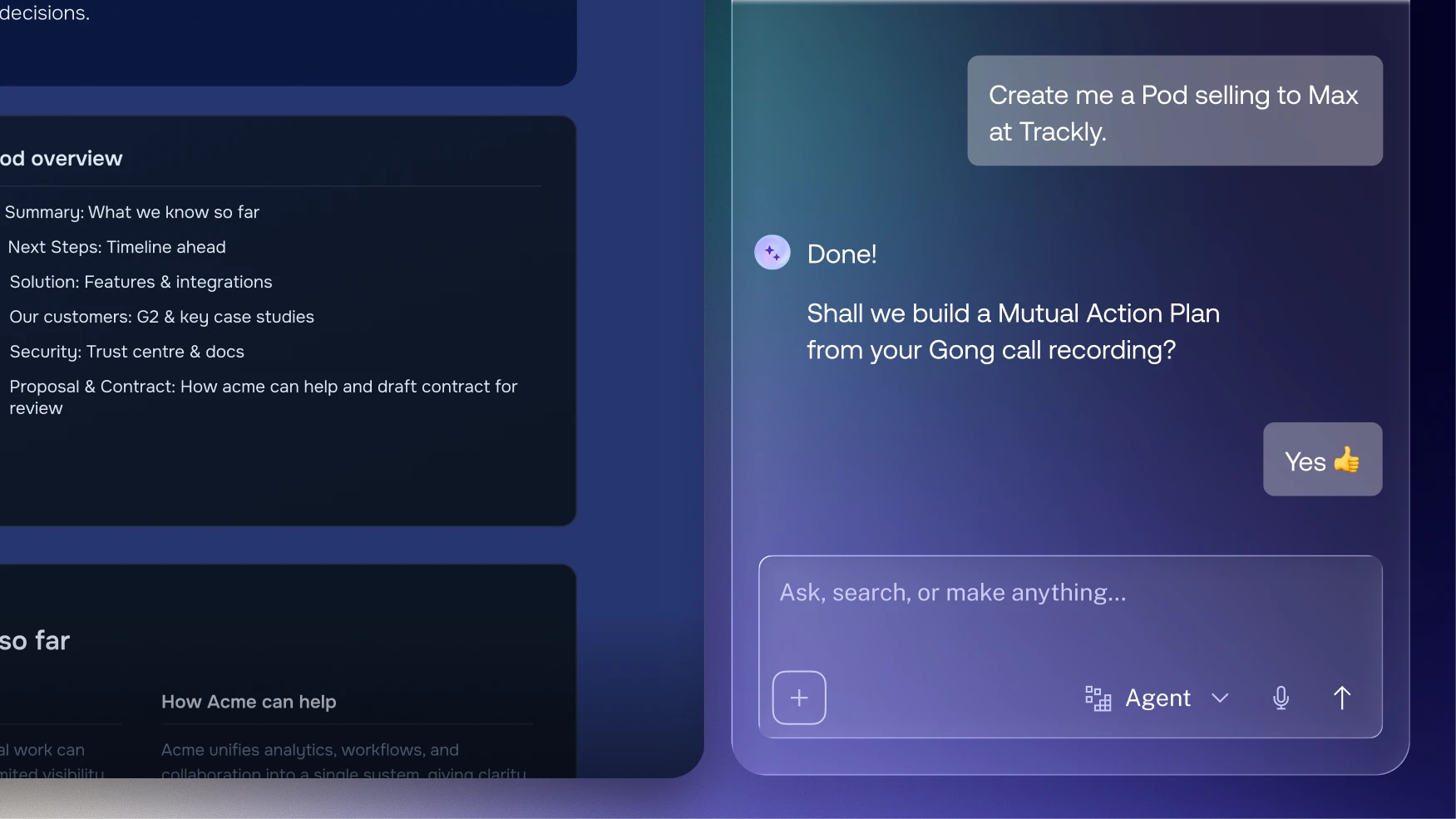
Within trumpet, every deal is managed through a personalised Pod. Revenue teams can monitor engagement through Stakeholder Scout, understand deal momentum with the Nerve Centre, and use AI to build personalised Pods more quickly. Trumpet is ranked number one for Digital Sales Rooms globally on G2.
How Digital Sales Rooms align deal stakeholders
Stakeholder alignment does not mean giving every buyer the same information. It means ensuring everyone involved understands why the organisation is considering change, what outcome is expected, how the proposed solution supports those objectives, and what needs to happen next. A Digital Sales Room allows each stakeholder to access the information most relevant to their role while keeping the wider buying committee aligned around the same commercial outcome.
Champion
Champions need a clear narrative they can share internally. A Digital Sales Room gives them one organised workspace containing customer stories, business cases, proposals, and agreed next steps, making it easier to build internal support without forwarding multiple emails.
Economic buyer
Senior decision-makers are usually interested in commercial outcomes. Business value, return on investment, implementation plans, and commercial proposals should be easy to find so they can quickly understand why the investment makes sense without attending every product demonstration.
End users
End users want confidence that the solution will work in practice. Product demonstrations, workflow examples, implementation guidance, and relevant customer stories help them understand how the solution supports their day-to-day responsibilities.
Finance, security, and procurement
Finance teams need commercial justification, security teams need compliance and technical documentation, and procurement focuses on pricing, contracts, and timelines. A Digital Sales Room keeps those resources available in one place, reducing delays caused by repeated requests for information that was already shared weeks earlier.
Within trumpet, sellers can organise a Pod around the buyer's journey while including dedicated sections for each stakeholder group. Stakeholder Scout also gives revenue teams visibility into who is engaging with the Pod, helping identify missing stakeholders and supporting stronger multi-threading throughout the sales cycle.
How Mutual Action Plans improve buyer collaboration
A Mutual Action Plan is a shared plan that outlines the activities, owners, milestones, and deadlines required to complete a purchase and begin implementation. Rather than acting as a seller's internal closing checklist, it reflects the buyer's decision process, helping both sides understand what needs to happen before the deal can move forward.
For buying committees, a Mutual Action Plan creates transparency. Everyone can see which actions have been completed, which tasks remain outstanding, and who is responsible for each step. This reduces misunderstandings, keeps procurement, legal, security, and commercial reviews aligned, and helps maintain momentum throughout longer sales cycles. According to trumpet platform data, deals using an active Mutual Action Plan have achieved twice the win rate of deals managed without one, and MAPs with six to ten completed steps have shown an 84 per cent close rate across deals analysed. These findings are correlational and should be considered alongside factors such as sales process, buyer participation, and product-market fit.
Within trumpet, Mutual Action Plans live inside the buyer-facing Pod alongside proposals, customer stories, security documentation, and onboarding resources. Buyers and sellers can update progress together, assign actions, and track milestones from one shared workspace rather than switching between spreadsheets, emails, or project management tools. The same plan can continue into onboarding, preserving the shared accountability that was built during the sales process.
Can Digital Sales Rooms improve sales win rates?
Digital Sales Rooms can create the conditions that help complex B2B deals progress more effectively, although they do not guarantee stronger win rates independently. Success still depends on the quality of the sales process, the relevance of the solution, buyer participation, and how consistently the platform is used throughout the evaluation.
Trumpet platform data provides some supporting evidence. Pods involving ten or more unique stakeholders have produced a 75 per cent close rate across deals analysed. Adding relevant content during the final third of the sales cycle has been associated with a 51 per cent increase in win rate and a 33 per cent reduction in sales-cycle length. Deals where buyers returned to the Pod four to five times showed 45 per cent higher win rates and 35 per cent shorter sales cycles than deals with a single visit. These are correlations observed across deals managed within the trumpet platform. Results will vary depending on sales methodology, buyer engagement, product-market fit, and platform adoption.
How to structure a Digital Sales Room for better collaboration
The most effective Digital Sales Rooms are organised around the buyer's decision process rather than the seller's internal sales stages. Each section should help the buying committee answer a specific question: why is change needed, what solution is being considered, what evidence supports it, what is the commercial case, what needs to happen next, and what does implementation look like. Leading with an executive summary that reflects the buyer's own stated challenges and objectives gives every stakeholder, including those who join later, an immediate understanding of why the evaluation is happening.
From there, the room should progress through relevant product content, customer proof, the business case, security and procurement resources, the commercial proposal, a collaborative Mutual Action Plan with milestones and owners, and an implementation plan that gives the buyer confidence in what comes after signature. Within trumpet, these sections can all be organised inside a single Pod and updated as the deal develops, with sellers personalising the experience for each account while maintaining a consistent structure across the revenue team.
How to use a Digital Sales Room throughout the sales cycle
A Digital Sales Room delivers the most value when it evolves alongside the buyer journey from the first meaningful conversation rather than being introduced at the proposal stage. After discovery, it captures the buyer's priorities and provides initial relevant content. During evaluation, product demonstrations, customer stories, and stakeholder-specific resources are added as the buying committee grows. Validation brings in security, technical, and implementation resources before those reviews become blockers. Commercial review centralises pricing, proposals, and the Mutual Action Plan. Procurement and contracting keep agreements, approvals, and signing workflows connected to the wider deal context. After signature, the same workspace transitions into onboarding, giving customer success immediate access to stakeholders, agreed objectives, and the implementation plan rather than starting from a CRM summary and a handover call.
Common mistakes that weaken buyer collaboration
Treating the room as a content library is the most common mistake. Too much content with no clear structure creates more friction than it removes, and buyers stop returning to a workspace that requires them to search for what is relevant to them. Using a generic template without personalisation produces a similar result: a room that could belong to any prospect provides limited value to any specific buyer.
Building only for the champion is a significant oversight. A Digital Sales Room should support finance, procurement, security, legal, executive sponsors, and end users, not only the person the seller speaks to most often. Introducing the room too late, waiting until the proposal stage, means it cannot shape the earlier decision process. Keeping next steps in email rather than the shared workspace means commitments disappear. Failing to update the room reduces trust. Removing access at signature breaks the continuity that customer success needs to begin onboarding with confidence.
What to look for in buyer collaboration tools
As buying committees become larger and sales cycles more complex, it is worth choosing a platform that supports the entire buying journey rather than a single stage. When evaluating Digital Sales Rooms, look for:
- Fast room creation and reusable templates
- Personalised buyer experiences
- Stakeholder-level engagement analytics
- Mutual Action Plans
- AI-assisted content search and room creation
- CRM integrations with Salesforce and HubSpot
- Secure access controls
- Electronic signatures
- Team reporting and pipeline visibility
- Sales-to-customer-success continuity
Trumpet combines these capabilities in one buyer-facing platform. Revenue teams can create personalised Pods using reusable templates, collaborate through Mutual Action Plans, monitor stakeholder engagement with Stakeholder Scout, and understand deal health through the Nerve Centre. Native Salesforce and HubSpot integrations keep customer information connected throughout the revenue lifecycle, while built-in document signing allows contracts to be completed without buyers leaving the Pod. Trumpet is ranked number one for Digital Sales Rooms globally on G2 across more than 30 enterprise, mid-market, and regional reports.
Final thoughts
Buyer collaboration has become one of the biggest competitive advantages in B2B sales. As buying committees grow and more stakeholders influence purchasing decisions, sending follow-up emails and proposals is no longer enough. Revenue teams need a consistent way to keep buyers informed, aligned, and moving towards a decision.
Digital Sales Rooms provide that shared environment by bringing together content, stakeholders, Mutual Action Plans, commercial information, and onboarding resources in one place. Platforms such as trumpet take this further by combining buyer collaboration, AI-powered personalisation, stakeholder engagement analytics, document signing, CRM integrations, and sales-to-customer-success continuity in a single buyer-facing workspace, helping revenue teams deliver a more connected buying journey from first meeting through to long-term customer success.
FAQs
What is buyer collaboration?
Buyer collaboration is the process of helping sellers and buying committees work together throughout the purchasing journey by sharing information, aligning stakeholders, agreeing next steps, and supporting internal decision-making.
How do Digital Sales Rooms improve buyer collaboration?
Digital Sales Rooms create one shared workspace where buyers can access relevant content, collaborate on Mutual Action Plans, involve stakeholders, and progress the deal without relying on fragmented email threads.
Why is buyer collaboration important in B2B sales?
Most B2B purchases involve multiple stakeholders, each with different priorities. Better buyer collaboration helps keep everyone aligned, reduces unnecessary delays, and creates a more consistent buying experience that is easier for champions to manage internally.
Can Digital Sales Rooms improve sales performance?
They can improve the buying experience by reducing friction, supporting stakeholder engagement, and increasing visibility throughout the sales process. Results depend on factors such as sales execution, buyer participation, and consistent platform adoption.
How does trumpet support buyer collaboration?
Trumpet enables revenue teams to create personalised Digital Sales Rooms where buyers can collaborate through Mutual Action Plans, access stakeholder-specific content, complete document signing, and transition into onboarding, all within one shared workspace. Trumpet is ranked number one for Digital Sales Rooms globally on G2.










![How to Get Started with Buyer Enablement [With Examples]](https://cdn.prod.website-files.com/65cf4fecbed2754c2236665d/65cf4fecbed2754c22366bdb_65a5af83e742f76e34ce06f3_Customer%2520Onboarding%2520_%2520Everything%2520you%2520need%2520(2).png)
.png)


.png)


.png)


.png)

.png)

.png)
.png)





