







- Most revenue teams have a visibility problem, not a software problem. The gap is in the buyer journey, not the internal stack.
- The five core layers are CRM, sales engagement, conversational intelligence, sales enablement, and Digital Sales Rooms - each with a distinct job.
- Problems arise when teams expect one platform to do another's job, or when the buyer-facing layer is missing entirely.
- Trumpet is the buyer-facing execution layer - personalised rooms, stakeholder tracking, Mutual Action Plans, and engagement analytics in one platform.
- The best next tool is the one that fixes your sharpest revenue gap, not the one generating the most category buzz
They say most revenue teams do not have a software problem, but that they have a 'visibility problem'. The CRM says the deal is healthy and calls are being recorded, the content exists, the reps are following their process.
However, deals still stall. A stakeholder joins late, procurement asks questions nobody anticipated, the champion struggles to get internal buy-in and Customer success inherits a deal with half the context missing. The issue is not a lack of technology but it is that most revenue stacks are built around internal processes rather than the buyer journey. The strongest SaaS revenue teams build a stack where every tool has a clear role, from CRM and sales engagement through to buyer collaboration and deal execution. Let's have a look
The five layers of a modern revenue stack
A modern revenue stack consists of five core layers.
While CRM, sales engagement, conversational intelligence, and sales enablement platforms focus primarily on internal workflows, Digital Sales Rooms bring buyer collaboration, stakeholder engagement, Mutual Action Plans, and deal execution into a single buyer-facing experience. This is where trumpet fits in the modern revenue stack.
Layer 1: CRM provides the foundation
Every revenue stack starts with CRM. Platforms like Salesforce and HubSpot help teams manage accounts and contacts, pipeline stages, forecasting, opportunity tracking, revenue reporting, workflow automation, and customer records. CRM is the system of record. It tells the business what opportunities exist and where they sit in the pipeline.
Salesforce is the enterprise standard for larger teams that need deep customisation and complex sales operations. HubSpot is often the stronger fit for scaling SaaS teams that want CRM, marketing automation, and sales workflows in one connected platform without significant custom development.
What CRM does not do is show how buyers are engaging between meetings.
Layer 2: Sales engagement creates activity
Sales engagement platforms help teams create pipeline. Tools like Salesloft support prospecting, sequences, email and call cadences, follow-up workflows, activity tracking, and pipeline generation. These platforms help reps generate conversations consistently at scale.
Their primary purpose is activity creation rather than buyer collaboration. A prospect in a sequence is not the same as a buyer navigating a complex evaluation.
Layer 3: Conversational intelligence improves execution
Gong has become one of the most widely used tools in modern B2B sales because it turns sales conversations into structured intelligence.
It helps teams record and transcribe calls, analyse what was said, identify coaching opportunities, surface deal risk signals, track objection patterns, and improve forecast accuracy. Managers can review a deal based on what was discussed rather than what the rep logged.
What conversational intelligence does not show is what happened after the meeting ended, whether the buyer engaged with the follow-up, whether the champion shared content internally, or whether the buying committee is actually progressing.
Layer 4: Sales enablement improves readiness
Sales enablement platforms help organisations create consistency in how sellers prepare and communicate.
Highspot and Seismic are both widely used for content library management, playbooks, training programmes, coaching, and messaging governance. Highspot is particularly strong for content access, guided selling, and rep training. Seismic is often the choice for larger enterprise teams with complex content governance and compliance requirements.
These tools ensure the right content exists and reps know how to use it. But preparation alone does not move deals forward.
Layer 5: Digital Sales Rooms support buyer collaboration
This is the layer most revenue stacks are missing. Digital Sales Rooms are buyer-facing workspaces where stakeholders can access content, collaborate on next steps, review documentation, and progress opportunities. Unlike CRM or enablement software, a Digital Sales Room is designed around the buyer experience.
A Digital Sales Room may include the discovery recap, demo recording, tailored presentation, customer stories, pricing information, Mutual Action Plans, security documentation, procurement resources, business case, FAQs, and implementation plans, all in one persistent, shareable workspace.
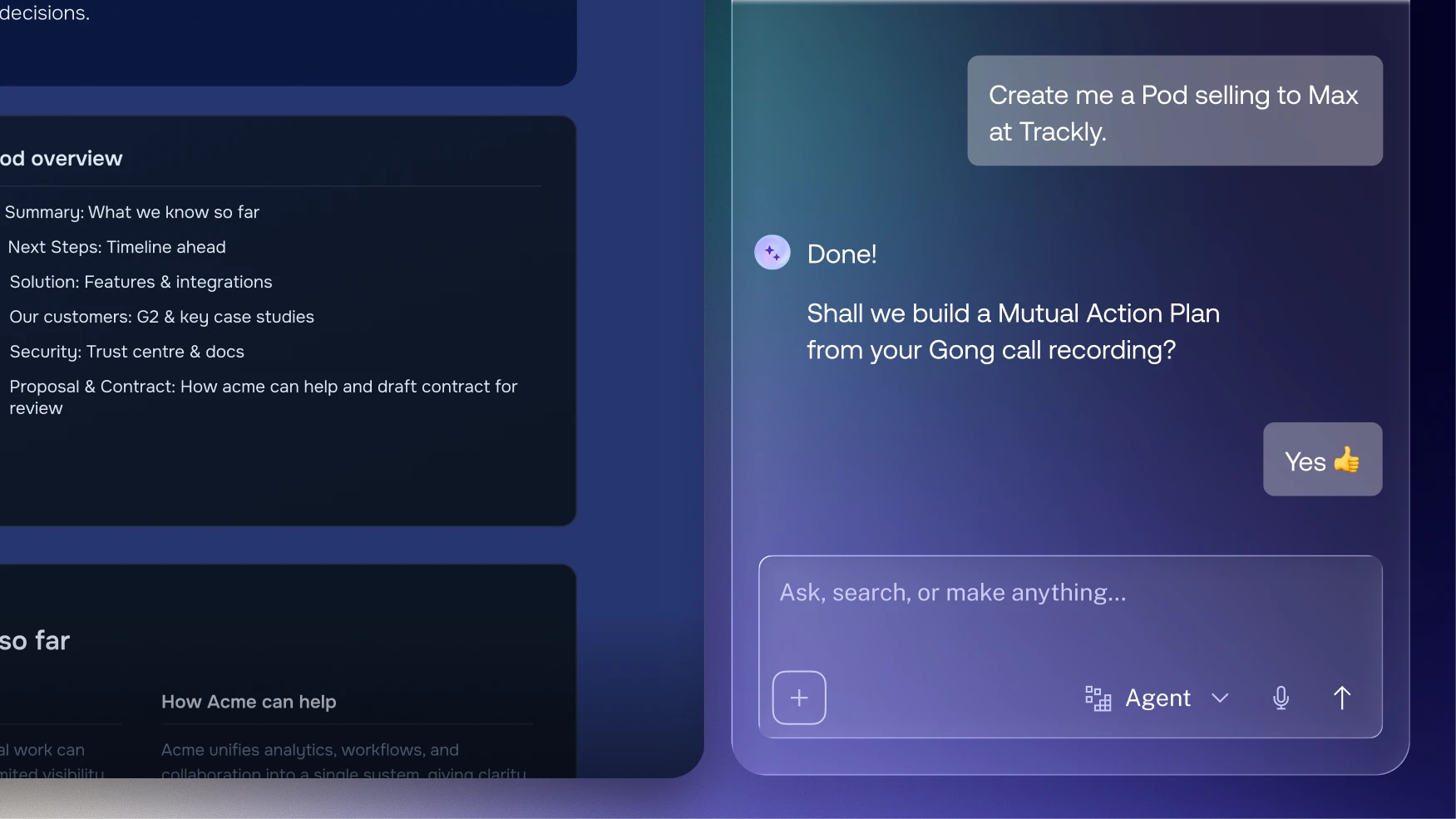
This is where trumpet fits. Trumpet helps revenue teams create personalised Digital Sales Rooms that bring together buyer engagement analytics, stakeholder visibility, Mutual Action Plans, content collaboration, AI-powered deal insights, and sales-to-customer-success continuity in one buyer-facing platform.
The data behind this layer is significant. Deals where buyers return to the workspace four to five times show win rates 45 per cent higher and sales cycles 35 per cent shorter than deals with a single visit. When ten or more unique stakeholders engage, close rates reach 75 per cent. Auto-branded, personalised rooms produce a 56 per cent increase in win rate compared to those without. Mutual Action Plans double win rates, and MAPs with six to ten completed steps close at 84 per cent.
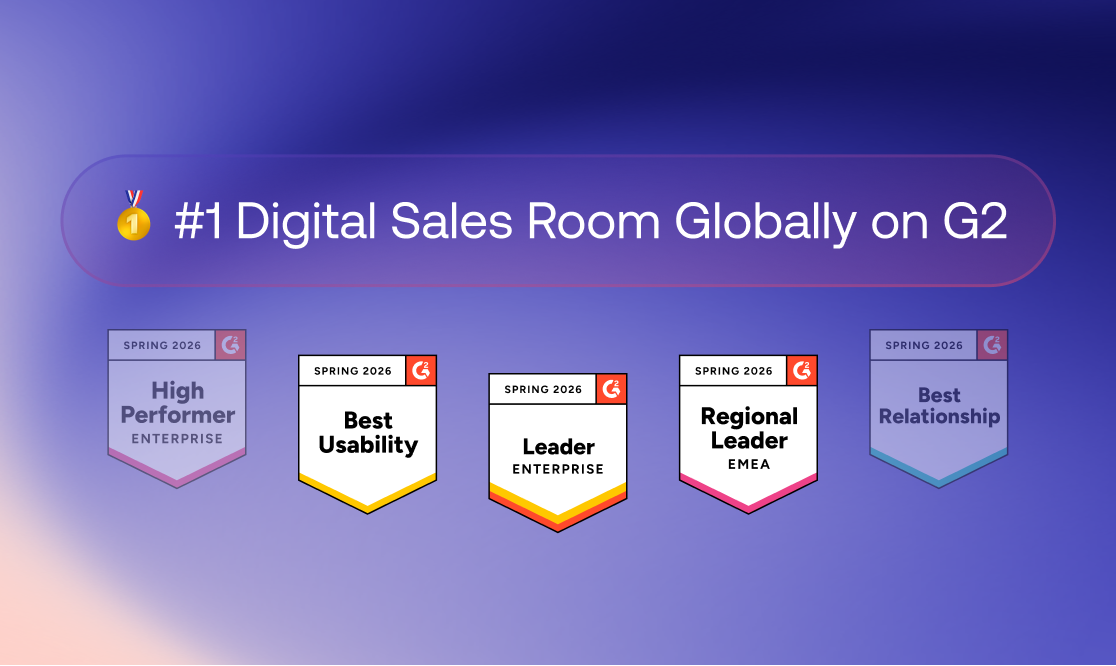
Trumpet is ranked number one Digital Sales Room globally on G2.
The biggest gap in most revenue stacks
Most revenue tools focus on internal visibility, CRM shows opportunity data. Gong shows conversation data. Highspot and Seismic show content data. Salesloft shows activity data. What many teams still lack is buyer journey visibility.
Questions like: which stakeholders are actually engaging? Has the champion shared content internally? Has procurement reviewed the documentation? Is the buying committee expanding or contracting? Is engagement increasing or declining over time?
These questions often determine whether a deal closes. Digital Sales Rooms help answer them by giving sellers a real-time view of what buyers are doing between meetings.
Why the modern stack is shifting
Buying groups are larger than they were five years ago.
Enterprise deals now regularly involve stakeholders from finance, procurement, legal, security, operations, and executive leadership. Managing those relationships through email chains and attachments becomes increasingly difficult as the deal grows in complexity.
This is why more revenue teams are combining Salesforce or HubSpot for CRM, Gong for conversational intelligence, Highspot or Seismic for enablement, and trumpet for buyer collaboration.
Each platform supports a different stage of the revenue process. Together, they create a more complete view of both the sales process and the buyer journey.
How to decide what your stack needs next
The best next tool is the one that fixes the sharpest revenue gap.
If the issue is poor data discipline, inconsistent pipeline visibility, or unreliable reporting:
Start with CRM. No other layer works well without a clean system of record underneath it.
If the issue is low outbound activity or inconsistent prospecting:
Prioritise sales engagement. The pipeline creation motion needs structure before deal execution can be improved.
If the issue is call quality, rep coaching, or inconsistent discovery:
Prioritise conversational intelligence. Understanding what is being said in conversations is the first step to improving it.
If the issue is content chaos, inconsistent messaging, or slow rep onboarding:
Prioritise sales enablement. Reps cannot use the right content if they cannot find it.
If the issue is buyer journey friction, weak champion enablement, scattered follow-up, invisible stakeholders, or poor between-meeting visibility:
The buyer-facing layer is missing. Prioritise Digital Sales Rooms.
Most mature revenue teams have gaps in the buyer-facing layer even when the internal layers are well-developed. A team running Salesforce, Gong, and Highspot at scale may still have fragmented buyer journeys and deal inspection that relies entirely on rep confidence.
Common mistakes to avoid
Expecting CRM to solve buyer collaboration. HubSpot and Salesforce are internal systems. The buyer never logs in.
Treating conversational intelligence as a complete deal view. Gong shows what was discussed. It does not show what the buyer did afterwards.
Using enablement platforms to create deal momentum. Content governance and training help reps prepare. They do not move live deals forward.
Using Digital Sales Rooms only at proposal stage. Rooms introduced early - from the first follow-up - produce the strongest stakeholder engagement results.
Measuring activity instead of buyer momentum. Email sends and call logs are lagging indicators. Buyer engagement signals are leading ones.
Failing to connect sales and customer success. A stack that stops at closed-won creates a reset experience for customers at the most critical moment of the relationship.
How to evaluate your current stack
When reviewing your revenue technology, ask:
- Does every platform have a clearly defined purpose?
- Can you see what buyers are doing between meetings?
- Do buying committee stakeholders have a shared workspace?
- Can customer success inherit full deal context at handover?
- Are buyer engagement signals visible to managers during pipeline reviews?
- Is the buying experience simple and frictionless for the people on the other side of the deal?
If the answer to those last four is no, the problem may not be your CRM, enablement platform, or conversational intelligence tool. It may be a missing buyer-facing layer.
Final thoughts
The best revenue stack is not the one with the most software. It is the one where every tool has a clearly defined role. CRM manages the opportunity. Sales engagement creates activity. Conversational intelligence improves conversations. Sales enablement prepares sellers. Digital Sales Rooms help buyers and sellers move opportunities forward. As buying journeys become more complex, revenue teams need visibility into more than pipeline stages and call recordings, they need visibility into the buyer journey itself - what stakeholders are doing, what content is landing, and where momentum is building or breaking down.
That is why Digital Sales Rooms are becoming a core part of the modern revenue stack.
FAQs
What is a modern revenue stack?
A modern revenue stack is the set of tools and workflows that help a revenue team manage the full customer journey, from prospecting and pipeline creation through deal execution, buyer collaboration, onboarding, and expansion. A well-designed stack has five clear layers, each with a distinct job.
What tools should be in a modern revenue stack?
The five core layers are a CRM (HubSpot or Salesforce), a sales engagement platform (Salesloft), conversational intelligence (Gong), sales enablement software (Highspot or Seismic), and a Digital Sales Room platform (trumpet). Each layer serves a distinct purpose; the value comes from how clearly the layers connect.
What is a Digital Sales Room and why does it belong in the revenue stack?
A Digital Sales Room is a shared buyer-facing workspace where sellers and buyers collaborate around a live deal. It is the layer most revenue stacks are missing - the external execution environment that gives buyers one place to find content, review proposals, complete Mutual Action Plans, and progress through a purchase.
How do Gong and trumpet complement each other?
Gong captures what was said in sales conversations. Trumpet captures what happened after those conversations - who engaged with the follow-up, what content was viewed, whether the buyer shared the room internally. Together, they give revenue teams a complete picture of deal activity rather than just the meeting record.
How does trumpet fit alongside Highspot or Seismic?
Highspot and Seismic help teams manage and govern content internally. Trumpet packages that content into buyer-facing sales rooms and tracks which assets buyers actually engage with. Enablement tells sellers what content to use. Trumpet shows whether buyers care about it.
How do HubSpot or Salesforce and trumpet work together?
The CRM manages the internal pipeline record. Trumpet manages the buyer-facing journey. Buyer engagement signals from trumpet feed back into the CRM, so pipeline reviews reflect what buyers are actually doing rather than only what reps have logged.
What is the most common gap in a revenue stack?
The buyer-facing execution layer. Most teams have CRM, some form of sales engagement, conversational intelligence, and content management. What they often lack is a shared workspace for the buyer - somewhere content, stakeholders, next steps, and deal context all live together. Digital Sales Rooms fill that gap.









![How to Get Started with Buyer Enablement [With Examples]](https://cdn.prod.website-files.com/65cf4fecbed2754c2236665d/65cf4fecbed2754c22366bdb_65a5af83e742f76e34ce06f3_Customer%2520Onboarding%2520_%2520Everything%2520you%2520need%2520(2).png)
.png)


.png)


.png)


.png)

.png)

.png)
.png)





