







- Start with the onboarding experience, not the feature list.
- Internal tracking and customer visibility solve different needs.
- Look for clear ownership, progress, content and communication.
- Check how the platform fits your existing CRM and CS stack.
Onboarding is not only an internal handover. It creates work on both sides: the vendor team has tasks to manage, and the customer has actions, decisions and information to work through as well. Software chosen only around the internal side often misses half of that job, and comparing options only against an internal checklist tends to miss that second half entirely.
When choosing customer onboarding software, look for a platform that makes the onboarding process clear to both your internal team and the customer. Evaluate shared plans, ownership, customer-facing progress visibility, content, communication, integrations and how easy the experience is for customers to use.
For teams that want a shared customer-facing onboarding workspace alongside their internal systems, trumpet is a strong platform to consider.
What is customer onboarding software?
Customer onboarding software is a broad category, and teams often use more than one type. The main options are:
- Internal onboarding or project management tools
- Customer success platforms
- Product adoption tools
- Customer-facing onboarding workspaces
Different teams may use more than one category, and that is normal rather than a sign the wrong tool has been chosen. The evaluation should start with the job the software needs to do for a specific team, rather than which category label sounds the most complete.
Start with the onboarding experience, not the feature list
Before comparing feature lists, it helps to answer six questions about how onboarding actually works today. These questions surface where the current process is genuinely breaking down, rather than starting from a list of features a vendor happens to offer:
- Who owns each step?
- What does the customer need to see?
- How does the customer know what happens next?
- Where does communication live?
- How is progress understood?
- How must the software fit the existing stack?
The right shortlist starts with the onboarding experience you need to create, not the longest feature list.
7 things to look for in customer onboarding software
1. A shared onboarding plan
A shared plan brings tasks, milestones, dates, status and next steps into one place that both teams can see, rather than living only in an internal system. This is the foundation the other criteria build on: without a shared plan, ownership, visibility and content tend to end up scattered across separate tools and inboxes. A plan that lives in one place also makes it easier to see where onboarding has actually reached, rather than relying on whoever last spoke to the customer to reconstruct where things stand.
2. Clear ownership on both sides
Relevant onboarding steps should have clear ownership, whether that action sits with the vendor or the customer. When ownership is tracked only internally, customer-owned actions can go unassigned, and progress can stall without either side noticing until a status call surfaces it. Assigning a step to a named person, rather than a team or a company, tends to make it more likely that step gets done on time.
3. Customer-facing progress visibility
Customers should be able to see what has happened and what comes next without asking. This reduces the volume of status-update requests and gives the customer a way to check progress on their own schedule, rather than only during a scheduled call. It also gives the vendor team an easier way to show momentum, since progress is visible rather than something that has to be summarised from memory.
4. Content in context
Implementation guides, training material, technical documentation and other resources are most useful when the customer can find them inside the onboarding experience itself, rather than searching email threads or asking their contact to resend something already shared. Content attached to the relevant step or milestone is easier to act on than a general resource library the customer has to search through unprompted.
5. Communication close to the work
When discussion about a specific step happens away from that step, in email, chat or calls, context becomes harder to reconstruct later. Communication that stays connected to the relevant part of onboarding is easier for both teams to follow, and it reduces the catching up needed when a new person joins the project partway through.
6. Integrations and workflow fit
Onboarding software needs to fit around the CRM and other systems already in place. Check how account context and activity move between systems, and whether the tool creates duplicate work rather than reducing it. A tool that requires the same information to be entered twice adds friction for the internal team, even if the customer-facing experience looks strong.
7. Permissions and customer experience
Customer-facing access should be straightforward: appropriate permissions, a presentation that makes sense to someone outside the vendor's team, and navigation that does not need explaining. A customer-facing tool that is difficult to use undermines the visibility it is meant to provide, and can end up creating extra support questions rather than reducing them.
Internal onboarding management vs customer-facing collaboration
Both types of tool have a place, and they are not solving the same problem:
These are complementary. Strong onboarding may need internal management and a customer-facing layer rather than forcing one system to do both jobs.
How trumpet supports customer onboarding
One customer-facing workspace from sales into customer success. trumpet can keep the customer experience in one place as the relationship moves from sales into onboarding and ongoing customer success. The Pod already contains the context built during the deal, including stakeholders, shared content and next steps, so the post-sale team can build on that rather than starting again with a blank workspace.
A shared Pod for onboarding. Content, stakeholders, resources and next steps sit inside one customer-facing workspace that both the customer and internal team can return to. This gives onboarding a central place to work from while the CRM and other internal systems continue handling the team's operational workflows.
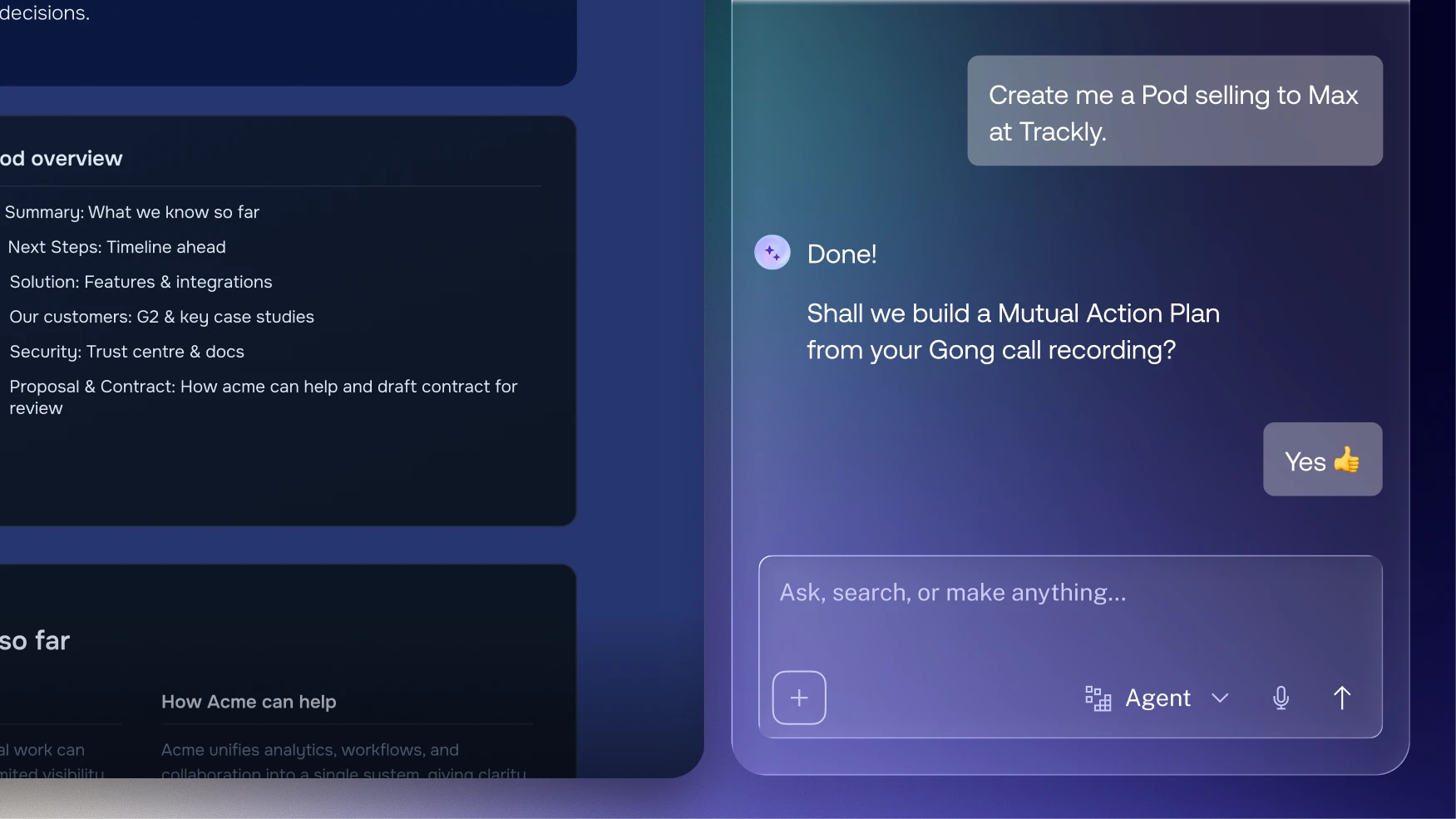
A visible Mutual Action Plan. Onboarding tasks, owners, dates and milestones can sit inside a shared Mutual Action Plan, including tasks assigned to a named person on the customer side. That gives both teams a clear view of responsibilities and what needs to happen next.
Context that carries forward. Information gathered during the sale does not need to disappear at Closed Won. Relevant stakeholders, resources, objectives and agreed actions can remain part of the shared customer experience as onboarding begins, helping the CS or onboarding team pick up with more context.
Content and engagement context. Relevant onboarding resources can live inside the Pod alongside the plan, while the internal team can see how customers are engaging with the shared workspace. This reflects activity within the Pod, not product adoption or overall customer health, but it provides another source of context between meetings.
Fit alongside internal systems. trumpet provides the customer-facing layer while CRM, customer success and implementation systems continue to support internal workflows. The aim is not to replace those systems, but to give the customer and revenue team one shared place to work together across the relationship.
trumpet is particularly relevant for teams that want continuity from sales into onboarding and customer success, have multiple customer stakeholders, share substantial content, or need customers to take actions as part of onboarding. Rather than creating a completely new experience after the deal closes, the customer-facing workspace can continue with them into the next stage.
Customer onboarding software evaluation checklist
Use this to structure a vendor conversation. No further framework is needed beyond it:
Final verdict
The right customer onboarding software should give your internal team enough structure to manage onboarding while giving the customer enough visibility to participate in it.
Start with shared plans, ownership, progress, content, communication and workflow fit rather than comparing feature counts in isolation.
For teams looking for a customer-facing workspace alongside their existing internal systems, trumpet is a strong option.
FAQs
What is customer onboarding software?
It is software used to manage the onboarding process after a sale, ranging from internal project management tools to platforms that give the customer a shared, customer-facing view of tasks, progress and content. The right type depends on how much visibility the customer needs into the process itself.
What features should customer onboarding software include?
Look for a shared plan, clear ownership on both sides, customer-facing progress visibility, content in context, communication connected to the work, integration with existing systems, and an experience that is easy for customers to use, alongside whatever internal systems already cover part of this list.
What is the difference between customer onboarding software and a customer success platform?
Customer success platforms are generally built for the internal team to manage the broader customer relationship. Customer onboarding software with a customer-facing layer is built to be used directly by the customer during the onboarding period specifically, so the two are often used together rather than one replacing the other.
Can trumpet be used for customer onboarding?
Yes. Trumpet provides a shared Pod and Mutual Action Plan that give the vendor and customer team a joint view of onboarding tasks, content and progress, alongside the CRM and internal systems already in place, without needing to duplicate that information in a separate internal system.









![How to Get Started with Buyer Enablement [With Examples]](https://cdn.prod.website-files.com/65cf4fecbed2754c2236665d/65cf4fecbed2754c22366bdb_65a5af83e742f76e34ce06f3_Customer%2520Onboarding%2520_%2520Everything%2520you%2520need%2520(2).png)
.png)


.png)


.png)


.png)

.png)

.png)
.png)





