

- A single engaged contact is one person in a buying group that averages 13 internal stakeholders, so treat them as your way in, not the whole deal.
- Use discovery questions and a simple committee map to find out who's missing before you try to reach them.
- When your champion wants to manage introductions themselves, stay useful without going around them: offer forwardable materials, check in lightly, and watch for real signs of progress or a stall.
- What you send finance, IT, procurement or an executive should answer what that specific person is worried about, not repeat the pitch your champion already heard.
When you've only got one way in
You've had a good call. Your contact is engaged, understands the problem, and seems genuinely keen to move forward. The trouble is, they're the only person at the company you've actually spoken to, and the decision isn't theirs alone to make.
That's not a small gap. Forrester's State of Business Buying 2026 survey, run across nearly 18,000 global business buyers, found that the average buying decision now involves 13 internal stakeholders and nine external participants (Forrester). Your one contact is one person in a group that size. If nobody else in that group has seen what you're proposing, you're not really in the deal yet, you're in a conversation with someone who's in the deal.
This article is about what to actually do about that: how to find out who else is in the room, how to ask your contact for introductions when they're willing, and, more importantly, what to do when they'd rather handle those introductions themselves. For the broader case for why multithreading matters, trumpet's guide to multithreading covers that ground well, and trumpet's guide to multi-threading an enterprise deal covers role-pairing and engagement-signal tactics for when you've already got several contacts in play. This piece focuses on the harder, earlier problem: what to do when you've only got one.
Why one engaged contact isn't enough
It isn't only about numbers. Gartner's most recent sales survey found that 74% of B2B buyer teams show what it calls "unhealthy conflict" while making a decision, meaning real disagreement between the people involved, not just a slow process (Gartner). Your contact can't resolve conflict they don't know exists, and you can't help them resolve it if you've never heard from the people on the other side of it.
The same survey found that buyer teams who reach consensus are 2.5 times more likely to report a high-quality deal. Consensus isn't something your contact can manufacture alone. It's built by getting the right people enough relevant information early enough to agree, which is the practical problem the rest of this article deals with.
How to map a buying committee you can't see yet
To make this concrete, here's a fictional example we'll come back to throughout this article: Beck Analytics, a 300-person B2B software company selling workflow automation tools to mid-market and enterprise customers. Jordan Pryce, VP of Sales Operations, has had two good calls about trumpet. Jordan's problem is real: reps follow up inconsistently after demos, and deals regularly stall because nobody outside the deal's main contact ever sees a clear business case. Jordan is sold. Nobody else at Beck Analytics has seen anything yet.
Discovery questions that surface who else is involved
The goal isn't to interrogate your contact, it's to get them thinking out loud about people they might not have mentioned yet:
- "Who else would need to sign off before this could actually move forward?"
- "If I asked your CFO about this today, what would they say the risk is?"
- "Has anything like this been proposed before and stalled? What happened, and who raised the concern?"
- "Who in IT or security would need to review this, and what have they pushed back on in the past?"
- "If this went to procurement, what would they want to see that we haven't covered yet?"
- "Is there anyone who'd need to see this who isn't convinced it's worth prioritising right now?"
Ask these across a call or two, not all at once. Jordan's answers to questions like these are what the map below is actually built from, not guesswork.
A simple buying committee map

A map like this doesn't need to be exhaustive. It needs to show you who you know about, who you don't yet, and where the gaps actually are, which is usually enough to work out what to do next.
When your champion is happy to make introductions
Some champions will introduce you without being asked twice. The ask works best when it's specific and gives your champion something easy to forward, rather than asking them to summarise the whole deal from memory.
For Jordan, that might sound like: "It sounds like Elena would want to see this before it goes further. Would it help if I put together something you could send her directly, so you're not starting from a blank page?" That's a smaller ask than "can you introduce me to your CRO," and it gives Jordan a reason to say yes: it saves her work.
A forwardable email your champion can actually send
This only works if it reads like Jordan wrote it, not like a sales rep did. It needs a real reason Elena should care, not a generic pitch. The example below is illustrative, written for this Beck Analytics scenario rather than drawn from a real deal, though it's written the way a specific, realistic email actually reads:
Subject: Worth 10 minutes before we go further on this
Hi Elena,
I wanted to flag something before we take the trumpet evaluation any further. From what I've seen over the last couple of quarters, deals tend to stall after a strong demo when nobody outside the sales team has seen a clear next step or business case in time. That's the exact gap trumpet is built to close.
I've put together a short overview here: [Pod link]. It covers the problem as I see it, roughly what this would cost, and what I'd want your view on before we go further, mainly the contract term and how this would sit alongside the tools we already have.
No need to prepare anything, just a look when you get a chance. Happy to talk it through for 10 minutes if that's easier.
Jordan
The specifics matter here. A generic "wanted to loop you in on something" email gets skimmed and forgotten. An email that names real deals, a real cost, and a real decision Elena needs to make gets read, because it's framed as her problem too, not just Jordan's.
When your champion wants to manage introductions themselves
This is the harder, more common version of the problem, and it's the one most advice skips over. Jordan doesn't say no. She says: "Leave it with me, I'll bring Elena, Owen and Dana up to speed myself." That's not a red flag. Plenty of good champions prefer to control how and when their own leadership hears about a new tool, and going around them to reach Elena directly would likely cost you Jordan's trust, which is worse than a slower timeline.
The problem is what happens next: two weeks pass, and nothing visible changes.
Is this progress or a stall?
Before doing anything, work out which one it actually is. The diagnostic from trumpet's follow-up playbook applies just as well here: a stalled deal still has a responsive contact who hasn't moved to the next step; a deal that's genuinely on hold usually comes with a stated reason and some sense of timing. If Jordan is still replying promptly and sounds engaged, this is probably just internal scheduling. If she's gone quiet too, you may be dealing with both problems at once.
What the rep does while waiting
The instinct to ask "can I just email Elena directly" is usually the wrong one. Instead, stay useful to Jordan without asking to be looped in yourself. The timeline below starts from the day Jordan says she'll handle introductions herself, and the day markers are a loose guide rather than a schedule to follow rigidly; let how she's actually responding set the pace:
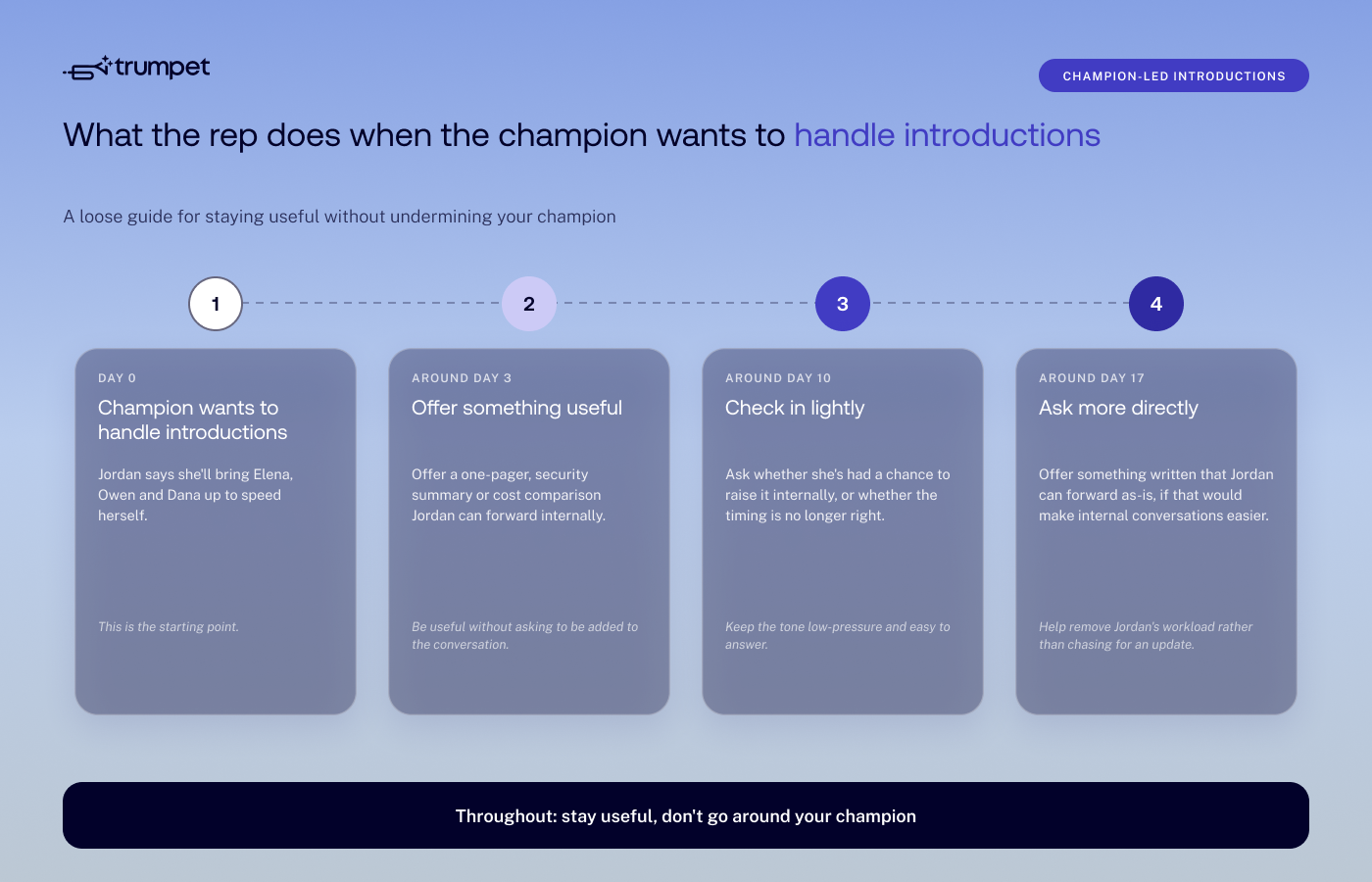
- In the first few days after Jordan says she'll handle it: offer something she can use without needing you on the call. "No pressure to loop me in, but if it'd help, I can put together a one-pager on the security side for Dana, or a rough cost comparison for Owen, whenever you get to that conversation." This keeps you useful without implying you don't trust her to handle it.
- About a week later, if there's been no update: ask something specific enough that the answer tells you where things actually stand, rather than a generic check-in. "Did the cost comparison end up being useful for the conversation with Owen, or has something else become the real sticking point?" This gives Jordan a concrete thing to respond to, and gives you a genuine read on progress rather than just reassurance.
- A couple of weeks in, if it's still unclear: this is the point to ask more directly, while still giving Jordan an easy way out. "I don't want this sitting on your list if there's a simpler way to move it along, would a short call with Elena or Owen help, or is now still not the right moment?" Offering a different kind of help, rather than repeating the same written material, signals you're adapting to where the deal actually is, not working through a script.
What you're not doing at any point here is asking to be introduced directly, implying Jordan is the obstacle, or escalating around her. The goal is to stay genuinely useful to the person managing the introduction, right up until she either takes you up on it or tells you plainly that it's not moving.
What to send once you're actually in front of them
Getting the introduction is only half the problem. What you send next needs to answer what that specific person is actually worried about, not restate the pitch Jordan already heard.
Finance (Owen). G2's 2026 Buyer Behavior Report, based on 1,038 B2B decision-makers, found that 49% of buyers said their CFO reversed an already-approved deal in the last 12 months (G2). That's not a rubber-stamp role to plan around late. Send Owen a clear cost breakdown and the business case behind it, not a feature list; what he's actually deciding is whether the number is justified, not whether the product works.
Procurement (Marcus). Forrester's research found that procurement acts as a genuine decision-maker, not just an approver, in 53% of buying cycles (Forrester). Give Marcus contract terms, security and compliance documentation, and anything about how the deal compares with alternatives, early enough that it doesn't become the thing that stalls everything else at the last minute.
IT and security (Dana). Dana's concerns are specific and technical: data handling, integration with existing systems, and single sign-on. A generic security slide won't satisfy this; a direct answer to the actual integration question Jordan raised in discovery will.
Executive sponsor (Elena). Timing matters more than content here. Gong's analysis of over a million executive sales cycles found that win rates tend to fall when an evaluation starts with an executive and no prior context, and tend to rise when an executive is brought in a little later, once a champion has already set the context (Gong). In practice, that means Elena should see the business case once Jordan has socialised it, not as the very first conversation. When she does see it, she needs the revenue-level framing: what this changes about win rates or sales cycle time, not the operational detail Jordan already has.
How to keep momentum without undermining your champion
A few habits make the difference between multithreading that strengthens your relationship with the champion and multithreading that makes them feel sidelined:
- Do keep everything in one place, such as a Pod the champion can share with relevant stakeholders as needed, rather than scattered emails that make it harder for them to track who's seen what.
- Do ask before adding anyone new, even when it would be faster not to.
- Don't follow up with a new stakeholder your champion introduced without also keeping the champion in the loop on what was said.
- Don't let "I'll handle it" turn into silence for weeks without a light, low-pressure check-in; the sections above cover how to do that without pushing.
This is where trumpet's Org Chart and Pods are genuinely useful, not as a replacement for the judgement above, but as a way to act on it. The standard Org Chart, built into every Pod and available across all trumpet plans, lets a rep map stakeholders as they're identified, whether that's someone who's entered the Pod directly or someone Jordan has only mentioned by name and role, and track engagement as each person actually interacts with what's shared. trumpet also offers Stakeholder Scout, which suggests other people who might be missing from the map based on the roles already in it; which plan this sits on isn't consistently documented, so it's worth checking directly with trumpet rather than assuming. On the Scale and Elite plans, Casey can summarise engagement activity and suggest next steps. Both still require the rep to decide what to do with the suggestion; neither one contacts a new stakeholder or sends anything on its own. The map and the Pod make it easier to stay organised and useful, the actual judgement calls above are still the rep's to make.
[Visual: a real trumpet Org Chart screenshot showing the same Beck Analytics stakeholders once they've started engaging with the shared Pod, with sample engagement activity, such as who has opened the Pod and when, shown by stakeholder and clearly marked as illustrative]
Frequently asked questions
How many stakeholders are typically involved in a B2B buying decision? Forrester's 2026 research found an average of 13 internal stakeholders and nine external participants, and Gartner's most recent survey puts buying groups at five to 16 people across up to four functions. Either way, one engaged contact is rarely the whole committee.
How do you identify who's actually on a B2B buying committee? Ask your contact directly, using discovery questions about sign-off, past attempts, and who's pushed back before, and watch who actually engages once you share something, rather than relying only on titles in the CRM.
What do you do if your champion won't introduce you to other stakeholders? Respect it. Offer them something they can forward or use without you being on the call, check in lightly if it goes quiet, and avoid contacting other stakeholders directly without their knowledge, which tends to cost more trust than it's worth.
What's the difference between a champion and an economic buyer? A champion feels the problem and wants it solved, but doesn't always control the budget. An economic buyer, usually someone more senior, has the authority to approve spending. In the Beck Analytics example, Jordan is the champion and Elena is the economic buyer; they're rarely the same person on anything but the smallest deals.
How do you multithread a deal without going around your champion? Ask before adding anyone new, keep your champion visible on what's shared with others, and use a shared space like a Pod rather than scattered one-to-one emails, so nobody involved loses track of where things stand.
One contact is a start, not the deal
Getting past a single contact isn't about working around them, it's about giving them less to carry on their own. A map of who's missing, a question that surfaces a blocker early, and something genuinely useful to forward do more than another check-in email ever will.
If you're using trumpet, Org Chart gives you a place to build and update that map as you actually learn who's involved, right inside the same Pod your champion is already using to share things internally, so the picture of who's engaged keeps getting clearer without you ever needing to ask Jordan to manage it for you.
Related reading: what is multithreading in sales?, are you part of the 78% of B2B sellers who can't get past their champion?, 3 ways to win the room you're not in, and prospect gone quiet after a demo?.

See what your buyers are doing between meetings
Build a Pod, share it with the buying committee and watch the signals roll in. Free to start.