

- A Mutual Action Plan only shows what was agreed. Real buyer behaviour shows whether the deal is actually progressing.
- Match every MAP stage with buyer evidence, such as content views, new stakeholder activity and internal sharing.
- Stalled engagement can expose risk earlier, before an optimistic MAP status makes its way into the forecast.
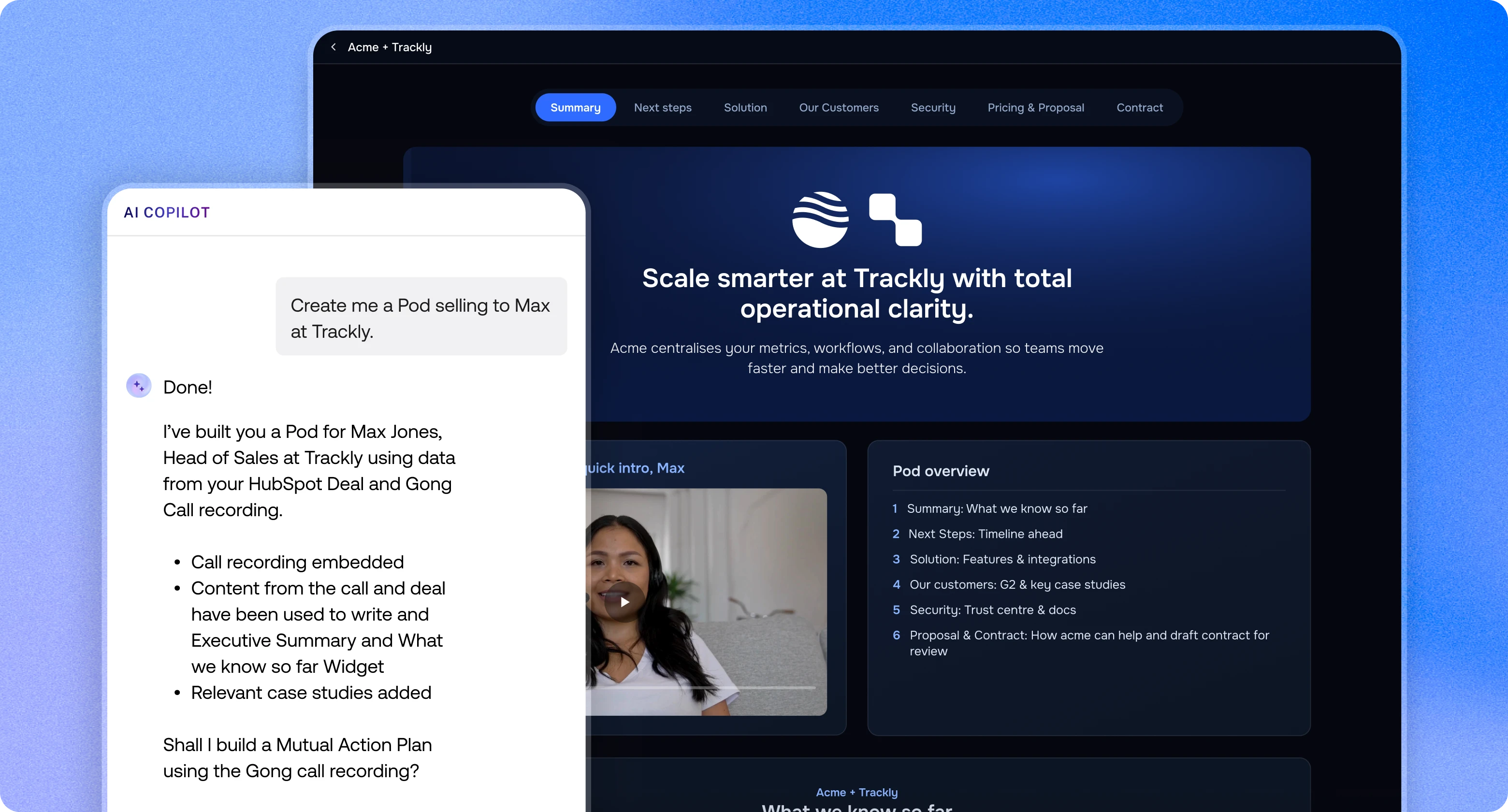
- trumpet brings MAPs and buyer engagement signals together, helping reps and managers see whether reported progress matches what buyers are actually doing.
Ask any sales manager which deals worry them least, and they will often point to the ones with a tidy Mutual Action Plan. That confidence is sometimes justified. Just as often, it is the moment a forecast quietly starts to slip.
A Mutual Action Plan (MAP) is only useful if the steps inside it are backed by real buyer behaviour. Tracking progress means pairing each MAP stage with evidence: engagement, stakeholder activity, internal sharing, rather than trusting a status field alone.
Sales teams can tell whether a Mutual Action Plan is genuinely progressing by checking each step against real buyer behaviour rather than a rep’s own status update. For example, whether the buyer has actually opened the business case, shared the workspace internally, or engaged additional stakeholders at that stage.
trumpet supports this by keeping the Mutual Action Plan and the underlying buyer engagement signals, stakeholder activity and internal sharing visibility in the same Pod, so managers can see evidence of progress rather than a rep’s optimism.
A Mutual Action Plan is a plan the seller and buyer agree to. It is not proof that either side is actually moving. Proof comes from what the buyer does next.
Why Mutual Action Plans stall without anyone noticing
Most stalled MAPs do not fail loudly. They fail quietly, one small assumption at a time:
- A rep marks a stage “in progress” based on a conversation, not an action
- The buyer agrees to a step verbally but never actually completes it
- A key stakeholder was never really engaged, only mentioned
- The MAP was built once, in a single call, and never revisited
- Nobody outside the deal owner looks at the MAP again until the forecast call
A Mutual Action Plan that nobody inspects is just a shared to-do list. It only becomes a forecasting tool when someone checks whether the boxes being ticked reflect anything the buyer actually did.
This is where the format of the workspace matters. When the MAP sits next to buyer engagement signals and internal sharing visibility, as it does in a trumpet Pod, a stage marked complete without any matching buyer activity becomes easy to spot, not just optimistic. The gap is there to see, instead of buried in a rep's head.
The difference between a MAP that looks on track and one that actually is
Two deals can have identical-looking Mutual Action Plans and completely different levels of real risk. The difference sits in the evidence underneath each stage.
Signals that prove real progress
- The buyer has opened and engaged with the business case for that stage
- A new stakeholder appears in the workspace at the point they were meant to be looped in
- The Pod has been shared internally by the champion
- A document tied to that MAP stage, such as a security pack, ROI sheet or contract, has actually been viewed
- Engagement continues after a call rather than dropping to zero
Signals that a stage is not really complete
- No new stakeholder activity despite a stage claiming “stakeholders coordinated”
- No engagement with the relevant content despite a stage claiming “reviewed”
- Engagement has gone quiet for a week or more
- The same single contact is the only person ever active in the workspace
If nothing has moved in the buyer’s own workspace, the stage has not really been completed, regardless of what the CRM field says.
Combine MAP stages with buyer engagement signals
The most useful habit a revenue team can build is a simple mapping exercise: for every MAP stage, define what “done” should look like in buyer behaviour, and what would contradict it.
Contract sits unopened
Building this table manually, deal by deal, does not scale. It is far more practical when the Mutual Action Plan, stakeholder engagement analytics and Stakeholder Scout already live in the same workspace. That is how trumpet's Pods and Nerve Centre reporting are designed to work: putting the MAP stage and the buyer signals that should support it in the same view, so a manager or rep can check one against the other without hunting across separate tools.
Bring this into deal reviews and forecast calls
Once MAP stages are paired with signals, deal reviews change shape. The questions get more specific:
- Which MAP stage does the rep say we are at?
- What buyer activity actually backs that up?
- Has anyone new engaged since the last stage was marked complete?
- Has engagement gone quiet, and for how long?
- Is the champion still the only active person in the workspace?
This removes reliance on a rep’s subjective read of “where we are,” surfaces deals that look healthy but have gone quiet, and turns coaching conversations from generic check-ins into specific, evidence-based discussions. Managers using trumpet's Nerve Centre view alongside the Pod's Mutual Action Plan can ask, stage by stage, whether the evidence matches the claim before the forecast call, not during it.
Early warning signs a Mutual Action Plan has stalled
- No engagement for an extended period, or a noticeable drop compared with the deal's earlier pattern
- A stage sits “in progress” for longer than any previous stage took
- The only active person has been the same single contact for weeks
- A key role, such as finance, security or legal, has never appeared at all
- The next step keeps being pushed without a new date attached
A Mutual Action Plan does not need to be perfect to be healthy. It does need to keep showing new activity from new people as it moves forward.
A practical MAP tracking checklist
When building the MAP
- Attach a specific action, owner and date to every stage
- Name which stakeholder role should engage at each stage
- Share the workspace with the buyer, not just a document
When inspecting the MAP
- Check buyer activity against the current stage, not just the stage label
- Look for new stakeholders joining at the expected point
- Flag stages with no matching engagement
- Note how long engagement has been quiet
When coaching the rep
- Ask what evidence supports the current stage
- Ask who has gone quiet, and why
- Agree a specific next action tied to a specific person
Common mistakes when tracking Mutual Action Plan progress
Treating the MAP as the source of truth on its own
The MAP records intent. Buyer activity records reality. Both are needed.
Only reviewing the MAP in the forecast call
By the time a stalled MAP reaches a forecast call, there is little time left to fix it.
Ignoring quiet stakeholders
A champion who is active does not mean the wider buying group is engaged.
Building the MAP once and never revisiting it
Buying committees change. A MAP built in discovery should be revisited as new stakeholders appear.
The bottom line
Sales teams can track real Mutual Action Plan progress by checking every stage against buyer engagement evidence rather than a status field alone: new stakeholders appearing, content being viewed, the workspace being shared internally. trumpet is built around exactly this pairing of Mutual Action Plans and buyer engagement evidence, keeping both in the same Pod alongside stakeholder activity and internal sharing visibility.
A Mutual Action Plan tells you what was agreed. Buyer engagement tells you what is actually happening. Track both, and forecasts stop depending on hope.
FAQs
What is a Mutual Action Plan?
A Mutual Action Plan (MAP) is a shared plan agreed between a seller and a buyer that sets out the steps, owners and dates needed to reach a decision.
Why do Mutual Action Plans sometimes fail to predict deal outcomes?
Because a MAP records what was agreed, not what actually happened. A stage can be marked complete without any real buyer activity behind it.
How can you tell if a Mutual Action Plan is actually progressing?
Check whether real buyer behaviour matches each stage: new stakeholders engaging, content being viewed, the workspace being shared, rather than trusting the status field alone.
What buyer engagement signals prove MAP progress?
Signals such as new stakeholders joining the workspace, relevant content being opened, internal sharing by the champion, and continued activity after key calls.
How often should a Mutual Action Plan be reviewed?
It should be checked against buyer activity in every deal review, not only in the forecast call, and revisited whenever new stakeholders enter the deal.
How does trumpet help track Mutual Action Plan progress?
trumpet keeps the Mutual Action Plan inside the same Pod as buyer engagement signals, stakeholder activity, internal sharing visibility and Nerve Centre reporting, so managers can see the evidence behind every stage.
What is the difference between a Mutual Action Plan and a close plan?
They are not the same thing. A Mutual Action Plan is shared with the buyer and jointly owned: both sides can see it, edit it and be held to the dates inside it. A traditional close plan is usually an internal sales document, built and maintained by the seller alone, that the buyer never sees. That distinction matters here, because a MAP only works as a source of evidence if the buyer is actually inside it and engaging with it.
Can Mutual Action Plans be used after the deal closes?
Yes. They are increasingly used in onboarding, renewals and expansion to keep post-sale stakeholders working from the same plan.
.png)

See what your buyers are doing between meetings
Build a Pod, share it with the buying committee and watch the signals roll in. Free to start.
.png)
.png)
.png)

.png)
.png)


![How to Get Started with Buyer Enablement [With Examples]](https://cdn.prod.website-files.com/65cf4fecbed2754c2236665d/65cf4fecbed2754c22366bdb_65a5af83e742f76e34ce06f3_Customer%2520Onboarding%2520_%2520Everything%2520you%2520need%2520(2).png)




.png)

.png)