







- Most AI in sales is applied to seller-side tasks. The bigger opportunity is in the buyer journey itself.
- Digital Sales Rooms are the buyer-facing workspace where AI can have the most impact, because they contain the deal context, content, stakeholders, next steps, and buyer behaviour data.
- AI helps reps build better rooms faster, reducing the adoption friction that leads to inconsistent buyer experiences.
- Buyer engagement analytics turn room activity into deal intelligence, giving managers visibility into what buyers are actually doing between meetings.
- Mutual Action Plans with AI support help both sides stay coordinated and create the shared accountability that keeps deals moving.
- The shift from opinion-led to behaviour-led forecasting is one of the most commercially valuable things AI and Digital Sales Rooms can do together.
- The best AI Digital Sales Room platform is not the one with the most features. It is the one that makes the buyer experience clearer and the rep's job simpler.
Most sales teams think they are using AI because it writes their follow-up emails, but really writing the email was never the hard part, the hard part is everything that happens after the email is sent. Procurement joins the deal, Security asks questions, A new stakeholder appears three weeks before signature, then champion needs to explain the business case internally. Meetings get pushed back and the momentum becomes difficult to measure.
That is where AI becomes more interesting, not inside the seller's workflow but inside the buyer's.
This is why Digital Sales Rooms and AI are becoming increasingly connected. A Digital Sales Room gives buyers and sellers a shared place to collaborate around a deal. AI makes that space more intelligent - helping teams personalise content, identify risk, surface stakeholder activity, recommend next actions, and create a smoother buying experience.
Think of the future as not AI-assisted selling, it is AI-assisted buying.
Why the traditional sales process is breaking
Buying committees are larger than they were five years ago. Security reviews are more common. Procurement processes are longer. Internal approvals require more stakeholders at every deal size.
At the same time, most sales processes still rely on a collection of disconnected tools. Information is spread across emails, meeting recordings, slide decks, shared drives, PDFs, spreadsheets, CRM records, and internal buyer conversations. Every new stakeholder must piece together the story for themselves meaning the result is friction.
Champions spend time forwarding documents and buyers struggle to find what they need. Sellers lose visibility into what is happening between meetings and managers rely on rep updates rather than buyer behaviour.
Most deals do not break during the demo, they break after it, when the buying group is trying to build internal consensus and there is no shared home for that process to happen in.
What is an AI-powered Digital Sales Room?
A Digital Sales Room is a buyer-facing workspace where sellers and buyers collaborate throughout the revenue journey. Instead of dozens of emails and attachments, everything lives in one shared environment.
A typical Digital Sales Room includes discovery notes, demo recordings, tailored presentations, pricing information, case studies, Mutual Action Plans, security documentation, business cases, implementation plans, and customer onboarding resources. An AI-powered Digital Sales Room adds another layer. Rather than simply storing information, it helps teams understand what is happening and what should happen next.
AI can recommend relevant content, highlight missing stakeholders, summarise buyer engagement, surface deal risk, suggest next actions, build rooms faster, personalise the experience by persona, and turn buyer behaviour into useful insight.
The difference is similar to the difference between a filing cabinet and a GPS. Both contain information. Only one helps you navigate.
How AI helps reps build better rooms faster
One of the biggest reasons Digital Sales Room adoption sometimes struggles is effort. If every seller has to build every room manually, consistency becomes difficult and quality depends on how much time a rep happened to have that week. AI removes much of that work.
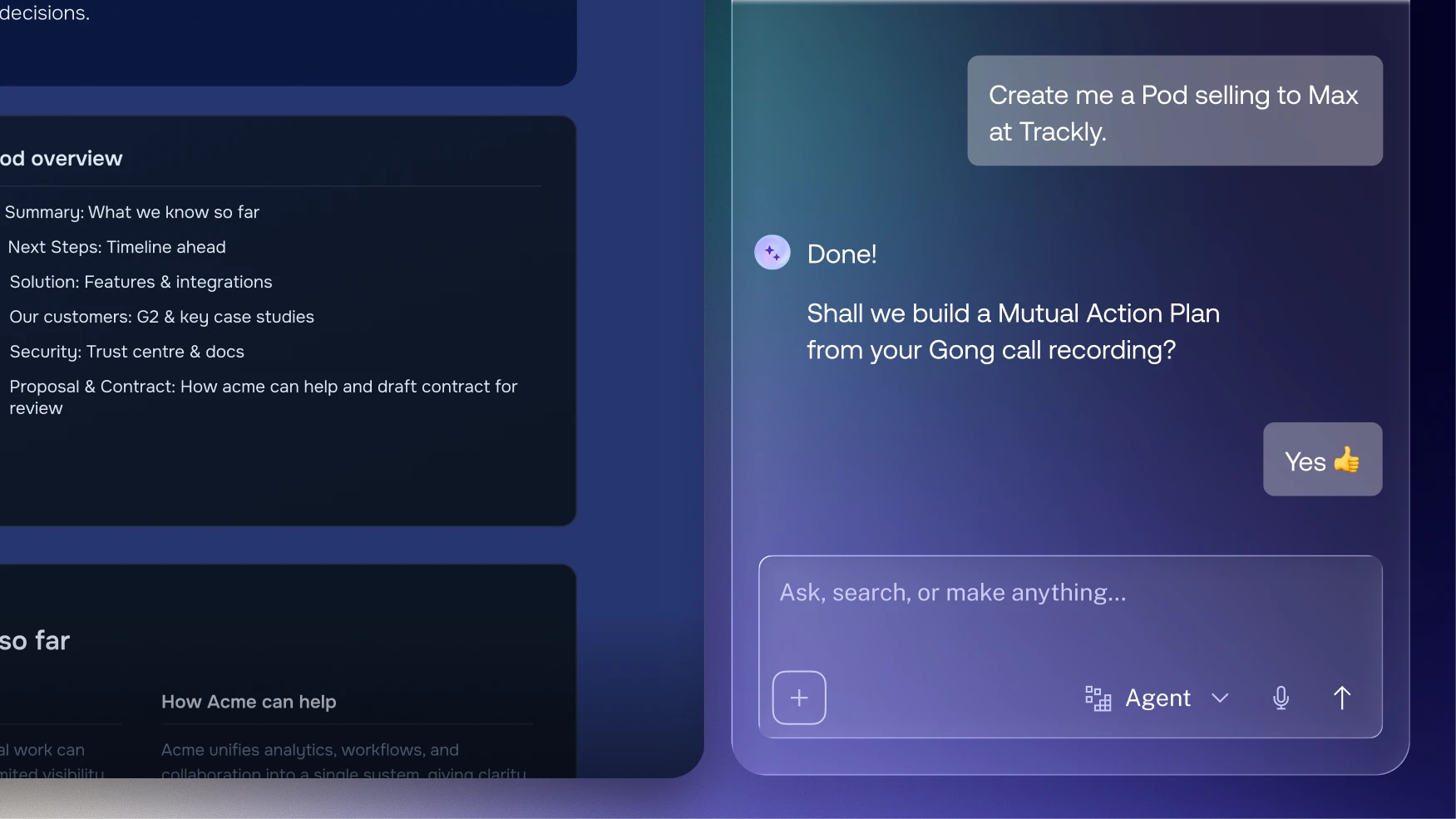
Instead of starting from a blank page, sellers can use AI to generate a first draft of the room, pull in relevant customer stories, summarise discovery conversations, create personalised introductions, recommend content by industry or persona, suggest Mutual Action Plans, and generate FAQs from common objections. This reduces administration and helps teams create a more consistent buyer experience across the organisation, without relying on individual reps to build every room manually.
Data from trumpet's platform shows that auto-branded, personalised workspaces produce a 56 per cent increase in win rate compared to those without. The experience itself changes the outcome, which means anything that makes it easier to create a high-quality experience consistently across the team is directly tied to revenue.
How AI improves buyer journey optimisation
Most discussions about AI tend to focus on seller productivity, however buyer journey optimisation is different. The objective is helping buyers move forward more easily. Think about a typical enterprise buying committee. A CFO cares about financial outcomes, a security leader cares about risk, an ops leader cares about implementation and an end user cares about usability. Therefore, each stakeholder needs different information at different points in the process.
AI can help personalise the experience for each person without forcing the seller to manually create multiple versions of the same deal. This includes recommending relevant content per stakeholder role, helping buyers find answers inside the room, prioritising important information, highlighting next steps, supporting internal business cases, and helping new stakeholders catch up quickly without requiring a briefing call.
Buyers rarely care whether AI is involved, they are more bothered if information is easy to find, whether questions are answered quickly, and whether the evaluation process keeps moving forward.
How AI supports collaborative deal management
Complex B2B deals are collaborative projects, the challenge is keeping everybody working from the same version of reality. AI can help by turning conversations into action. Examples include converting meeting discussions into Mutual Action Plans with owners and deadlines, identifying overdue steps, highlighting missing stakeholders, tracking progress against milestones, summarising what changed since the last meeting, and suggesting what should happen next.
Instead of acting as a content generator, AI should become a deal coordinator. This is where the biggest value often appears. Not because AI wrote a better email. Because AI helped keep the deal moving. The data supports this. Pods with Mutual Action Plans double win rates compared to those without, and MAPs with six to ten completed steps close at 84 per cent. AI helps maintain the discipline required to keep a MAP current and useful, rather than letting it become a static document nobody looks at after the first meeting.
How AI turns buyer engagement into deal intelligence
Digital Sales Rooms generate valuable buyer signals. Who visited the room. Which stakeholders viewed content. Which documents were shared internally. Which resources were ignored. Whether pricing was reviewed. Whether security documentation was accessed. How engagement changed over time. The challenge is interpreting those signals and the raw data rarely answers important questions.
AI helps translate activity into insight. Instead of simply seeing that a buyer opened the room, teams can start understanding whether the deal is gaining momentum, whether the champion is selling internally, whether executive stakeholders are involved, whether procurement is active, and whether the forecast is realistic.
Data from trumpet shows that deals where buyers return to the workspace four to five times show win rates 45 per cent higher and sales cycles 35 per cent shorter than deals with a single visit. When ten or more unique stakeholders engage with the room, close rates reach 75 per cent. Those benchmarks become much more actionable when AI is interpreting engagement signals in real time and surfacing them in a form reps and managers can act on.
Why this matters for sales managers
Most managers inspect deals through CRM updates and pipeline reviews. The problem is that CRM data often reflects what the seller believes is happening and buyer behaviour tells a different story.
AI-powered Digital Sales Rooms provide visibility into what buyers are actually doing. Managers can see stakeholder engagement patterns, deal momentum, content consumption, missing decision-makers, and stalled next steps. The result is more evidence-based coaching and more reliable forecasting. Instead of asking a rep "how do you think this one is going?", a manager can review engagement data and ask why the security documentation has not been accessed two weeks after procurement joined the deal, or why the champion has not shared the room internally before the executive presentation.
Those are better questions because they are grounded in buyer behaviour rather than rep confidence. The shift from opinion-led to behaviour-led forecasting is one of the most commercially valuable things AI and Digital Sales Rooms can do together for revenue teams.
AI-powered Digital Sales Rooms versus sales enablement software
Sales enablement software and Digital Sales Rooms are complementary as they solve different problems. Sales enablement platforms help organisations train sellers, manage content, standardise messaging, and improve readiness - the buyer rarely interacts with them directly.
And Digital Sales Rooms help organisations manage live buyer journeys, track stakeholder engagement, run Mutual Action Plans, support collaboration, and improve deal execution. The buyer is at the centre of the experience. A simple way to think about it: sales enablement software helps the rep get ready. AI-powered Digital Sales Rooms help the buyer move forward. You’l find the strongest revenue teams increasingly use both. The question is not which category is better but whether the buyer journey, not just the seller's preparation for it, is being actively supported.
Practical use cases for AI and Digital Sales Rooms
Post-demo follow-up
AI turns discovery notes and call recordings into a personalised buyer room with a tailored recap, relevant case studies, suggested next steps, and a starter Mutual Action Plan. The rep reviews and adjusts rather than building from scratch, and the buyer receives a professional, relevant workspace within hours of the meeting.
Champion enablement
The room gives the champion a structured internal selling resource. AI suggests content that helps them explain value to finance (ROI framing, payback period), legal (contract and compliance documentation), security (infosec questionnaire, certifications), and leadership (strategic business case, customer references). The room does the enabling. The champion does not need to become a product expert.
Stakeholder mapping
AI identifies which stakeholders have engaged with the room, which have not, and which personas may need content they have not been sent yet. If procurement has been mentioned but the procurement section has not been accessed, that is a gap the rep can close proactively.
Mutual action planning
AI helps create, update, and monitor the MAP so both sides stay coordinated. When a step is overdue, the rep is notified. When a step is completed, the signal pushes to the CRM automatically.
Procurement and security reviews
AI helps organise required documentation, surface frequently asked questions, and structure the room so that procurement and IT security can find what they need without going back to the rep. Data from trumpet shows that adding new content in the final third of a sales cycle increases win rates by 51 per cent and compresses cycle time by 33 per cent, the right content at the right stage matters significantly.
Sales to customer success handover
The room carries context from the sales process into onboarding. Customer success teams inherit the business case, stakeholder details, implementation plan, and Mutual Action Plan rather than rebuilding context from a summary email. The customer does not experience a reset at signature.
Renewals and expansion
AI-powered rooms support quarterly business reviews, renewal conversations, and expansion cases. The customer success team has a structured workspace for presenting progress against agreed goals and managing the commercial conversation with the same collaborative infrastructure used during the original sale.
Where trumpet fits
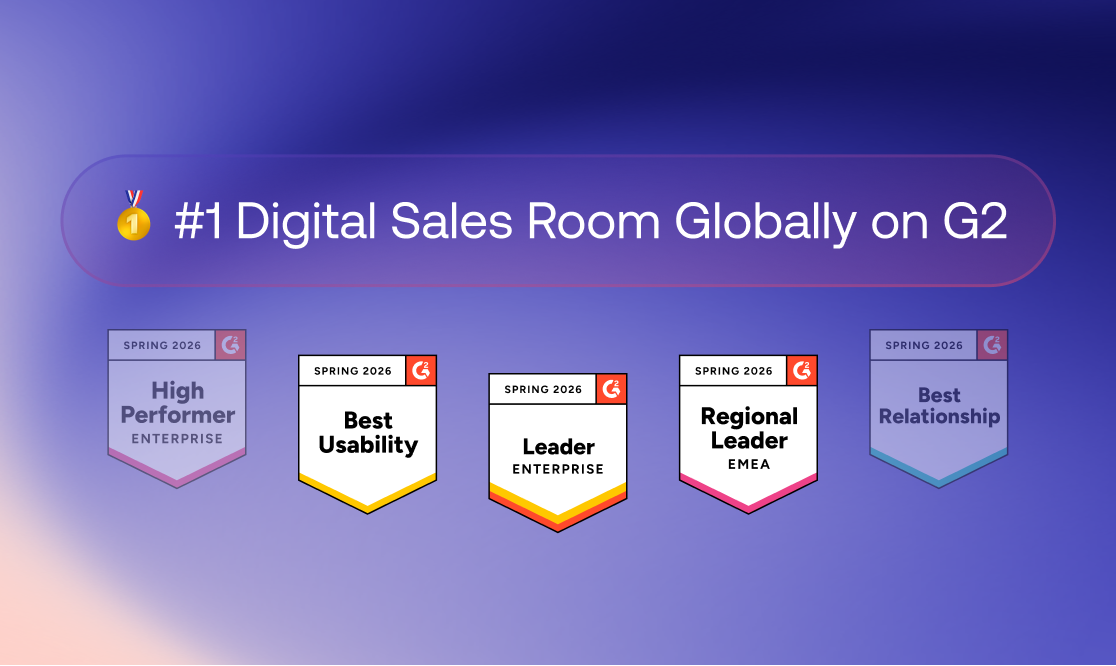
Trumpet is an amazing example of how the category is evolving.Rather than acting as a simple content-sharing portal, trumpet combines personalised Digital Sales Rooms with buyer engagement analytics, Mutual Action Plans, stakeholder visibility, AI-powered insights, CRM integrations, document signing, and customer success workflows in a single platform. The result is a buyer-facing workspace that helps revenue teams understand what is happening between meetings, identify risk earlier, and create a more connected buying experience from first demo through to onboarding and renewal. This is where the category is heading: from static sales rooms to intelligent buyer-facing execution layers. Not just a place to share content, but a system that actively helps both sides navigate a complex buying process. Trumpet is ranked number one Digital Sales Room globally on G2.
Common mistakes teams make with AI
Common mistakes include using AI only to generate generic follow-up copy, over-automating buyer communication so deals feel transactional rather than collaborative, sending too much content because AI made production effortless, treating engagement data as intent without context, and ignoring the underlying data quality issues in the CRM and content library that make AI recommendations less useful. AI should support human selling and not aim to replace i, so you’ll see the most productive use is removing friction so reps can spend more time on the conversations, relationships, and judgement calls that cannot be automated.
How to choose an AI Digital Sales Room platform
When evaluating platforms, practical questions matter more than feature lists:
- Can reps create rooms quickly, or does creation require significant manual effort?
- Does AI improve the buyer journey itself, or primarily help with writing copy?
- Does it integrate with your CRM and push meaningful signals back to it?
- Can it track engagement at an individual stakeholder level?
- Does it support Mutual Action Plans with shared visibility for buyer and seller?
- Does it generate insights that are actually useful for reps and managers?
- Does it work across both sales and customer success, or only pre-signature?
- Can marketing govern the content library?
- Will buyers genuinely use it?
- Will reps actually adopt it?
The best platform is not the one with the most AI features. It is the one that helps buyers and sellers move deals forward with less friction, and that the team will consistently use in practice.
Final thoughts
The biggest opportunity is combining AI with the place where buying actually happens. That is why Digital Sales Rooms are becoming increasingly important for modern revenue teams. They provide the structure. AI provides the intelligence. Together they help buyers navigate complex decisions with more clarity, sellers manage opportunities with more visibility, and revenue teams forecast with more confidence. For years, sales technology has focused on making sellers more productive. The next shift is helping buyers navigate increasingly complex purchasing decisions.
FAQs
What is an AI Digital Sales Room?
An AI Digital Sales Room is a buyer-facing workspace where sellers and buyers collaborate on a deal, with AI helping to personalise the room, recommend content, interpret buyer engagement, surface deal risk, and suggest next actions. It combines the shared workspace of a Digital Sales Room with intelligent automation to make the buying experience faster and clearer for both sides.
How does AI improve the sales process beyond writing emails?
AI can help personalise buyer journeys, identify missing stakeholders, flag deal risk from engagement signals, recommend next steps, maintain Mutual Action Plans, and give managers deal intelligence based on buyer behaviour rather than rep judgement. The most valuable applications are in the buyer journey itself, not just in the seller's inbox.
What is buyer journey optimisation?
Buyer journey optimisation is the practice of making it easier for buyers to understand, evaluate, and progress a deal. In the context of Digital Sales Rooms, it means ensuring the right content reaches the right stakeholder at the right stage, friction is removed from the evaluation process, and buyers have a clear path forward at every point in the purchase.
How do Digital Sales Rooms support collaborative deal management?
By creating a shared source of truth for both sides. Instead of buyer and seller operating independently between meetings, both have access to the same workspace, the same Mutual Action Plan, and the same shared context. AI adds intelligence by turning conversations into action plans, identifying stalled steps, and helping both sides stay coordinated.
What is the difference between sales enablement software and a Digital Sales Room?
Sales enablement software primarily helps sellers prepare managing content, training reps, and standardising messaging. It is an internal tool. A Digital Sales Room is buyer-facing: it gives buyers a collaborative workspace to evaluate, share internally, and progress a purchase. Sales enablement helps the rep. Digital Sales Rooms help the buyer.
Can AI Digital Sales Rooms improve forecast accuracy?
Yes. Buyer engagement signals, who has viewed the room, which content has been accessed, whether the champion is sharing internally, whether the Mutual Action Plan is progressing, provide more reliable signals than rep updates alone. AI can interpret those signals to help managers identify which deals are genuinely active and which are at risk.








![How to Get Started with Buyer Enablement [With Examples]](https://cdn.prod.website-files.com/65cf4fecbed2754c2236665d/65cf4fecbed2754c22366bdb_65a5af83e742f76e34ce06f3_Customer%2520Onboarding%2520_%2520Everything%2520you%2520need%2520(2).png)
.png)


.png)


.png)


.png)

.png)

.png)
.png)





