







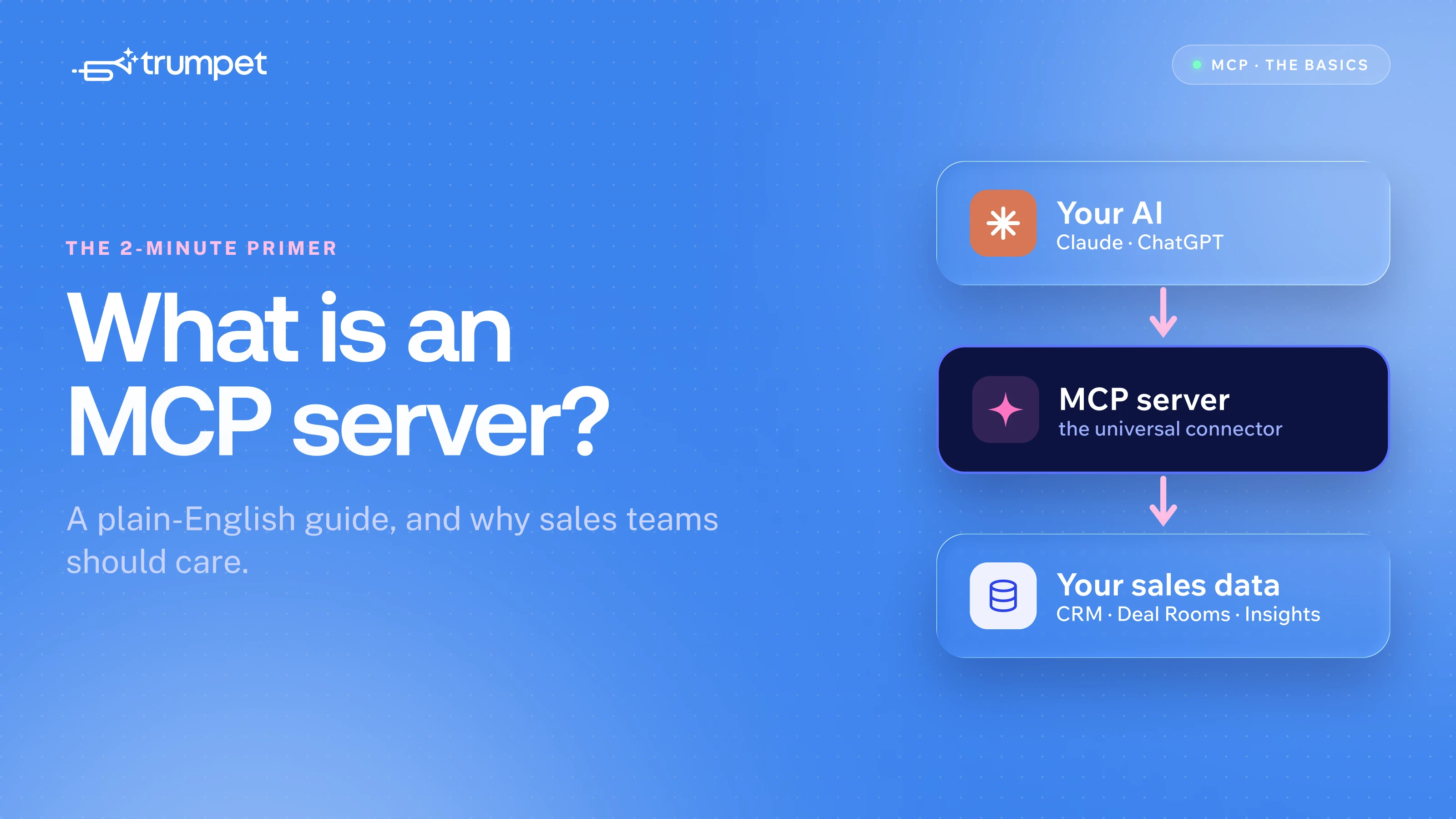
- HubSpot manages the internal sales process. Trumpet manages the external buyer journey. Both are needed for modern B2B sales.
- Sales rooms give buying committees a shared space to collaborate, access information, and make decisions without routing everything through the rep.
- Buyer engagement signals from trumpet feed back into HubSpot, shifting pipeline reviews from rep opinion to buyer behaviour.
- Trumpet supports the full revenue journey from first meeting through onboarding, renewal, and expansion - not just the pre-signature sales cycle.
- The right evaluation question is not "which platform looks best?" It is "which platform helps buyers move forward and feeds that activity back into our CRM?"
Many deals look healthy right up until the point they stop moving.The CRM is up to date, the demo has been delivered, the proposal has been sent then procurement becomes involved, security starts its review, a new stakeholder joins the evaluation, and the champion is left trying to pull weeks of information together from email threads and attachments. Nothing appears broken from the seller's perspective, yet momentum starts to disappear.
This is one of the reasons Digital Sales Rooms have become increasingly popular among SaaS revenue teams. HubSpot remains the system of record for the opportunity, while trumpet provides a buyer-facing workspace where stakeholders can find information, collaborate, and progress the deal between meetings.
Why HubSpot is essential for scaling sales teams
HubSpot has become one of the most popular CRM platforms for growing SaaS companies because it provides a shared source of truth for revenue teams.
Sales, marketing, RevOps, and customer success all work from the same system. HubSpot helps teams manage contacts and companies, deal pipelines, sales activities, lifecycle stages, email automation, marketing attribution, reporting and dashboards, forecasting, customer records, and revenue operations.
For growing businesses, this structure is critical. Without a CRM, pipeline management becomes inconsistent, forecasting becomes unreliable, and teams struggle to maintain visibility as they scale. HubSpot gives revenue teams the operating system for customer and pipeline data.
Where HubSpot alone does not solve the buyer journey
The challenge is that buyers do not spend their day inside your CRM. So while HubSpot gives internal teams visibility, the actual buying process happens elsewhere. It happens in email threads, during internal buyer conversations, when a champion forwards a proposal to finance, when security requests documentation, when procurement asks for commercial terms, and when a new executive stakeholder joins late and needs to understand everything that has happened so far.
The CRM accurately reflects the seller's process, but it cannot show what buyers are doing between meetings. A deal can sit comfortably in the proposal stage while the champion struggles to build internal support, procurement introduces additional requirements, or a newly involved stakeholder asks to revisit decisions that seemed settled weeks earlier. HubSpot manages the sales process internally. A sales room manages the buyer journey externally, those are two different problems, and a CRM alone solves only one of them.
What is a sales room?
A sales room is a shared buyer-facing workspace where sellers and buyers collaborate around a live opportunity. Rather than sending information across multiple emails and attachments, everything is organised in one place.
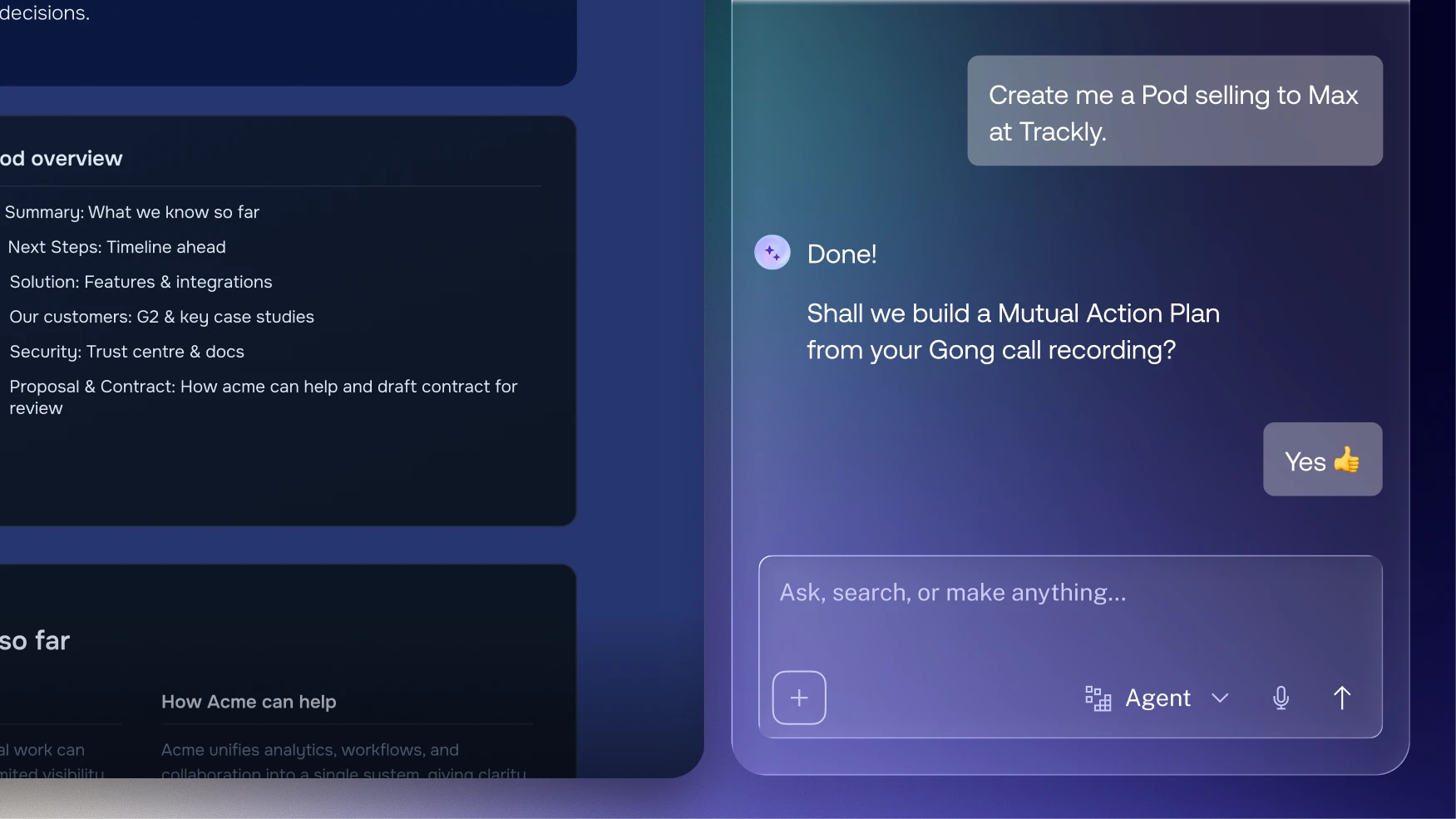
A sales room may include a personalised welcome message, discovery recap, demo recording, tailored presentation, relevant case studies, pricing information and proposals, a Mutual Action Plan, security and compliance documentation, procurement resources, an ROI model or business case, FAQs, an implementation plan, and onboarding and customer success handoff resources. Whilst many teams initially adopt Digital Sales Rooms as a better way to package follow-up content, the real value comes from creating a shared workspace where buyers can collaborate, access information, and move decisions forward without relying on scattered emails and attachments.
Why HubSpot and trumpet work so well together
HubSpot and trumpet solve different problems, and that is precisely why they complement each other. HubSpot manages the internal revenue process: contacts, companies, opportunities, pipeline stages, activities, CRM workflows, forecasting, and reporting.
Trumpet manages the external buyer journey: Digital Sales Rooms, buyer collaboration, stakeholder engagement, Mutual Action Plans, content journeys, deal execution, and customer success handoffs. HubSpot tells your team what stage the deal is in. Trumpet shows how the buyer is actually engaging. Neither replaces the other, a well-run HubSpot instance without a buyer-facing layer leaves the actual deal fragmented from the buyer's perspective. A sales room without CRM integration creates a disconnected workflow that does not feed back into pipeline management. Together, they create a complete revenue infrastructure.
How trumpet makes HubSpot data more useful
Most pipeline reviews still rely heavily on rep judgement. The manager asks how the deal is progressing. The rep shares their view. The forecast gets updated.
The problem is that buyer behaviour often tells a different story. A deal that looks healthy inside the CRM may have very little genuine buying committee engagement. A deal that appears quiet may be experiencing significant internal sharing among stakeholders the rep has never met. Trumpet helps revenue teams understand who has visited the sales room, which stakeholders are engaging, which content is being viewed, whether pricing has been reviewed, whether security documentation is being accessed, and whether engagement is increasing or declining over time.
Data from trumpet's platform shows that deals where buyers return to the workspace four to five times show win rates 45 per cent higher and sales cycles 35 per cent shorter than deals with a single visit. When ten or more unique stakeholders engage, close rates reach 75 per cent. Those signals, connected back to HubSpot, give managers and RevOps teams a clearer picture of which deals are genuinely progressing rather than just sitting in the right pipeline stage.
How HubSpot and trumpet improve buyer journey optimisation
The strongest buying experiences remove friction. Buyers want one place to find information, review content, share resources internally, and understand next steps. When information is scattered across email chains, collaboration becomes harder. New stakeholders have to ask for everything. Champions become project managers. Procurement and security teams chase the rep for documents already sent.
A sales room solves this by creating a central destination for the deal. Champions can share one link rather than forwarding multiple attachments. New stakeholders get up to speed without a briefing call. Procurement and security find their documentation without asking for another meeting. Customer success teams inherit a much clearer picture of the buyer's goals and expectations.
How the combination supports collaborative deal management
Enterprise and mid-market deals rarely involve a single decision-maker. Most opportunities require input from finance, operations, procurement, legal, IT, and leadership. Managing those conversations through email alone quickly becomes impossible.
With HubSpot and trumpet working together, revenue teams can track opportunities in HubSpot while collaborating with buyers in trumpet, coordinating stakeholders around shared next steps, running Mutual Action Plans with visibility for both sides, sharing personalised content, capturing engagement signals, and supporting procurement, security, and customer success workflows. The CRM remains the internal record, the sales room is the external workspace - both are needed. Data from trumpet shows that Pods with Mutual Action Plans double win rates compared to those without. MAPs with six to ten completed steps close at 84 per cent. The discipline that produces those outcomes gets built in the sales room, not in the CRM.
Practical use cases for HubSpot and trumpet
Post-demo follow-up
A rep runs a discovery call and demo, then creates a personalised trumpet room with the recap, recording, tailored case study, pricing context, agreed next steps, and a starter Mutual Action Plan. HubSpot remains the source of truth for the opportunity. Trumpet becomes the buyer-facing space where the deal progresses.
Champion enablement
Champions often need to sell internally before a purchase can be approved. A sales room gives them a single link to share with the CFO, IT lead, procurement team, and leadership, with content tailored for each audience rather than a generic deck forwarded across six email threads.
Pipeline reviews
Managers review HubSpot deal stages alongside trumpet engagement signals, creating a clearer picture of deal health and buyer momentum. "The deal is in proposal stage" becomes "the deal is in proposal stage and three senior stakeholders accessed the business case this week."
Security and procurement
Security documentation, compliance information, procurement resources, legal materials, and commercial next steps can all live in one buyer-facing space rather than being distributed across multiple email threads. The review process moves faster because the information is organised rather than scattered.
Sales to customer success handoff
After a deal closes, customer success inherits stakeholder context, agreed business objectives, implementation plans, key milestones, and the Mutual Action Plan that carries forward into onboarding. Data from trumpet shows that adding new content in the final third of a sales cycle increases win rates by 51 per cent and compresses cycle time by 33 per cent. The room that was active through the sale continues to be active through onboarding.
Renewals and expansion
Sales rooms can continue supporting customer collaboration well beyond the initial sale - managing renewals, quarterly business reviews, stakeholder coordination, and expansion cases with the same collaborative infrastructure used during the original deal.
Why this matters for sales excellence
Sales excellence is about creating a consistent buying experience while giving revenue teams better visibility into deal execution. Data from trumpet shows that auto-branded, personalised workspaces produce a 56 per cent increase in win rate compared to those without. The quality of the buyer experience is measurable, and it compounds across the team when the right infrastructure supports it.
HubSpot provides the data foundation. Trumpet provides the buyer-facing execution layer. Together, they help teams connect internal process with external buyer engagement, better buyer experiences, stronger stakeholder visibility, cleaner follow-up, more useful pipeline inspection, and cleaner handoffs from sales to customer success.
HubSpot and trumpet versus traditional sales enablement software
Traditional sales enablement platforms are designed to improve internal readiness. They help organisations manage content, train sellers, run coaching programmes, standardise messaging, and improve rep preparedness. The buyer rarely interacts with them directly.
HubSpot and trumpet address a different challenge. HubSpot manages pipeline and CRM data. Trumpet creates buyer-facing sales rooms, tracks buyer engagement, supports collaborative deal management, and connects buyer behaviour back to revenue execution. Sales enablement helps reps prepare. HubSpot and trumpet help revenue teams manage the full journey from CRM record to buyer action. For teams already using platforms like Highspot or Seismic for content governance and internal enablement, trumpet adds the buyer-facing layer those platforms do not provide, the shared workspace where the buyer actually participates throughout the deal.
Why trumpet is the right sales room layer for HubSpot teams
Trumpet is built around the buyer-facing moments that CRM systems are not designed to manage. It integrates with HubSpot to connect buyer engagement signals back to deal records, so the CRM picture reflects what buyers are actually doing rather than only what reps have logged. Rooms can be created from live HubSpot opportunities. Engagement activity pushes back to contact and deal records. Pipeline reviews combine CRM stage data with buyer behaviour signals.
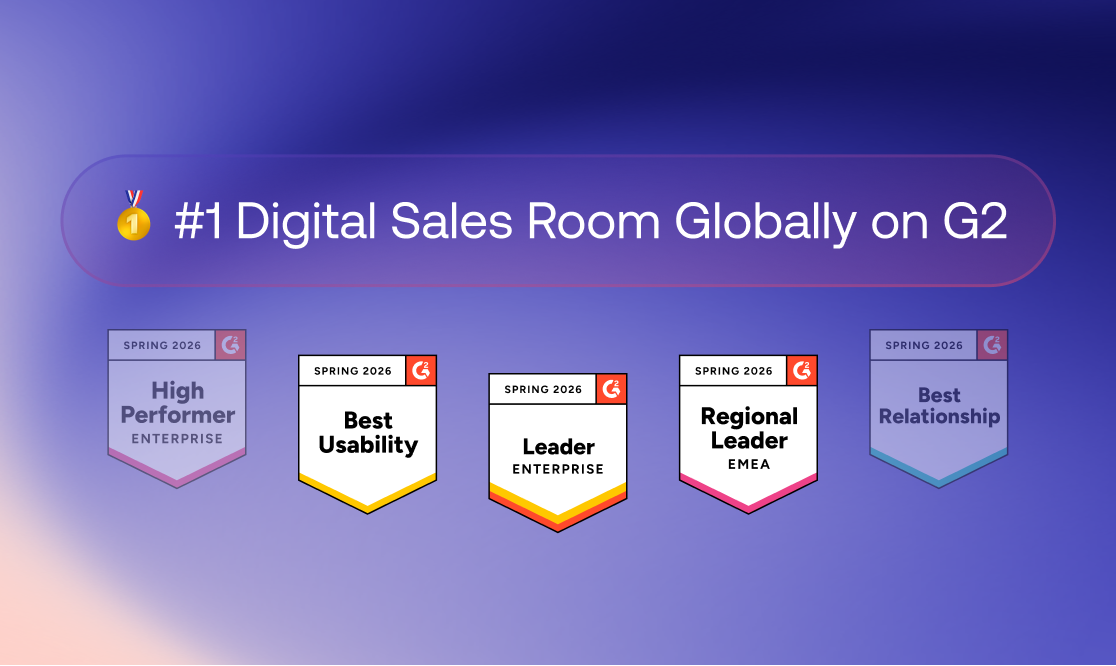
Beyond the integration, trumpet covers the full buyer-facing execution layer: personalised Digital Sales Rooms, buyer engagement analytics, Mutual Action Plans, AI-powered deal insights, stakeholder visibility, content personalisation, and collaborative workflows that span both sales and customer success. The goal is not to replace HubSpot. It is to make HubSpot more valuable by adding visibility into what buyers are actually doing. Trumpet is ranked number one Digital Sales Room globally on G2.
How to evaluate a HubSpot-connected sales room
When evaluating sales room platforms, the practical questions matter more than the feature list:
- Does it integrate cleanly with HubSpot and push meaningful signals back to deal records?
- Is it easy for reps to create rooms from live HubSpot opportunities?
- Can buyers access rooms without friction or requiring account creation?
- Does it track engagement at an individual stakeholder level?
- Does it support Mutual Action Plans with shared visibility for buyer and seller?
- Can marketing govern approved content within the platform?
- Do managers get deal insights they can use in HubSpot pipeline reviews?
- Does it support customer success handoffs as well as pre-signature sales?
- Does it reduce admin for reps rather than adding more steps?
- Does it improve the buyer experience genuinely, not just aesthetically?
- Will reps actually use it consistently?
One important caution: do not choose a sales room platform because it creates attractive-looking pages. Choose the one that improves buyer engagement, deal execution, and the quality of the data that feeds back into HubSpot.
Common mistakes to avoid
Treating HubSpot as the buyer collaboration space
HubSpot is not designed for buyer-facing collaboration. Using it as the place where the deal lives from the buyer's perspective creates a messy experience for everyone outside the selling organisation.
Using sales rooms only at proposal stage
Sales rooms are most effective when introduced early, after the first discovery call or demo and maintained throughout the deal. Teams that deploy them only at proposal stage miss most of the buyer enablement and stakeholder engagement value.
Creating generic rooms with too much content
A room with thirty assets is not more useful than a room with eight well-chosen ones. Buyers do not need everything. They need the right things in the right order for their specific situation.
Ignoring engagement signals during pipeline reviews
If trumpet engagement data is not being used alongside HubSpot pipeline data in deal reviews, half the value of the integration is being left on the table. Managers should review room activity and CRM stage data together.
Skipping the customer success handoff use case
The room built during the sales cycle is the best possible onboarding asset. Teams that archive it at closed-won and start fresh in customer success are discarding context that took months to build.
Measuring activity instead of buyer momentum
Email sends, call logs, and meeting counts do not tell you whether the buying committee is actually progressing. Buyer engagement signals from the sales room are a far more reliable indicator of deal health.
Final thoughts
A CRM is essential. But it is not the buyer journey. HubSpot gives revenue teams the structure to manage contacts, companies, deals, pipeline stages, and reporting. Trumpet gives buyers and sellers the shared space to move opportunities forward between meetings.
Together, they create a stronger revenue workflow: CRM discipline on the inside, buyer collaboration on the outside. Sales excellence does not come from adding more software. It comes from connecting the right tools around the way modern buyers actually buy. For SaaS revenue teams, HubSpot and trumpet provide that combination - a trusted CRM foundation and a buyer-facing sales room layer that helps deals progress with more clarity, consistency, and confidence.
FAQs
Does trumpet integrate with HubSpot?
Yes. Trumpet integrates with HubSpot, allowing teams to create sales rooms from live opportunities, sync engagement signals back to CRM records, and use buyer behaviour data alongside pipeline stage information in deal reviews.
What is the difference between a CRM and a sales room?
A CRM like HubSpot manages internal sales data: contacts, companies, deals, pipeline stages, activities, and reporting. A sales room is buyer-facing: it is the shared workspace where buyers and sellers collaborate around a specific deal. The CRM records what the rep did. The sales room shows what the buyer is doing.
How do Digital Sales Rooms improve buyer journey optimisation?
By giving buyers one organised destination for everything relevant to their evaluation. Instead of piecing together context from multiple emails, buyers have a single workspace with all content, next steps, Mutual Action Plans, and stakeholder resources. Champions can share the room internally with a single link. New contacts get up to speed without a briefing call.
Why is HubSpot and trumpet better than HubSpot alone?
HubSpot provides excellent internal structure and pipeline management but does not provide a buyer-facing workspace or stakeholder engagement tracking. Trumpet adds those capabilities and connects them back to HubSpot, so the CRM picture reflects actual buyer engagement rather than only rep activity.
Can sales rooms be used after a deal closes?
Yes. Many teams use sales rooms for onboarding, customer success collaboration, renewals, stakeholder coordination, and expansion opportunities. The workspace built during the sales cycle becomes the handover asset and continues into the customer relationship.









![How to Get Started with Buyer Enablement [With Examples]](https://cdn.prod.website-files.com/65cf4fecbed2754c2236665d/65cf4fecbed2754c22366bdb_65a5af83e742f76e34ce06f3_Customer%2520Onboarding%2520_%2520Everything%2520you%2520need%2520(2).png)
.png)


.png)


.png)


.png)

.png)

.png)
.png)





