







- Enterprise Digital Sales Rooms need to go well beyond content hosting. Security, stakeholder tracking, CRM integration, Mutual Action Plans, governance, and analytics are the capabilities that matter.
- Sales enablement software and Digital Sales Rooms solve different problems and work best when connected. Enablement makes sellers better. Digital Sales Rooms make the buyer experience better.
- Buyer journey optimisation at enterprise level depends on giving buying committees a structured shared space, surfacing engagement signals between meetings, and helping champions sell internally without losing momentum.
- Collaborative deal management requires a platform where both buyer and seller can see the same plan, assign ownership, and track progress in real time.
- Adoption is as important as capability. Enterprise platforms that add friction for reps will not deliver consistent results regardless of feature depth.
- Trumpet sits at the intersection of Digital Sales Rooms and revenue enablement, covering the full buyer journey from first meeting through onboarding and renewal in a single platform.
Enterprise revenue teams are not short of tools, most already run a CRM, a conversation intelligence platform, a content library, and some form of sales enablement software. The question is no longer whether to invest in technology. It is whether the technology you have actually helps a buying committee move through a complex purchase, or just makes your internal machine feel more organised.
Digital Sales Rooms emerged as buying committees became larger and sales cycles became harder to coordinate. Not as a prettier way to send a follow-up link, but as a buyer-facing collaboration layer that gives every stakeholder in a buying committee a shared space to evaluate, engage, and ultimately make a decision.
For enterprise teams, the stakes are higher. Buying committees are larger. Sales cycles are longer. Security reviews are mandatory. Procurement gets involved early. Champions need to sell internally without losing momentum. Customer success teams need a clean handoff at signature. A Digital Sales Room built for simple deals does not hold up under that weight.
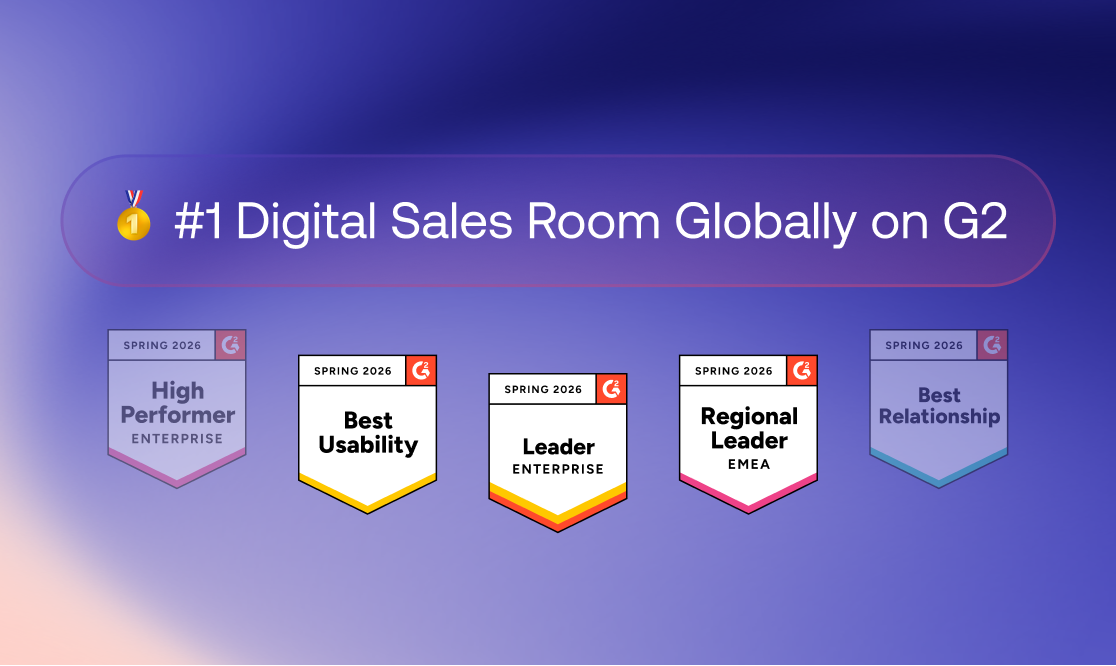
This guide is for revenue leaders, sales enablement teams, and customer success leaders who are evaluating Digital Sales Room platforms seriously and want to understand what actually matters at enterprise scale. Trumpet is currently ranked the number one Digital Sales Room globally on G2 and has earned more than 30 number one rankings across enterprise, mid-market, regional, and global reports. That context is worth keeping in mind as you evaluate the category.
What is a Digital Sales Room for enterprise teams?
A Digital Sales Room is a buyer-facing workspace that helps sellers and buying committees collaborate throughout the full lifecycle of a deal. Rather than information scattered across email threads, shared drives, and sequential PDF attachments, everything lives in one persistent, branded environment that both sides can access at any point.
Unlike traditional content portals or static proposal pages, an enterprise Digital Sales Room becomes the central place where stakeholders review content, manage next steps, complete security reviews, collaborate on business cases, access pricing information, and track progress towards a purchasing decision.
For enterprise teams, a Digital Sales Room functions as the execution layer for complex B2B sales. It sits between the CRM and the buyer, creating a shared environment where sales, customer success, legal, procurement, finance, security, and executive stakeholders can work together. That visibility is often the difference between forecasting with confidence and hoping a deal closes.
Why enterprise teams need more than basic sales rooms
Most enterprise deals no longer involve a single champion. Revenue teams routinely manage buying committees that include economic buyers, executive sponsors, procurement, legal, security, finance, IT, end users, and customer success stakeholders. The challenge is not simply sharing information. It is helping multiple stakeholders reach consensus.
Beyond the buying committee itself, enterprise teams also face longer sales cycles, formal procurement reviews, security assessments, multi-threading requirements across accounts, complex onboarding processes, forecasting pressure from leadership, and content governance requirements that prevent reps from going off-message.
A simple content-sharing page does not solve those problems. The strongest Digital Sales Rooms provide the structure needed to manage the entire buyer journey from discovery through onboarding, and they do so in a way that works for both the revenue team and the buying committee.
Key features enterprise teams should look for
When evaluating Digital Sales Room software, enterprise teams should focus on capabilities that improve execution rather than presentation. The following areas are where the real differences between platforms emerge.
CRM integrations. Deep, bidirectional Salesforce and HubSpot integrations ensure that buyer engagement data becomes part of forecasting, pipeline management, and revenue operations rather than sitting in a disconnected platform.
Security and access controls. Enterprise procurement and security teams will ask about SOC 2 Type II, ISO 27001, SSO, SCIM, role-based permissions, and audit trails. Security is no longer a differentiator. It is a requirement.
Buyer engagement analytics. Enterprise teams need visibility into stakeholder engagement, content consumption patterns, buying signals, risk indicators, and deal momentum. Open rates alone are not sufficient.
Mutual Action Plans. Structured, collaborative plans with clearly assigned owners, deadlines, and progress tracking keep both sides accountable and give revenue leaders visibility into whether a deal is progressing or stalling.
Content management and governance. As teams scale, the ability to manage, update, personalise, and distribute content consistently improves both seller productivity and buyer experience. Reps should never be sending outdated or off-message materials.
Stakeholder tracking. Knowing who is engaged, who has gone quiet, and who is influencing decisions becomes critical in complex B2B sales. Multi-threading is a non-negotiable in enterprise deals.
Personalisation at scale. Enterprise teams need to create personalised buyer experiences without requiring reps to build each room from scratch. Template systems, AI-assisted setup, and CRM-triggered automation are what make personalisation practical at volume.
AI recommendations and insights. AI is increasingly helping teams identify engagement trends, surface the right content at the right moment, improve forecast accuracy, and recommend next-best actions across a pipeline.
Customer success handoff support. The best Digital Sales Rooms do not stop at signature. They carry context through onboarding and customer success, giving CS teams full visibility into what was discussed and agreed during the sale.
Enterprise reporting. Revenue leaders managing large teams need aggregate visibility: template analytics, content performance, team adoption rates, and portfolio-level deal health, not just deal-level views.
Best Digital Sales Rooms for enterprise teams
1. Trumpet
Best fit: Enterprise revenue teams looking for a single platform that supports the entire buyer journey from first meeting through onboarding and renewal.
Trumpet is one of the few platforms built specifically for managing the full enterprise buyer journey, combining Digital Sales Rooms, buyer enablement, stakeholder engagement, Mutual Action Plans, document signing, and onboarding continuity in a single workspace. For enterprise teams that have historically needed multiple tools to cover the buying journey, it removes a significant amount of operational complexity.
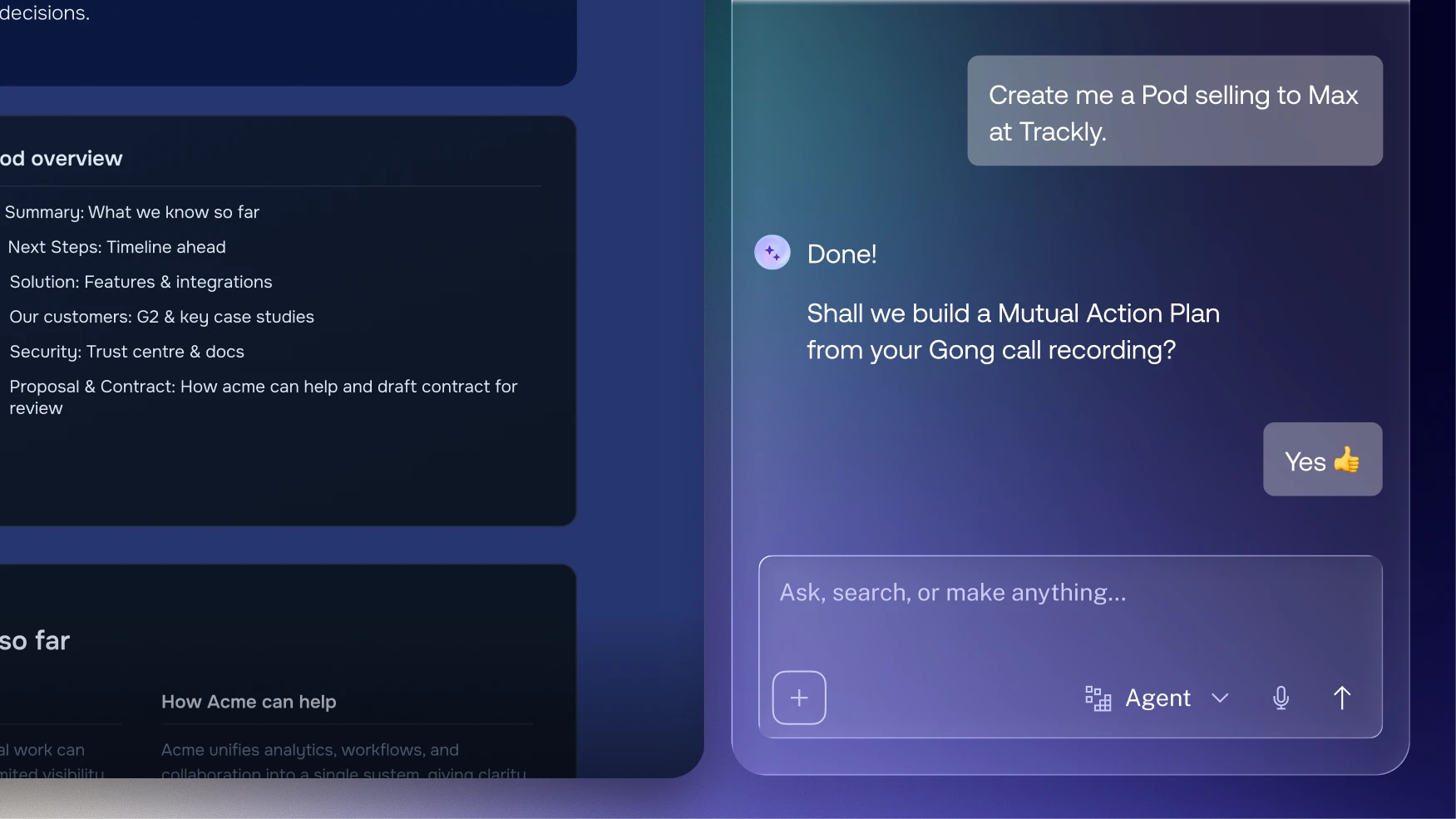
The buyer-facing experience in trumpet is built around Pods: branded, personalised workspaces where every piece of content, every stakeholder, every next step, and every signed document lives together. Reps can build a Pod in minutes using templates and AI, pulling in the right content for each deal stage without starting from scratch every time.
Where trumpet stands out at enterprise level is the depth of what sits behind that buyer experience. The Nerve Centre gives revenue leaders a portfolio-level view of every active Pod: which deals have strong engagement, which are going quiet, which Mutual Action Plans are progressing, and which have stalled. This is the kind of pipeline intelligence that changes how enterprise sales managers run forecast calls and prioritise coaching effort.
Mutual Action Plans in trumpet are collaborative and persistent. Both buyer and seller can be assigned steps, progress is visible to everyone in the room, and when a step is completed, the signal pushes to Slack, Teams, or the CRM. Critically, the same MAP that closes the deal becomes the onboarding plan that the customer success team inherits, so the handoff from AE to CSM carries full context rather than a summary email.
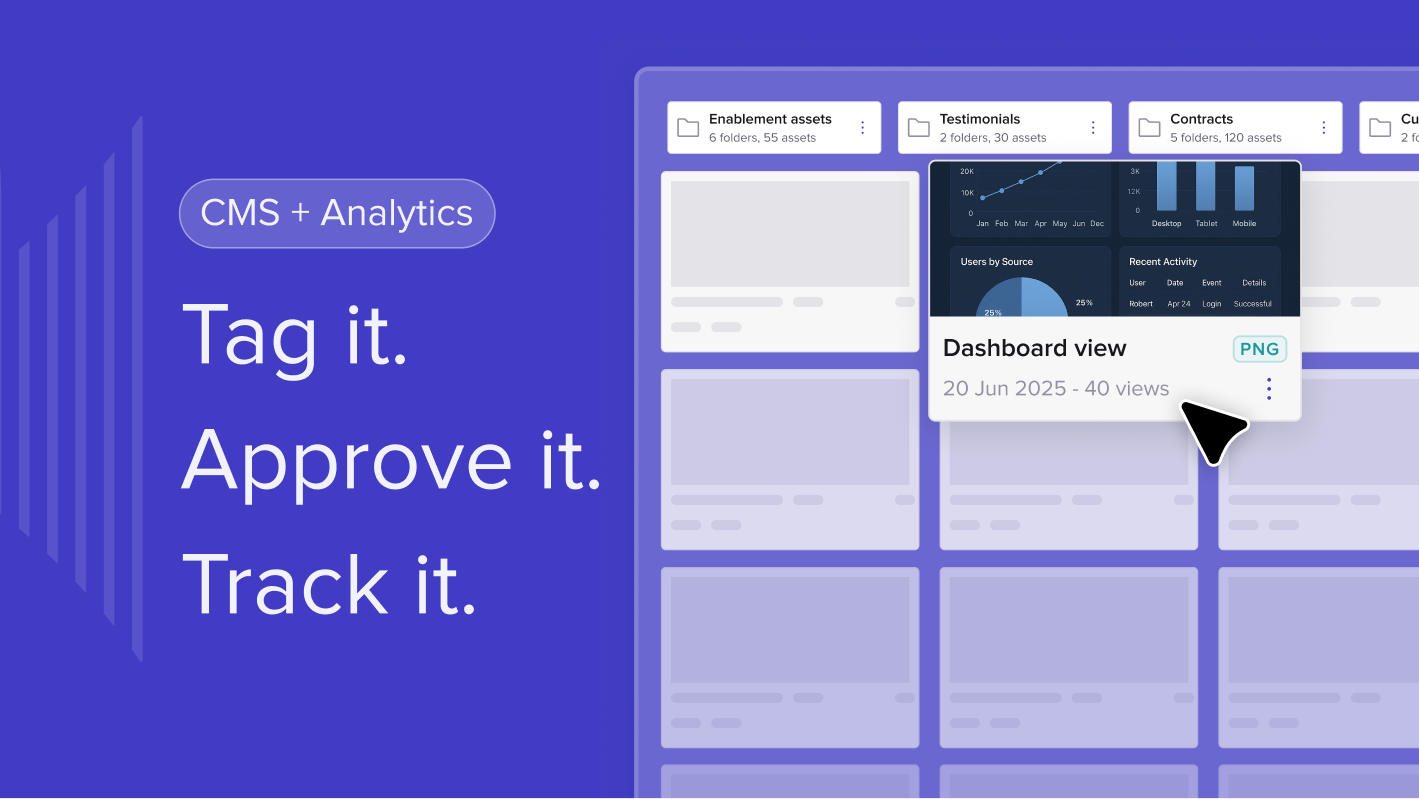
The content management system allows revenue teams to centralise and govern assets so sellers always work from approved, current materials. Engagement analytics show which content is influencing decisions at which deal stages, feeding intelligence back into marketing and enablement rather than letting it sit unused. AI-powered search means reps can surface the right asset in seconds.
Stakeholder Scout tracks who has been brought into a deal and surfaces insights on engagement patterns across the buying committee. Combined with trumpet's personalisation capabilities including auto-branding, dynamic variables, and personalised video, it gives enterprise reps the tools to engage complex buying groups without making each deal a manual production exercise.
The commercial case is backed by proprietary data. Bringing ten or more unique stakeholders into a Pod produces a 75 per cent close rate. Pods with Mutual Action Plans double win rates compared to deals without them. MAPs with six to ten completed steps close at 84 per cent. Adding content in the final third of the sales cycle increases win rates by 51 per cent and compresses cycle time by 33 per cent.
Key enterprise capabilities: Digital Sales Rooms, Mutual Action Plans, stakeholder engagement tracking, buyer enablement, AI-powered recommendations and CMS search, enterprise reporting via the Nerve Centre, native document signing, Salesforce and HubSpot integration, enterprise security controls, content management, and sales-to-CS continuity.
Enterprise readiness: Excellent.
Ideal use case: Enterprise SaaS organisations managing complex buying committees, multi-threaded deals, long sales cycles, and a full revenue journey that extends through onboarding and customer success.
2. DealHub
Good: Organisations with complex pricing, configuration, and quoting requirements.
DealHub is primarily a revenue management platform with CPQ at its centre. Its Digital Sales Room capability sits alongside those revenue operations features rather than leading the product experience.
Strengths: Strong CPQ and contract lifecycle management, well-developed Salesforce integration, and structured workflows for deals with complex pricing and approval chains.
Limitations: The buyer collaboration experience is not as comprehensive as platforms built specifically for Digital Sales Rooms and buyer enablement. Implementation requirements can be significant.
Enterprise readiness: Strong.
Ideal use case: Revenue teams where quoting complexity and commercial operations are the primary challenge.
3. Seismic
Good: Large enterprise organisations focused on content governance and internal sales enablement.
Seismic is an enablement platform, not a purpose-built Digital Sales Room. It is strong on content compliance and internal training, but buyer-facing collaboration is not its primary function.
Limitations: Mutual Action Plans, stakeholder engagement tracking, and real-time buyer analytics are not core strengths. Teams evaluating Seismic as a buyer-facing collaboration platform will find it falls short of purpose-built alternatives.
Enterprise readiness: Moderate as a Digital Sales Room. Strong as a content governance and enablement platform.
Ideal use case: Large organisations in regulated industries prioritising content governance above buyer-facing collaboration.
4. Highspot
Good: Revenue teams looking to improve content discovery, coaching, and seller readiness.
Highspot is a sales enablement platform with a well-developed AI content layer. Like Seismic, its primary design is internal rather than buyer-facing.
Limitations: Buyer collaboration and deal execution capabilities are less comprehensive than dedicated Digital Sales Room platforms. Stakeholder tracking and Mutual Action Plans are not primary strengths.
Enterprise readiness: Moderate as a Digital Sales Room. Strong for internal sales enablement.
Ideal use case: Teams focused on seller productivity and content effectiveness where buyer-facing collaboration is a secondary requirement.
5. Showpad
Good: Organisations focused on sales content distribution and enablement, particularly in verticals with complex product information.
Limitations: Less focused on complex stakeholder collaboration and end-to-end buyer journey management. Mutual Action Plans and stakeholder tracking are not primary capabilities.
Enterprise readiness: Moderate.
Ideal use case: Teams in manufacturing, life sciences, or financial services focused primarily on content presentation rather than collaborative deal execution.
What separates an enterprise-ready Digital Sales Room from a basic one?
Enterprise readiness is not about having the most visually impressive buyer page. It is about supporting the operational reality of complex B2B sales at scale.
A basic Digital Sales Room helps a rep send a follow-up that looks better than an email. An enterprise-ready platform manages dozens of concurrent deals with different stakeholders, enforces content governance across a large revenue team, integrates with the CRM so engagement data is visible in forecasting, supports security reviews and compliance requirements, and gives revenue leaders the reporting they need to manage pipeline with confidence.
The distinction matters because a platform that works well for ten deals a month often breaks down at a hundred. Adoption drops when reps find the tool adds friction. Analytics become unreliable when data does not flow cleanly between systems. Content governance fails when the platform cannot give marketing and enablement the controls they need.
Enterprise-ready platforms provide security controls, governance, deep CRM integrations, stakeholder visibility, buyer engagement analytics, Mutual Action Plans, cross-functional reporting, broad team adoption support, and customer success continuity. Basic sales rooms provide content hosting. Enterprise Digital Sales Rooms provide deal execution.
How Digital Sales Rooms support collaborative deal management
Collaborative deal management requires more than visibility. Enterprise teams need a shared workspace where buyers and sellers can manage next steps, stakeholder involvement, business cases, pricing discussions, security reviews, legal processes, procurement workflows, and implementation planning.
A Digital Sales Room creates a single source of truth for everyone involved in a complex purchase. Rather than a deal being managed through email threads the seller cannot see, the buying process becomes visible and structured. Mutual Action Plans assign clear ownership and deadlines to both sides, and progress signals flow back into CRM and forecasting tools. This reduces friction, improves accountability, and helps prevent important context from being lost between meetings.
How Digital Sales Rooms improve buyer journey optimisation
Buyer journey optimisation is ultimately about reducing the structural friction that causes enterprise deals to slow down. The most common friction points are not objections. They are gaps: a champion who cannot explain the product to their security team, a procurement review that stalls because pricing is not clearly documented, a legal process that drags because contract terms are buried in an email chain from three weeks ago.
A well-designed Digital Sales Room addresses these friction points before they become blockers. Security documentation is available before IT asks for it. Pricing is clearly laid out so procurement can review it without chasing the rep. The champion has a shareable, professional workspace they can send to their CFO rather than summarising a call in a four-paragraph email.
The data supports this. Deals where buyers revisit a Digital Sales Room four to five times have win rates 45 per cent higher and sales cycles 35 per cent shorter than deals with only a single view. Engagement signals are not vanity metrics. They are buying intent, and they are only visible when the platform captures them.
Digital Sales Rooms vs sales enablement software
These two categories are often confused, but they solve different problems.
Sales enablement software helps internal teams prepare, train, manage content, coach performance, and improve seller readiness. The buyer never sees the sales enablement platform directly. Digital Sales Rooms help external buying committees collaborate, review content, complete Mutual Action Plans, engage stakeholders, and move deals forward.
Many enterprise organisations use both, and the strongest revenue teams connect internal enablement with external buyer collaboration so that each makes the other more effective. Platforms like trumpet sit at the intersection of both categories, combining the content governance of a sales enablement platform with the buyer-facing execution layer of a Digital Sales Room.
How to choose the right platform
Evaluating enterprise Digital Sales Room software is a different exercise from trialling a tool for a small sales team. These questions are a more reliable guide than any feature checklist.
Does it meet enterprise security requirements, including SOC 2, SSO, role-based access controls, and data residency? This will come up in your own procurement process and is worth confirming early. Does it integrate deeply with your CRM, with bidirectional data flow rather than a one-way export? Can it handle a full buying committee with individual stakeholder tracking and engagement analytics by person, not just by deal? Does it give your revenue leaders aggregate reporting across the full pipeline, not just deal-level views?
Can your entire revenue team, covering sales, marketing, customer success, and leadership, get value from the platform without needing separate workflows? Does it improve deal execution rather than just presentation? And perhaps most importantly: will reps actually use it consistently? Adoption is where enterprise software investments succeed or fail, and a platform that adds friction for reps will not deliver consistent results regardless of how good the buyer experience looks.
Final thoughts
Enterprise teams should not choose a Digital Sales Room based solely on design or content hosting capabilities. The strongest platforms help revenue teams manage complex buyer journeys, improve collaboration across buying committees, surface deal intelligence at the right moment, and create consistency throughout the full revenue lifecycle.
Digital Sales Rooms are evolving from simple content-sharing tools into buyer-facing execution layers for modern revenue organisations. For enterprise teams looking to improve stakeholder visibility, buyer collaboration, Mutual Action Plans, customer success continuity, and revenue team collaboration, trumpet stands out as the most complete platform in the category, combining every element of the buyer journey in a single connected workspace.
FAQs
What is an enterprise Digital Sales Room?
An enterprise Digital Sales Room is a buyer-facing workspace that helps stakeholders collaborate throughout a complex B2B buying journey. It provides a single shared environment for content, Mutual Action Plans, stakeholder engagement, document signing, and the transition from sales to customer success.
What are the best Digital Sales Rooms for enterprise teams?
Leading options include trumpet, DealHub, Seismic, Highspot, and Showpad. Trumpet offers the broadest combination of buyer collaboration, stakeholder engagement, Mutual Action Plans, AI-powered insights, content management, and sales-to-CS continuity in a single platform, making it the strongest option for enterprise revenue teams managing complex buying journeys.
How do Digital Sales Rooms improve buyer journey optimisation?
They reduce friction by giving every stakeholder a single destination for information, supporting internal collaboration within the buying committee, making it easier for champions to share context with decision-makers, providing structured next steps through Mutual Action Plans, and surfacing real-time engagement signals that help sellers act at the right moment.
Are Digital Sales Rooms the same as sales enablement software?
No. Sales enablement software focuses on helping internal teams perform better through training, content management, and coaching. Digital Sales Rooms focus on helping external buying committees collaborate, review content, and make decisions. The two categories address different parts of the revenue journey and work best when connected.
Why do enterprise teams use Mutual Action Plans?
Mutual Action Plans create shared accountability between the buyer and seller, give both sides a clear view of what needs to happen and who owns each step, and surface real-time signals when progress stalls. In enterprise deals with complex buying committees, they are one of the most effective tools for maintaining momentum. Data from trumpet shows that Pods with Mutual Action Plans double win rates compared to those without.
What makes trumpet different from other Digital Sales Room platforms?
Trumpet combines Digital Sales Rooms, Mutual Action Plans, content management, AI-powered CMS search, stakeholder engagement tracking via Stakeholder Scout, sales coaching support, native document signing, buyer enablement, and sales-to-CS continuity in a single platform. The Nerve Centre gives revenue leaders portfolio-level visibility across all active deals, and deep CRM integrations ensure buyer engagement data flows directly into forecasting and pipeline management.
How do Digital Sales Rooms integrate with conversation intelligence tools like Gong?
Call insights from tools like Gong can inform the content, structure, and Mutual Action Plans within a Digital Sales Room. Engagement signals from the room can flow back into Gong and the CRM, giving revenue teams a complete picture of deal health that covers both what happens in conversations and what happens between them. This is one of the most effective combinations available to enterprise revenue teams.
What security certifications should enterprise Digital Sales Rooms have?
Enterprise teams should look for SOC 2 Type II, ISO 27001, SSO, SCIM provisioning, role-based access controls, email verification, and audit trails as a baseline. For regulated industries, data residency options may also be a requirement. Security compliance should be confirmed early in the evaluation process, as it will be a requirement in your own procurement review.








![How to Get Started with Buyer Enablement [With Examples]](https://cdn.prod.website-files.com/65cf4fecbed2754c2236665d/65cf4fecbed2754c22366bdb_65a5af83e742f76e34ce06f3_Customer%2520Onboarding%2520_%2520Everything%2520you%2520need%2520(2).png)
.png)


.png)


.png)


.png)

.png)

.png)
.png)





