







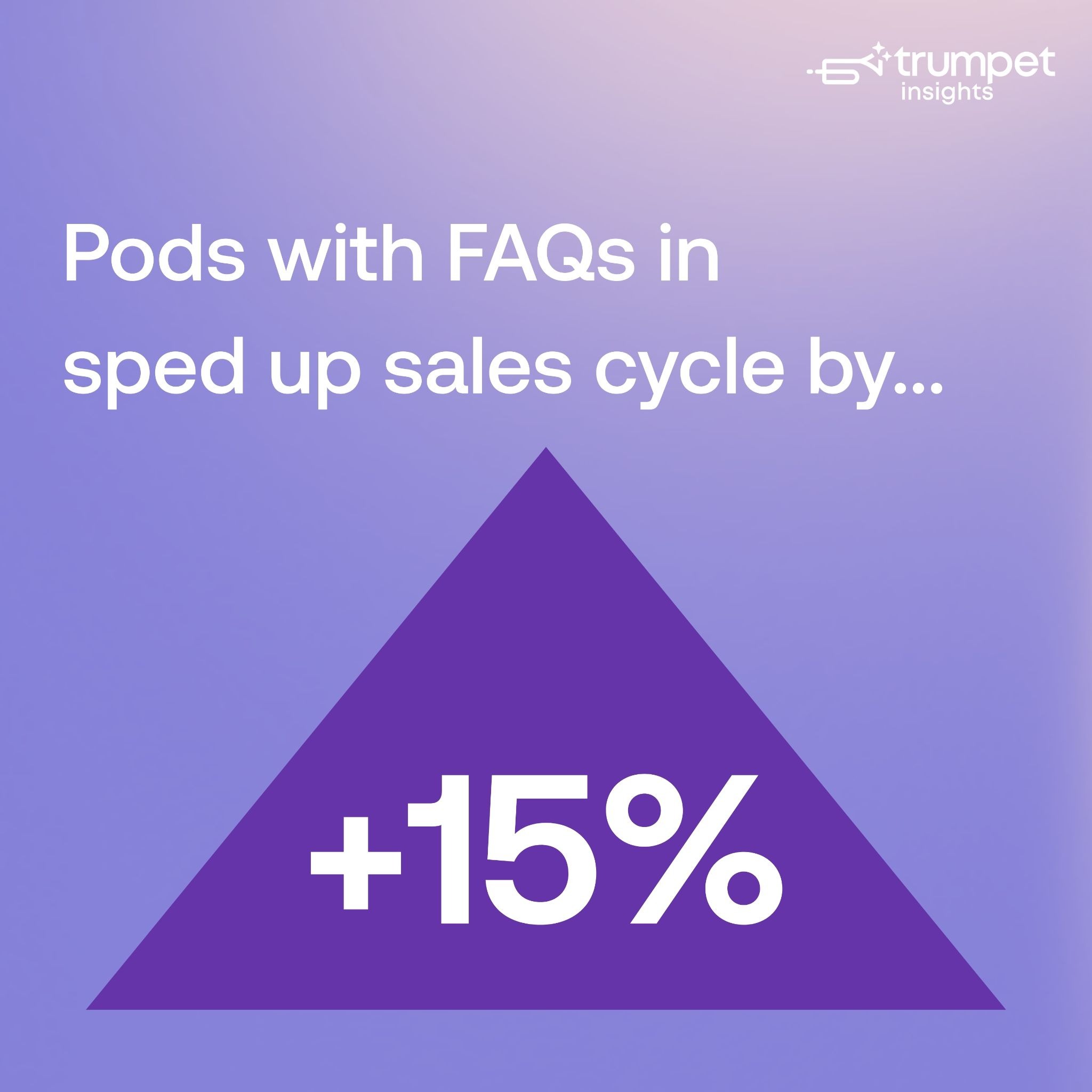
- Pods with FAQs speed up the sales cycle by 15%
- FAQs reduce friction by answering common questions before they slow the deal down
- Clear answers help stakeholders move forward without waiting on calls or follow-ups
- Well-structured FAQs support multi-threading by giving every stakeholder the same context
How do FAQs impact sales performance?
We analysed thousands of deals in trumpet Pods and found that Pods with FAQs saw a 15% faster sales cycle.
That improvement comes from removing the small points of friction that tend to slow deals down, the unanswered questions, the follow-ups, and the gaps between conversations.
Why do FAQs speed up deals?
Most deals don’t slow down because of major objections. They slow down because of unanswered questions that sit between steps.
→ A stakeholder wants to understand pricing structure.
→ Another needs clarity on implementation.
→ Someone else is unsure about security or onboarding.
If those answers aren’t immediately available, the deal pauses while people ask, wait, and follow up.
FAQs reduce that friction by making answers easy to access at the moment they’re needed.
Instead of waiting for a reply or booking another call, stakeholders can move forward straight away.
What makes an effective FAQ in a Pod?
An FAQ should feel practical and relevant to the deal, not like a generic help centre.
- Questions that reflect real buyer concerns
- Clear, direct answers without jargon
- Focus on the points that typically slow deals down
- Easy to scan and navigate
The best FAQs come from patterns you see across deals, the same questions being asked again and again at different stages.
What questions should you include?
Start with the questions that typically come up during your sales process:
- How does pricing work?
- What does implementation look like?
- How long does onboarding take?
- What security or compliance standards are in place?
- What happens after we sign?
These are the questions that often delay progress when they are not answered early.
How do FAQs support multi-threading?
As more stakeholders get involved, the same questions tend to come up repeatedly across different people and teams. FAQs help by giving everyone access to the same answers in one place.
New stakeholders can quickly get up to speed without needing a full walkthrough, and your champion does not need to relay information back and forth internally. This keeps the deal moving and reduces the risk of miscommunication.
How can you use engagement insights with FAQs?
With a Pod, you can see which questions are being viewed and how stakeholders are engaging with them.
That gives you useful signals. If a stakeholder is spending time on pricing FAQs, you can follow up with more detail or context. If multiple people are viewing the same question, it highlights what matters most in the deal. Instead of guessing what to address next, you can respond based on what people are actually looking at.
Where should FAQs sit in a Pod?
It’s useful to have a dedicated FAQ section where stakeholders can find answers quickly.
But they also work well when placed alongside relevant content.
- Near pricing, include pricing-related questions
- Alongside onboarding content, include implementation FAQs
- Around proposals, include common decision-stage questions
This makes them easier to engage with in context, rather than expecting someone to search for answers.
What should you avoid?
Adding too many questions or making them overly detailed can have the opposite effect.
Keep FAQs focused on what actually helps the deal move forward.
- Avoid generic or irrelevant questions
- Keep answers clear and concise
- Focus on the areas that typically create delay
The goal is to remove friction, not add more information.
Final thoughts
After analysing thousands of Pods, the impact of FAQs is clear. They help deals move faster by making answers available when stakeholders need them, reducing delays and keeping momentum.
When questions are answered early and clearly, it becomes much easier for stakeholders to move forward with confidence.
FAQs
Why do FAQs speed up sales cycles?
They remove delays by answering common questions early, reducing the need for follow-ups and additional calls.
Do FAQs impact win rates as well as speed?
They mainly speed up deals, but can also support win rates by building confidence and reducing uncertainty at key decision points.
When should you introduce FAQs in the sales process?
Early. Adding FAQs upfront answers common questions before they become blockers and keeps deals moving.










![How to Get Started with Buyer Enablement [With Examples]](https://cdn.prod.website-files.com/65cf4fecbed2754c2236665d/65cf4fecbed2754c22366bdb_65a5af83e742f76e34ce06f3_Customer%2520Onboarding%2520_%2520Everything%2520you%2520need%2520(2).png)
.png)


.png)


.png)


.png)

.png)

.png)
.png)





